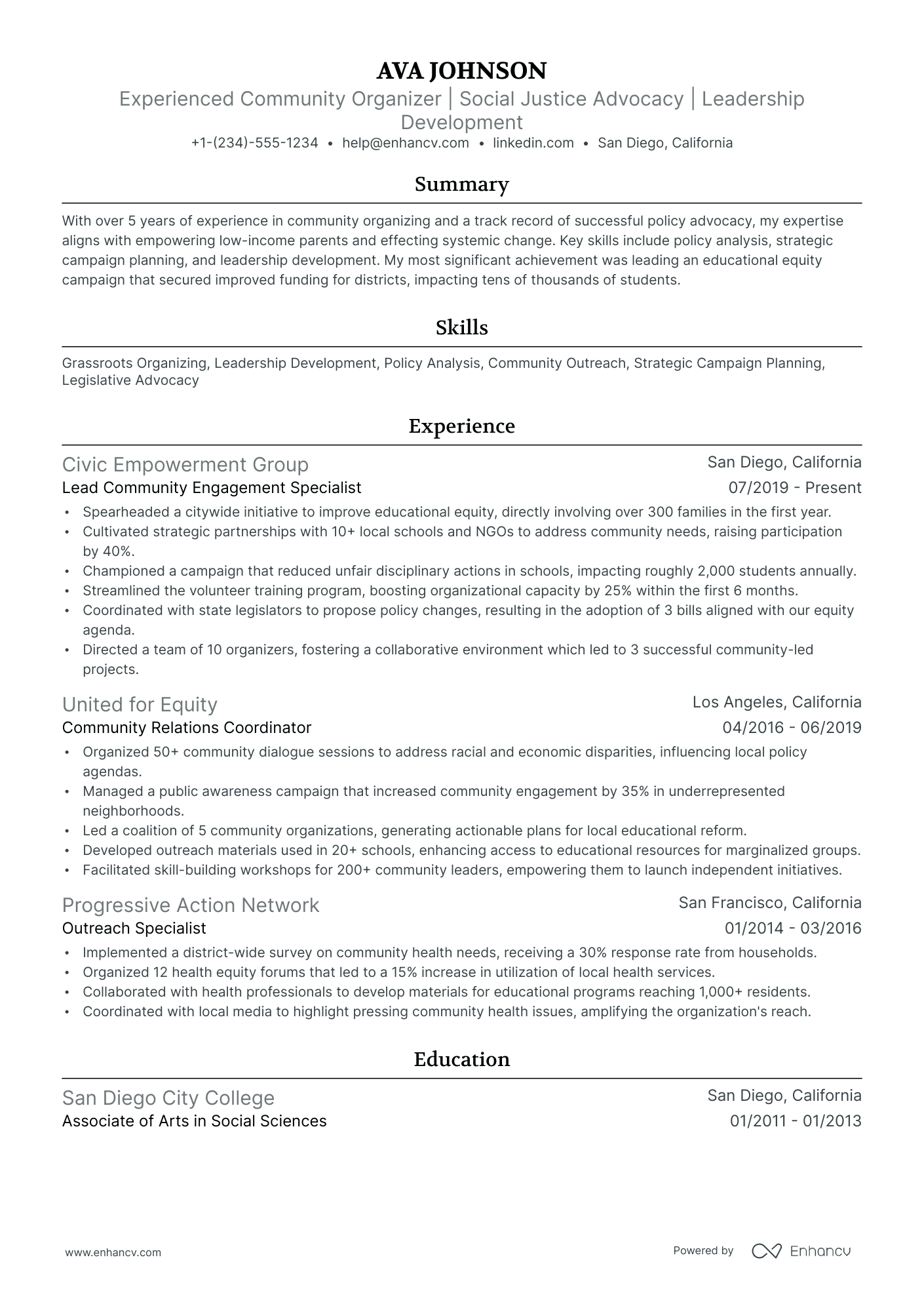
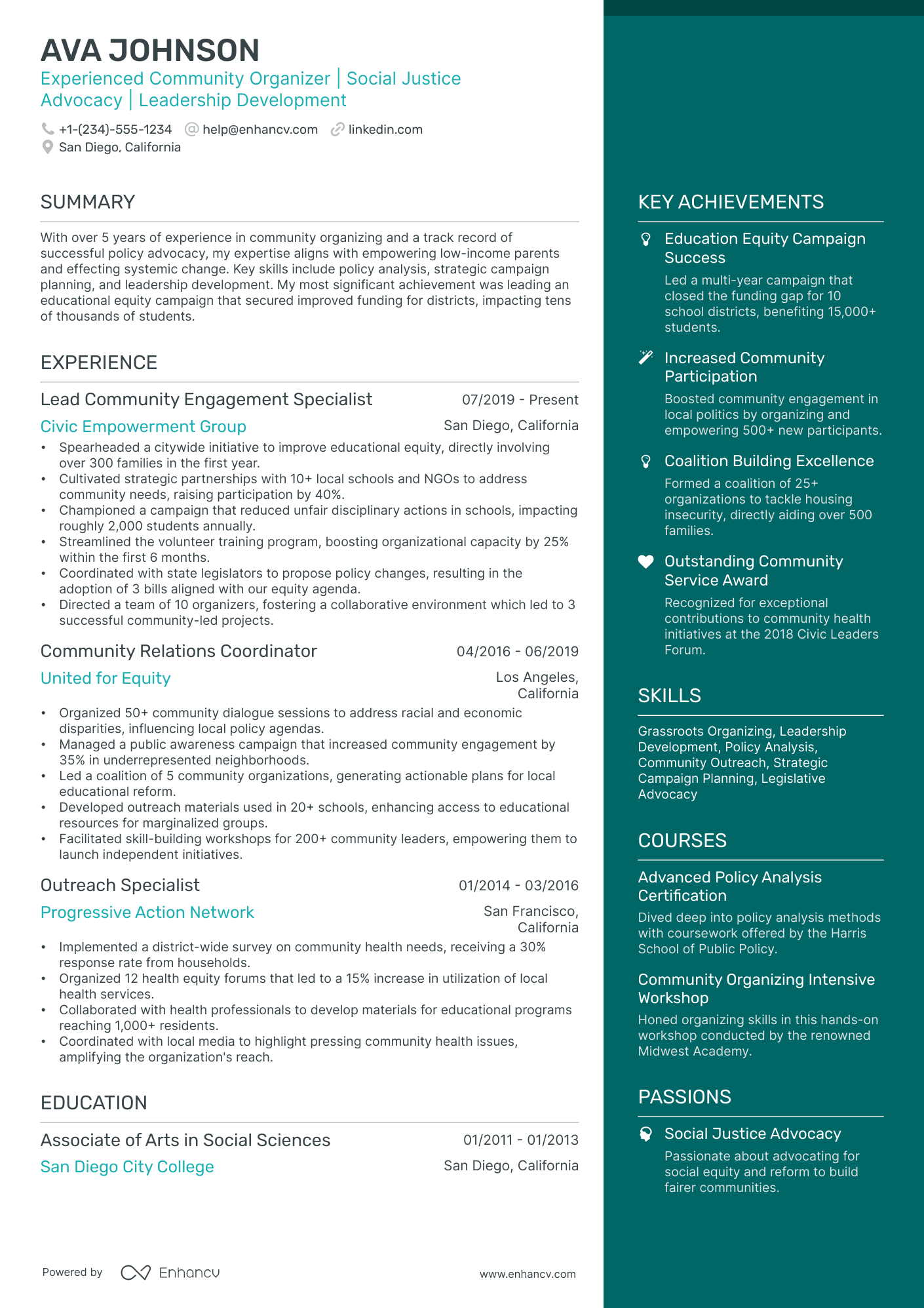
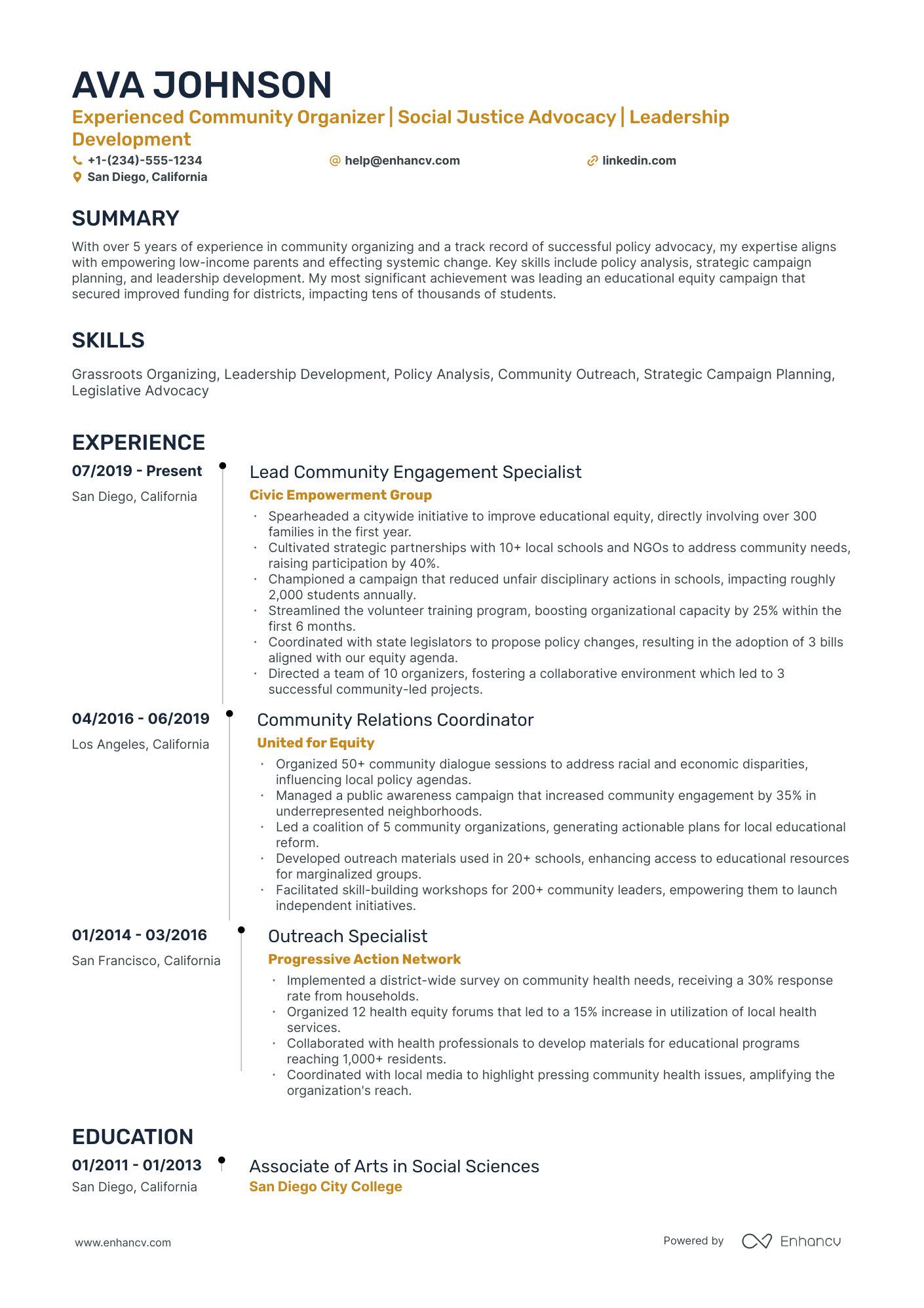
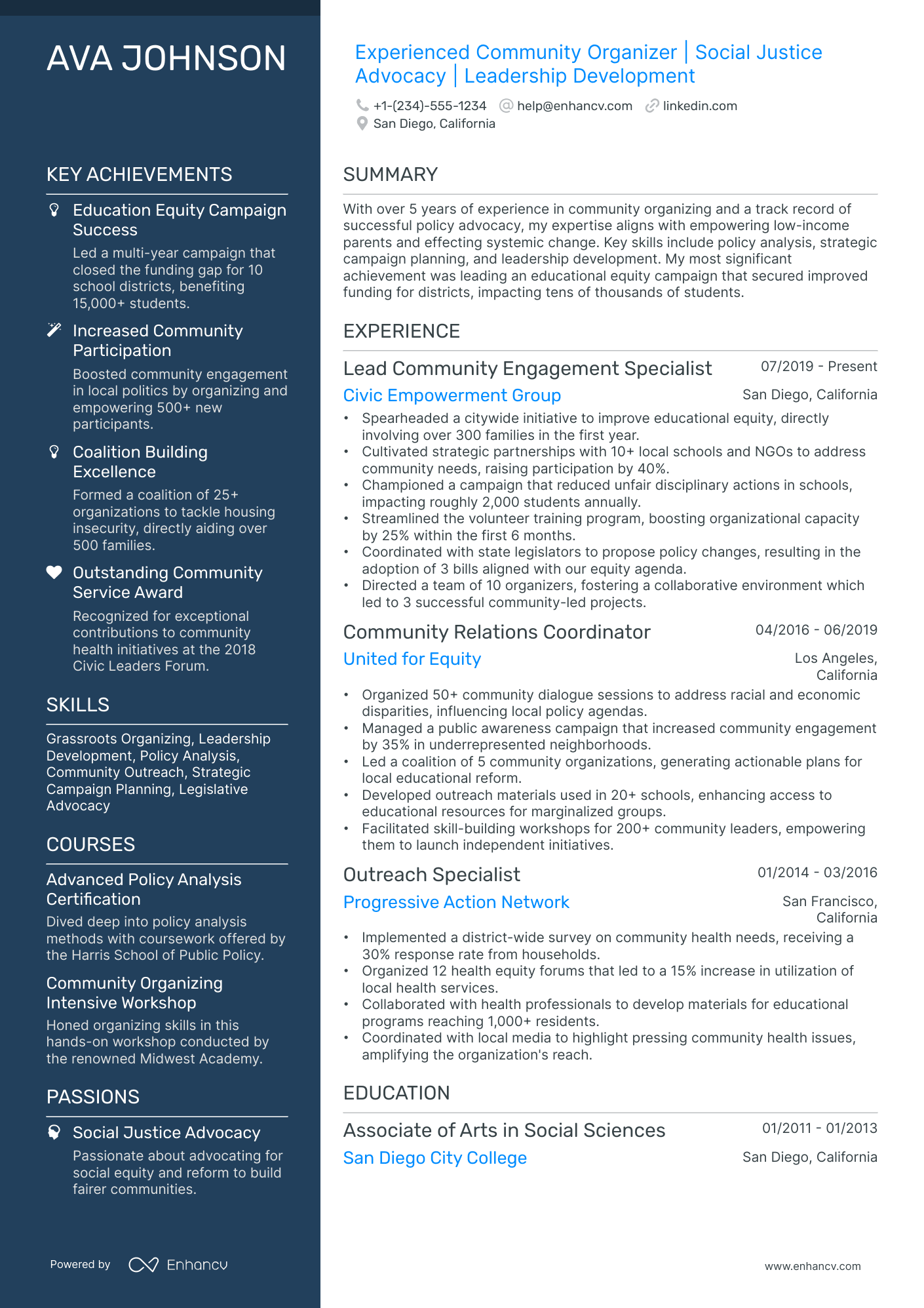
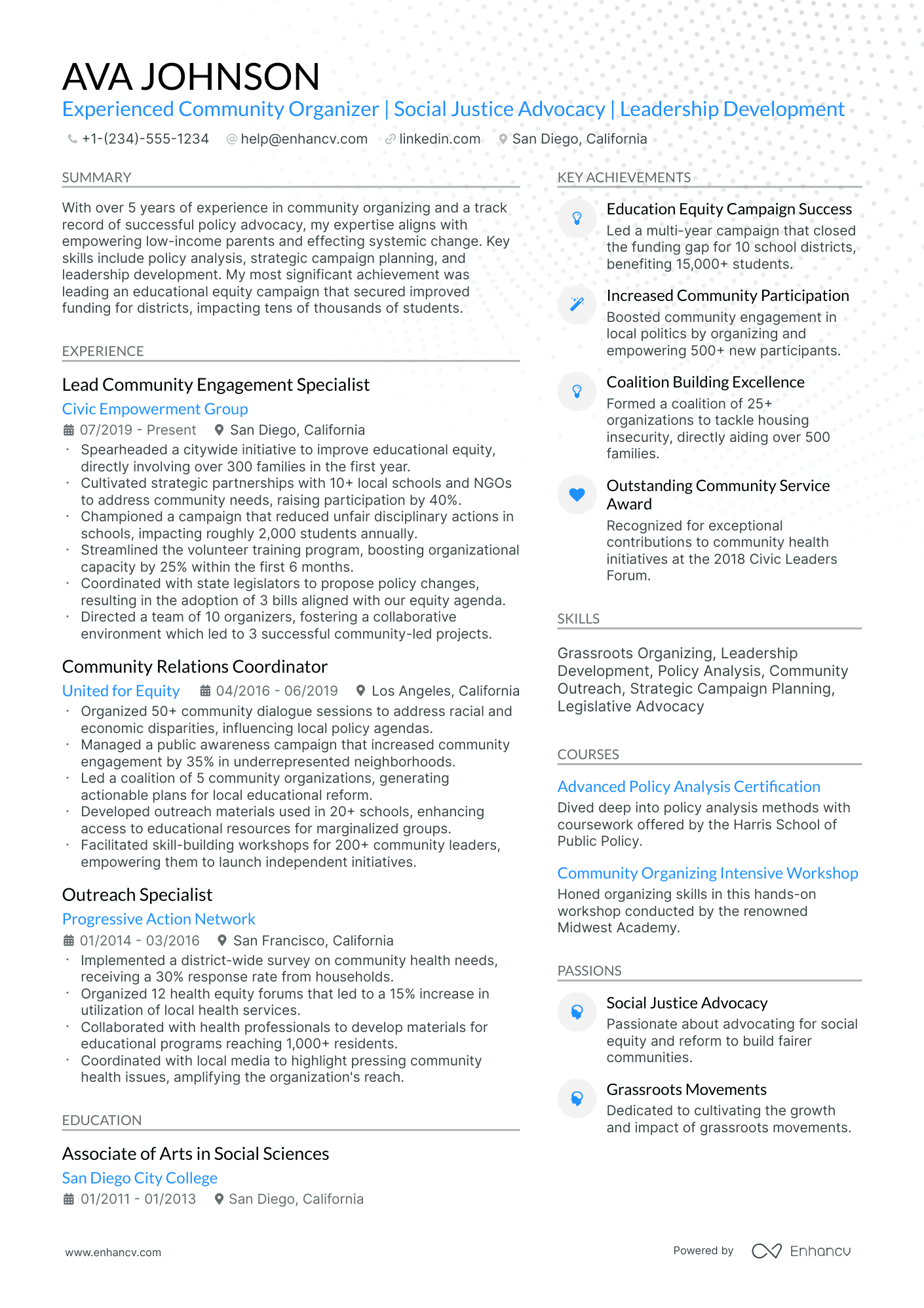
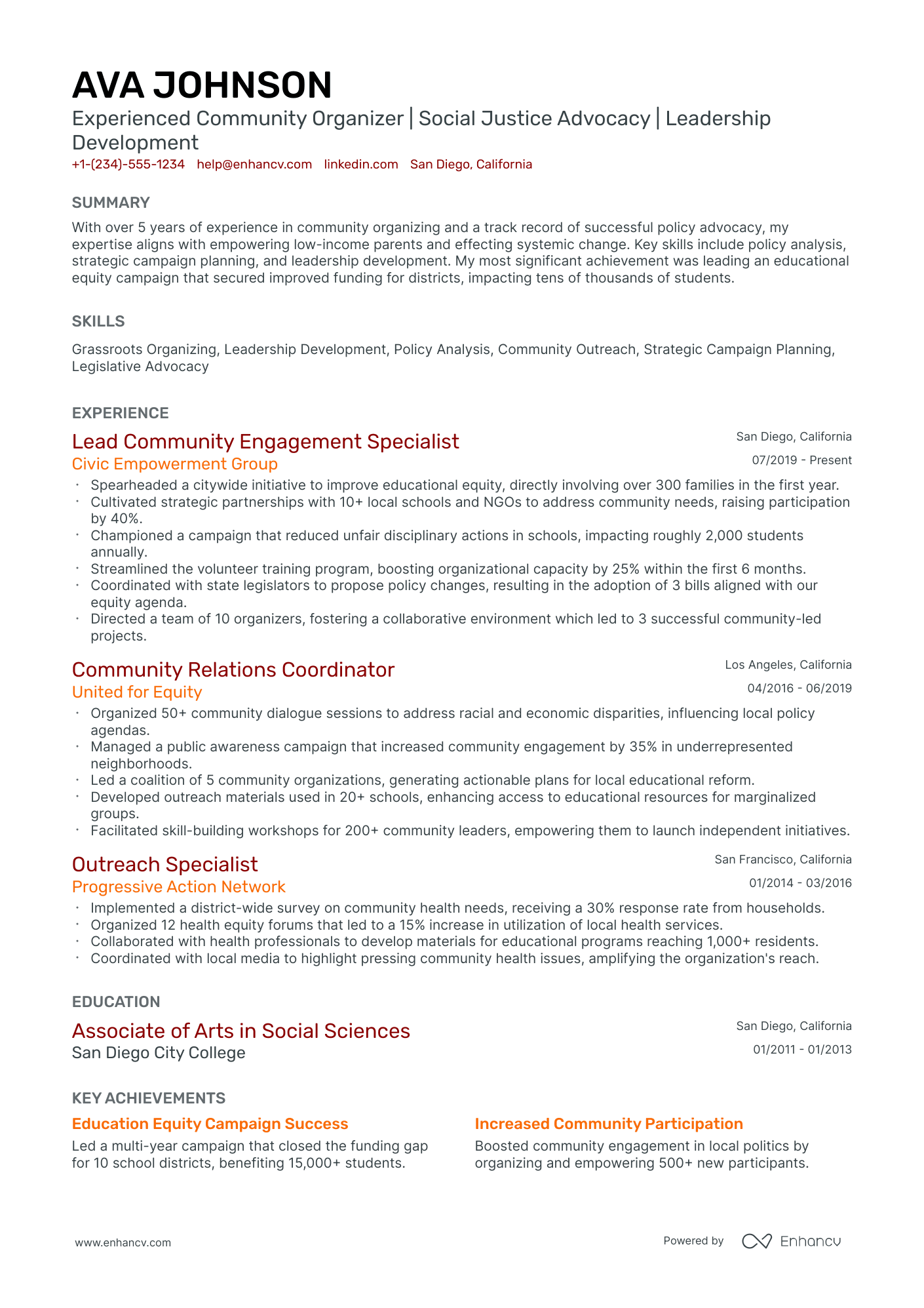
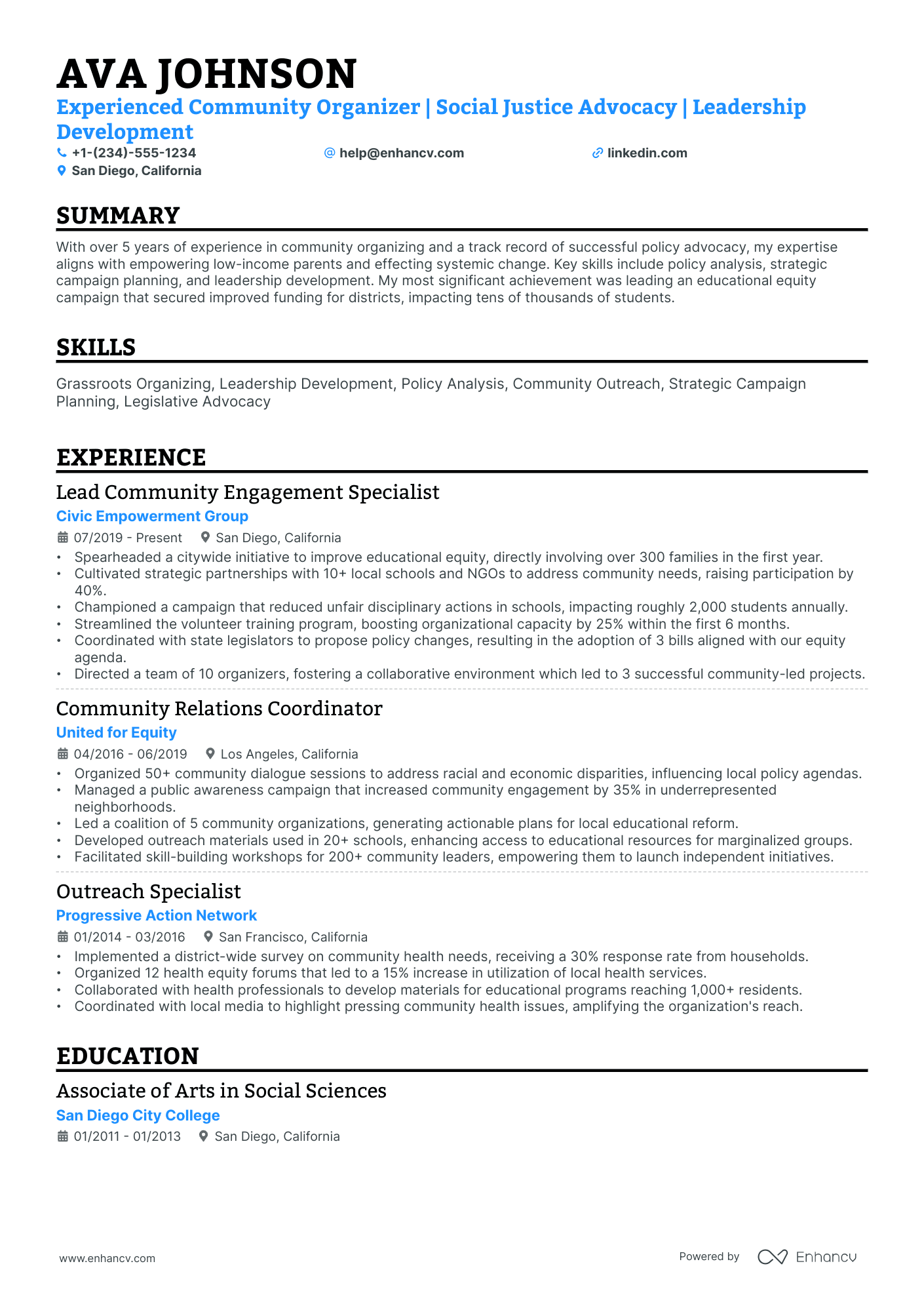
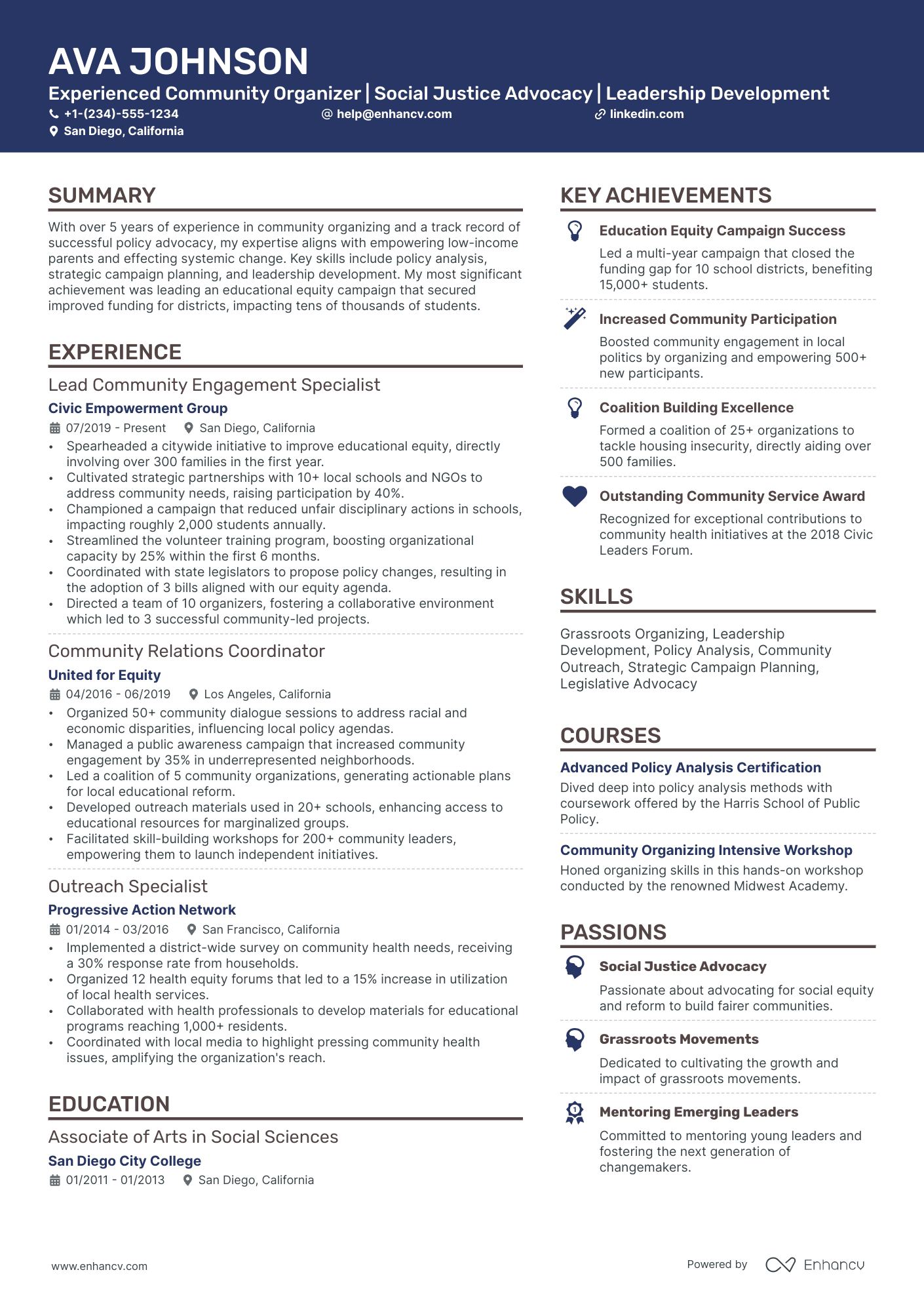
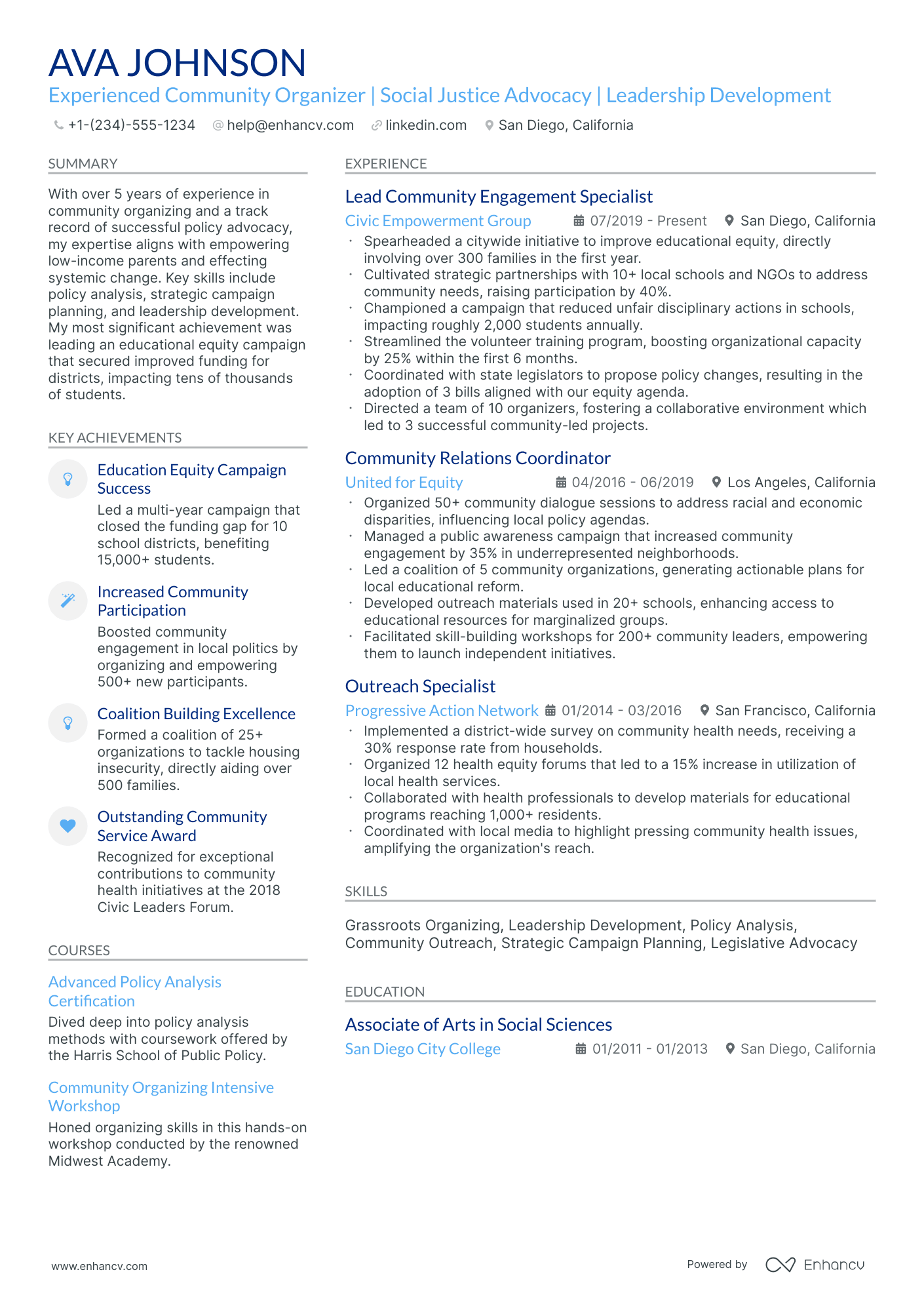
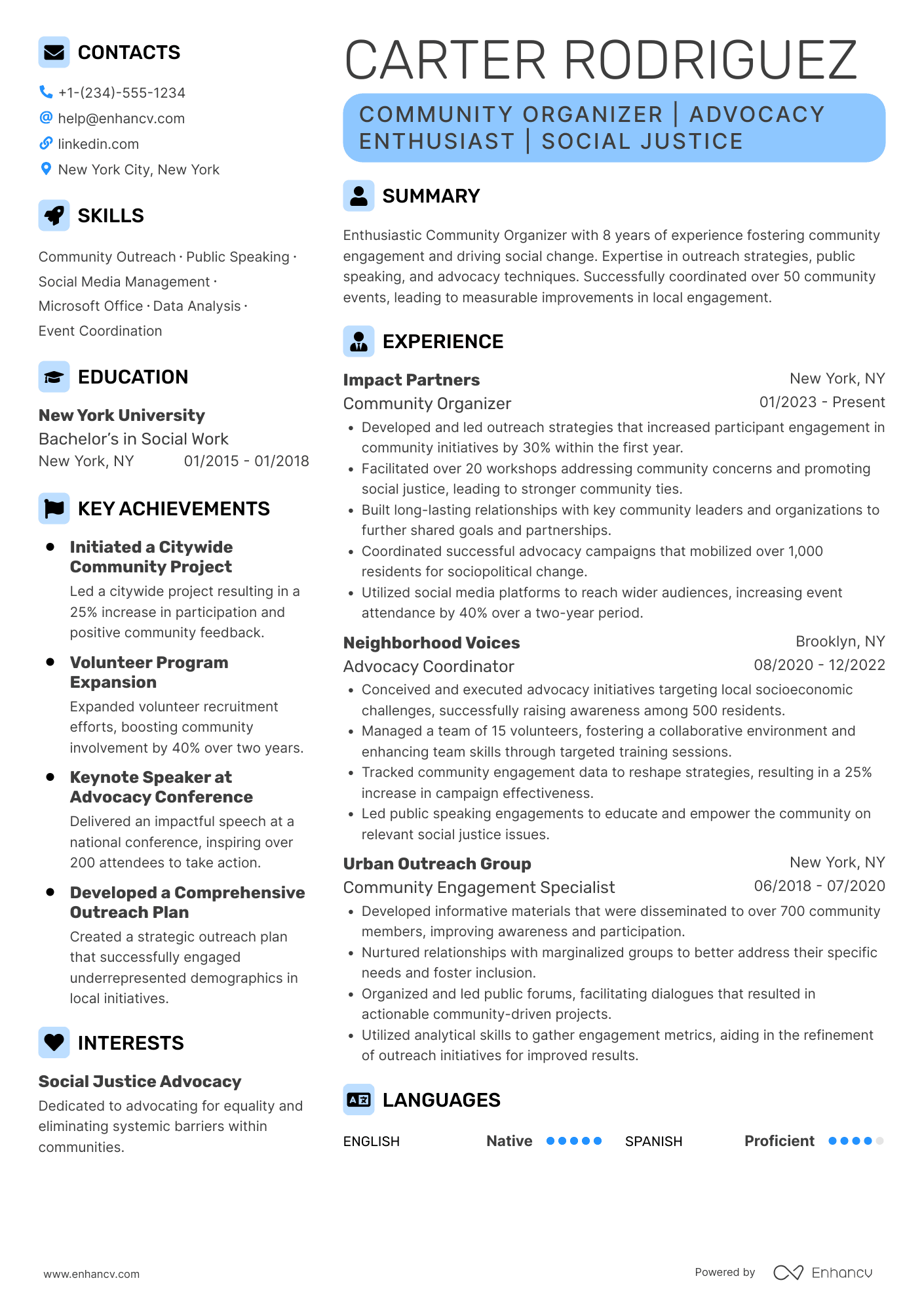
A community organizer resume often fails because it reads like a task list and buries impact under program names and acronyms. That hurts in ATS screening and quick recruiter scans, especially when competition is high.
A strong resume shows what changed because of your work, so you stand out fast. You should highlight turnout growth, funds raised, volunteer retention, coalition size, policy wins, event attendance, and faster service delivery. Quantify scope, timelines, and community outcomes.

Key takeaways
- Quantify every bullet with metrics like turnout growth, funds raised, or volunteer retention rates.
- Use a reverse-chronological format if you have direct organizing experience.
- Choose a hybrid format to foreground transferable skills when switching into organizing.
- Tailor experience bullets to mirror each job posting's tools, terminology, and priorities.
- Demonstrate skills through measurable outcomes in your summary and experience, not just lists.
- Include volunteer work, campus activism, and service projects as substantive experience entries.
- Use Enhancv's tools to sharpen bullet points and align your resume with specific role requirements.
How to format a community organizer resume
Recruiters evaluating community organizer resumes prioritize evidence of grassroots engagement, coalition building, campaign outcomes, and the ability to mobilize diverse stakeholders toward measurable goals. A clear, well-structured format ensures these signals surface quickly during both automated screening and manual review.

I have significant experience in this role—which format should I use?
Use a reverse-chronological format to showcase your progression in community engagement, campaign leadership, and stakeholder coordination. Do:
- Lead with your most recent roles, emphasizing the scope of communities served, coalitions managed, and organizational partnerships you owned.
- Highlight role-specific competencies such as grassroots outreach, advocacy campaign design, grant writing, volunteer management, and platforms like EveryAction, NationBuilder, or Salesforce.
- Quantify outcomes tied to mobilization targets, funding secured, policy changes influenced, or membership growth achieved.
I'm junior or switching into this role—what format works best?
A hybrid format works best, allowing you to foreground transferable organizing skills while still presenting your experience in chronological order. Do:
- Place a skills section near the top of your resume that highlights competencies like community outreach, event coordination, public speaking, conflict resolution, and data tracking.
- Include volunteer work, campus activism, internships, or service-learning projects as substantive experience entries, with descriptions that mirror professional organizing tasks.
- Connect every action to a clear result, demonstrating that your efforts produced tangible community impact even in informal or unpaid roles.
When does a functional resume make sense?
A functional format is appropriate only in a narrow set of circumstances for community organizer candidates:
- You're transitioning from a related field—such as social work, teaching, or nonprofit administration—and need to reframe existing skills around organizing competencies.
- You have significant volunteer-based organizing experience but limited formal employment history in the field.
- You're re-entering the workforce after an extended gap and want to foreground relevant projects and campaign involvement.
- Edge-case exception: A functional format is acceptable if you're making a career change from an unrelated industry and your organizing work has been entirely volunteer-based, but you must still anchor every listed skill to a specific project, campaign, or measurable community outcome.
Once your layout and formatting choices are in place, the next step is determining which sections to include so each one reinforces your qualifications.
What sections should go on a community organizer resume
Recruiters expect to see clear evidence that you can build coalitions, mobilize stakeholders, and deliver measurable community outcomes.
Use this structure for maximum clarity:
- Header
- Summary
- Experience
- Skills
- Projects
- Education
- Certifications
- Optional sections: Volunteering, Leadership, Languages
Strong experience bullets should emphasize impact, outcomes, scope, and results, including people reached, funds raised, partnerships built, and policy or program wins.
Is your resume good enough?
Drop your resume here or choose a file. PDF & DOCX only. Max 2MB file size.
Once you’ve organized your resume with the right core sections, the next step is to write your community organizer experience in a way that fits that structure and shows your impact.
How to write your community organizer resume experience
Your experience section is where you prove you've built real community power—through outreach campaigns you led, organizing frameworks you applied, and measurable shifts in engagement, participation, or policy outcomes. Hiring managers prioritize demonstrated impact over descriptive task lists, so every bullet should connect what you did to a result that mattered.
Each entry should include:
- Job title
- Company and location (or remote)
- Dates of employment (month and year)
Three to five concise bullet points showing what you owned, how you executed, and what outcomes you delivered:
- Ownership scope: the campaigns, coalitions, geographic territories, volunteer networks, or issue areas you were directly accountable for as a community organizer.
- Execution approach: the organizing models, canvassing strategies, digital mobilization platforms, facilitation techniques, or data-tracking tools you used to plan actions and make strategic decisions.
- Value improved: changes to voter turnout, member retention, event attendance, resource accessibility, coalition strength, or community safety that resulted from your organizing work.
- Collaboration context: how you coordinated with elected officials, nonprofit partners, faith-based organizations, government agencies, or grassroots volunteer leaders to advance shared goals.
- Impact delivered: outcomes expressed through coalition growth, policy wins, funding secured, legislative testimony delivered, or sustainable community infrastructure built—rather than routine activities performed.
Experience bullet formula
A community organizer experience example
✅ Right example - modern, quantified, specific.
Community Organizer
Neighborhood Action Network | Philadelphia, PA
2022–Present
Grassroots nonprofit advancing housing stability and public health across eight neighborhoods through resident-led campaigns and coalition work.
- Built and maintained a Salesforce nonprofit success pack (Nonprofit Success Pack) database for twelve thousand constituents, improving segmentation accuracy by twenty-eight percent and increasing event turnout by eighteen percent through targeted outreach.
- Launched a multi-channel organizing program using Action Network, Hustle, and Mailchimp, driving three thousand four hundred petition signatures in six weeks and lifting volunteer retention by sixteen percent.
- Led weekly canvasses and phone banks using MiniVAN and Google Sheets, training eighty-five volunteers and cutting turf assignment time by forty percent while improving contact rate from thirty-one percent to thirty-nine percent.
- Facilitated a cross-organization coalition with city council staff, public health clinics, and legal aid partners, securing one point two million dollars in rental assistance allocations and reducing average client intake cycle time by nine days.
- Produced campaign dashboards in Looker Studio from Salesforce and Action Network exports, aligning priorities with executive leadership and partner stakeholders and increasing on-time reporting from sixty percent to ninety-five percent.
Now that you've seen how a strong experience section comes together, let's look at how to adjust those details to match the specific role you're applying for.
How to tailor your community organizer resume experience
Recruiters evaluate your community organizer resume through both human review and applicant tracking systems. Tailoring your experience section to mirror the job posting ensures your qualifications stand out in both screening stages.
Ways to tailor your community organizer experience:
- Match outreach tools and platforms named in the job description.
- Use the same terminology for engagement strategies or organizing models.
- Mirror specific campaign goals or mobilization metrics the posting references.
- Include relevant issue areas like housing or public health advocacy.
- Emphasize coalition-building or cross-sector collaboration if mentioned.
- Highlight grant management or fundraising experience when the role requires it.
- Reflect community assessment methods or participatory frameworks the employer values.
- Reference cultural competency or language skills tied to the target population.
Tailoring means aligning your real achievements with the role's stated requirements—not forcing keywords where they don't belong.
Resume tailoring examples for community organizer
| Job description excerpt | Untailored | Tailored |
|---|---|---|
| "Lead grassroots outreach campaigns in underserved neighborhoods using door-to-door canvassing and coalition-building to increase civic participation." | Helped with community outreach and engagement activities. | Led door-to-door canvassing campaigns across three underserved neighborhoods, building coalitions with 12 local organizations to boost civic participation by 34% over one election cycle. |
| "Recruit, train, and manage a team of 20+ volunteers to support food equity initiatives using Mobilize and EveryAction platforms." | Managed volunteers and helped coordinate events. | Recruited and trained a team of 25 volunteers through Mobilize and EveryAction to run weekly food equity distribution events, serving 400+ families per month. |
| "Develop and facilitate community workshops on tenants' rights, partnering with legal aid nonprofits to connect residents with housing resources." | Organized workshops and connected people with resources. | Designed and facilitated monthly tenants' rights workshops in partnership with two legal aid nonprofits, connecting over 150 residents with pro bono housing attorneys and emergency rental assistance programs. |
Once you’ve aligned your experience with the role’s priorities, the next step is to quantify your community organizer achievements so hiring managers can quickly see the impact of your work.
How to quantify your community organizer achievements
Quantifying shows how your organizing changed turnout, retention, and outcomes. Track participation growth, volunteer capacity, fundraising efficiency, campaign delivery speed, and satisfaction or issue-resolution rates across events and programs.
Quantifying examples for community organizer
| Metric | Example |
|---|---|
| Event turnout | "Grew monthly town hall attendance from 45 to 120 in six months by adding SMS reminders through Hustle and partnering with three neighborhood groups." |
| Volunteer retention | "Improved volunteer sixty-day retention from 52% to 71% by launching a buddy system and tracking follow-ups in Airtable." |
| Fundraising efficiency | "Raised $18,400 from 230 donors in eight weeks, cutting cost per donation from $3.10 to $1.85 using ActBlue email segmentation." |
| Issue resolution | "Reduced average case-closure time from fourteen to nine days by standardizing intake forms and coordinating weekly escalations with city services." |
| Stakeholder satisfaction | "Increased post-event satisfaction from 4.1 to 4.6 out of five across twelve events by updating agendas and adding multilingual materials." |
Turn vague job duties into measurable, recruiter-ready resume bullets in seconds with Enhancv's Bullet Point Generator.
Once you've crafted strong bullet points to showcase your experience, you'll also want to strategically present your hard and soft skills to give hiring managers a complete picture of your qualifications.
How to list your hard and soft skills on a community organizer resume
Skills show how you mobilize residents and partners, and recruiters and an ATS (applicant tracking system) scan this section to match you to the job post, so aim for a balanced mix of role-specific hard skills and execution-focused soft skills. community organizer roles require a blend of:
- Product strategy and discovery skills.
- Data, analytics, and experimentation skills.
- Delivery, execution, and go-to-market discipline.
- Soft skills.
Your skills section should be:
- Scannable (bullet-style grouping).
- Relevant to the job post.
- Backed by proof in experience bullets.
- Updated with current tools.
Place your skills section:
- Above experience if you're junior or switching careers.
- Below experience if you're mid/senior with strong achievements.

Hard skills
- Community needs assessments
- Stakeholder mapping
- Coalition building frameworks
- Volunteer recruitment pipelines
- Event planning and logistics
- Canvassing, phone banking
- Voter file tools (VAN)
- Constituent relationship management, Salesforce
- Email and text outreach, Mailchimp, Hustle
- Survey design, Google Forms
- Program evaluation, logic models
- Grant writing and reporting
Soft skills
- Facilitate community meetings
- Build trust across groups
- De-escalate conflict in public
- Run structured listening sessions
- Translate issues into actions
- Align partners on shared goals
- Persuade through storytelling
- Set priorities under constraints
- Follow through on commitments
- Coordinate volunteers and staff
- Negotiate roles and resources
- Communicate clearly with empathy
How to show your community organizer skills in context
Skills shouldn't live only in a bulleted list on your resume.
They should be demonstrated in:
- Your summary (high-level professional identity)
- Your experience (proof through outcomes)
Here's what that looks like in practice.
Summary example
Community organizer with 10 years of experience building grassroots coalitions around housing justice. Skilled in door-to-door canvassing, EveryAction CRM, and volunteer training. Led a tenant advocacy campaign that increased voter turnout by 34% across three districts.
- Signals senior-level depth immediately
- Names role-relevant tools and methods
- Leads with a measurable campaign outcome
- Highlights leadership and collaboration ability
Experience example
Senior Community Organizer
Bridges Civic Alliance | Chicago, IL
June 2019–March 2024
- Recruited and trained 120+ volunteers using EveryAction, growing canvass teams that registered 4,800 new voters in 18 months.
- Partnered with 15 local nonprofits to launch a food security coalition, securing $280,000 in municipal grant funding.
- Facilitated weekly strategy meetings with cross-functional teams, improving campaign response time by 25% through streamlined communication workflows.
- Every bullet includes measurable proof.
- Skills surface naturally through real outcomes.
Once you’ve tied your organizing strengths to real outcomes and settings, the next step is applying that approach to a community organizer resume when you don’t have formal experience.
How do I write a community organizer resume with no experience
Even without full-time experience, you can demonstrate readiness through:
- Mutual aid distribution shifts
- Tenant union meeting facilitation
- Campus advocacy campaign leadership
- Volunteer phone banking and texting
- Petition drives and signature collection
- Community survey design and analysis
- Event planning for local coalitions
- Public comment testimony preparation
Focus on:
- Measurable outreach and turnout results
- Stakeholder mapping and coalition building
- Data tracking in spreadsheets or CRM
- Clear issue framing with evidence
Resume format tip for entry-level community organizer
Use a hybrid resume format because it highlights organizing projects and transferable skills while still showing consistent involvement. Do:
- Lead with a Projects section.
- Start bullets with strong action verbs.
- Add metrics: contacts, turnout, funds.
- Name tools: Google Sheets, VAN, Action Network.
- Tailor keywords to each posting.
- Built an Action Network petition and tracked outreach in Google Sheets, collecting 215 signatures in two weeks to support a tenant union repair demand.
Even without formal work experience, your educational background can demonstrate the knowledge and involvement that qualify you for a community organizer role.
How to list your education on a community organizer resume
Your education section helps hiring teams confirm you have foundational knowledge in areas like social justice, public policy, or communications—fields central to community organizer work.
Include:
- Degree name
- Institution
- Location
- Graduation year
- Relevant coursework (for juniors or entry-level candidates)
- Honors & GPA (if 3.5 or higher)
Skip month and day details—list the graduation year only.
Here's a strong education entry tailored for a community organizer resume.
Example education entry
Bachelor of Arts in Sociology
Howard University, Washington, D.C.
Graduated 2021
GPA: 3.7/4.0
- Relevant coursework: Community Development, Social Movements, Urban Policy, and Nonprofit Management.
- Honors: Magna Cum Laude, Dean's List (six consecutive semesters).
How to list your certifications on a community organizer resume
Certifications show a community organizer’s commitment to learning, proficiency with core tools, and alignment with current community practices and standards.
Include:
- Certificate name
- Issuing organization
- Year
- Optional: credential ID or URL
- Place certifications below education when they are older, less relevant, or mainly support your baseline qualifications.
- Place certifications above education when they are recent, highly relevant, or required for the community organizer role you want.
Best certifications for your community organizer resume
Certified Nonprofit Professional (CNP) Certified Fund Raising Executive (CFRE) Grant Professional Certified (GPC) Project Management Professional (PMP) Certified Community Action Professional (CCAP) Mediation Training Certificate Mental Health First Aid Certification
Once you’ve positioned your credentials where hiring managers can spot them quickly, shift to your community organizer resume summary to frame those qualifications in a clear, role-relevant narrative.
How to write your community organizer resume summary
Your resume summary is the first thing a recruiter reads. A strong one instantly frames you as a relevant candidate for the community organizer role.
Keep it to three to four lines, with:
- Your title and years of experience in community organizing or related advocacy work.
- Domain focus, such as grassroots mobilization, civic engagement, or nonprofit outreach.
- Core skills like coalition building, volunteer recruitment, event coordination, or campaign planning.
- One or two quantified achievements, such as membership growth or campaign participation rates.
- Soft skills tied to real outcomes, like cross-cultural communication that expanded outreach to new demographics.

PRO TIP
At an entry or early-career level, emphasize specific skills and tools you've used. Highlight any measurable contributions, even from internships or volunteer roles. Avoid vague phrases like "passionate change-maker" or "motivated self-starter." Focus on what you did, for whom, and the result it produced.
Example summary for a community organizer
Community organizer with two years of experience in grassroots civic engagement. Recruited and trained 85 volunteers across three neighborhoods. Skilled in canvassing strategy, CRM tracking, and bilingual outreach coordination.
Optimize your resume summary and objective for ATS
Drop your resume here or choose a file.
PDF & DOCX only. Max 2MB file size.
Now that your summary captures the impact of your organizing work, make sure your header presents the essential contact and professional details recruiters need to reach you.
What to include in a community organizer resume header
A resume header is the contact and identity block at the top, and it boosts visibility, credibility, and recruiter screening for a community organizer.
Essential resume header elements
- Full name
- Tailored job title and headline
- Location
- Phone number
- Professional email
- GitHub link
- Portfolio link
A LinkedIn link lets recruiters verify experience fast and supports screening with consistent dates, titles, and organizations.
Don’t include a photo on a community organizer resume unless the role is explicitly front-facing or appearance-dependent.
Keep your header to one or two lines of contact details, and match your job title to the posting’s wording.
Example
Community organizer resume header
Jordan Lee
Community Organizer | Tenant Rights and Neighborhood Outreach
Chicago, IL
(312) 555-01XX
your.name@enhancv.com github.com/yourname yourwebsite.com linkedin.com/in/yourname
Once your contact details and role focus are clearly presented at the top, add relevant extra sections to provide a fuller view of your qualifications.
Additional sections for community organizer resumes
When your core sections don't fully capture your impact, additional sections help showcase the unique strengths that set you apart as a community organizer.
- Languages
- Volunteer experience
- Publications and media features
- Awards and community recognition
- Professional affiliations and memberships
- Certifications and training
- Conference presentations and speaking engagements
With your resume's additional sections reinforcing your community impact, pairing it with a tailored cover letter can further strengthen your application.
Do community organizer resumes need a cover letter
A cover letter isn’t required for every community organizer role, but it often helps. It matters most in competitive openings or when hiring teams expect a clear narrative beyond your resume.
Use a cover letter when it can add context your resume can’t:
- Explain role and team fit by connecting your organizing approach to the organization’s mission, community, and operating style.
- Highlight one or two relevant projects or outcomes, including the goal, your actions, and measurable results.
- Show you understand the product, users, or business context by referencing the community’s needs, success metrics, and constraints.
- Address career transitions or non-obvious experience by mapping transferable skills to core community organizer responsibilities.
Drop your resume here or choose a file.
PDF & DOCX only. Max 2MB file size.
Even if you decide to include a cover letter to add context beyond your resume, you can use AI to improve your community organizer resume so it communicates that context clearly and efficiently.
Using AI to improve your community organizer resume
AI can sharpen your resume's clarity, structure, and impact. It helps refine language and highlight measurable results. But overuse strips authenticity. Once your content feels clear and role-aligned, step away from AI tools.
Here are 10 practical prompts to strengthen specific sections of your community organizer resume:
Strengthen summary statement
Quantify experience bullets
Tighten action verbs
Align skills section
Clarify project descriptions
Refine education details
Showcase certifications
Remove filler language
Improve bullet consistency
Tailor for specific roles
Conclusion
A strong community organizer resume shows measurable outcomes, role-specific skills, and a clear structure. Use numbers to prove impact, highlight organizing strengths, and keep each section easy to scan.
Today’s and near-future hiring market rewards clarity and results. When your community organizer resume reads cleanly and backs claims with outcomes, you look ready to deliver from day one.