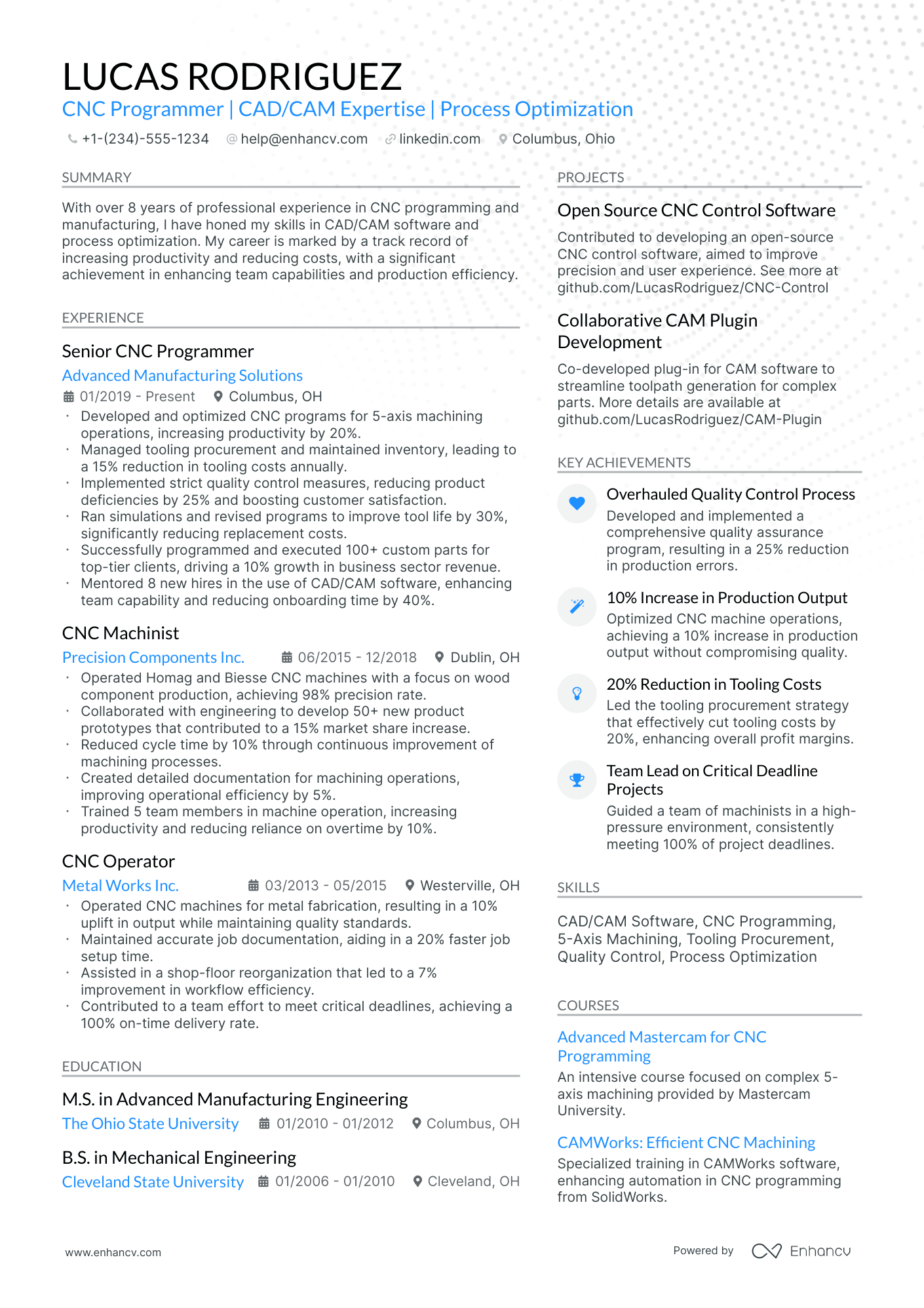
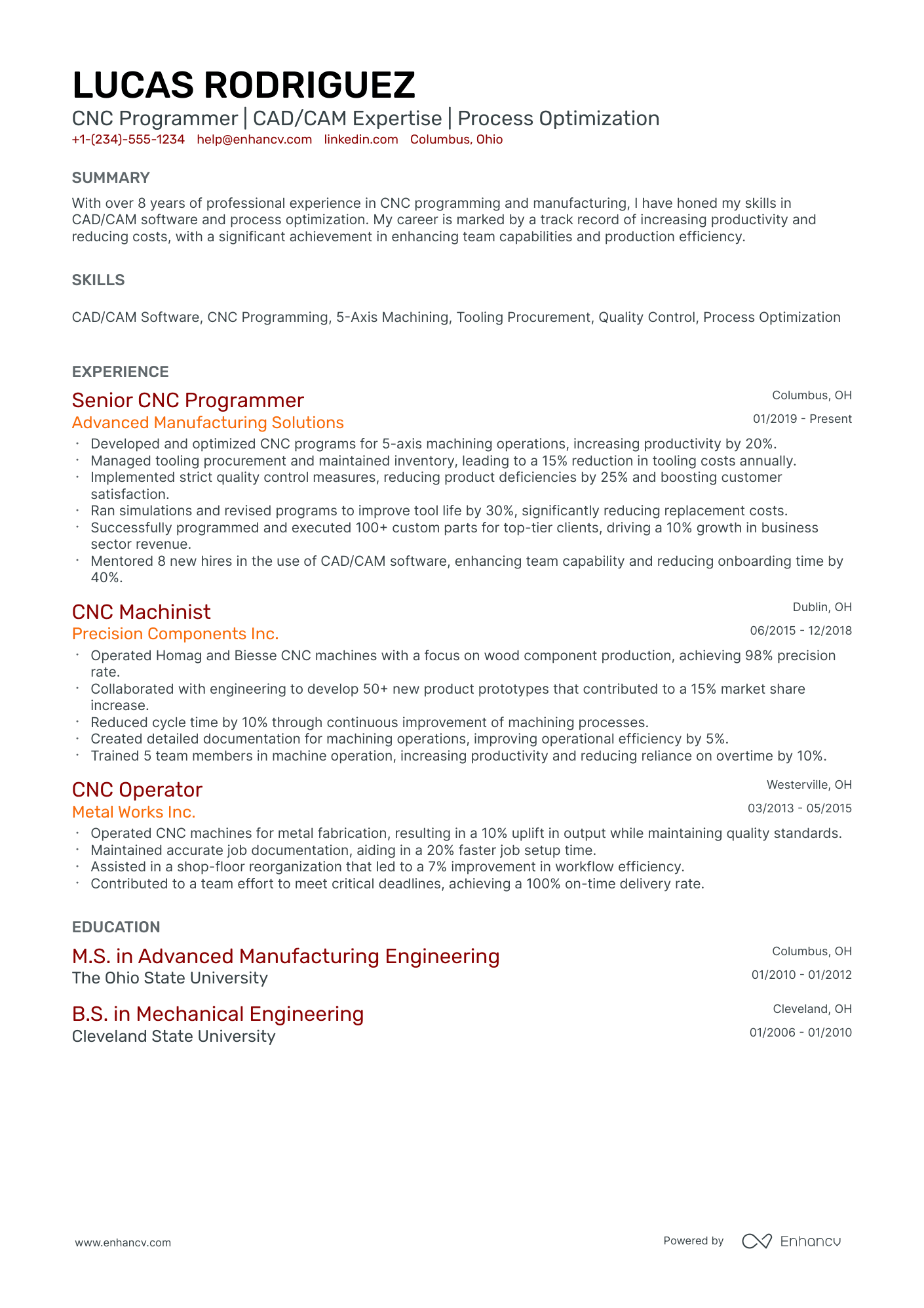
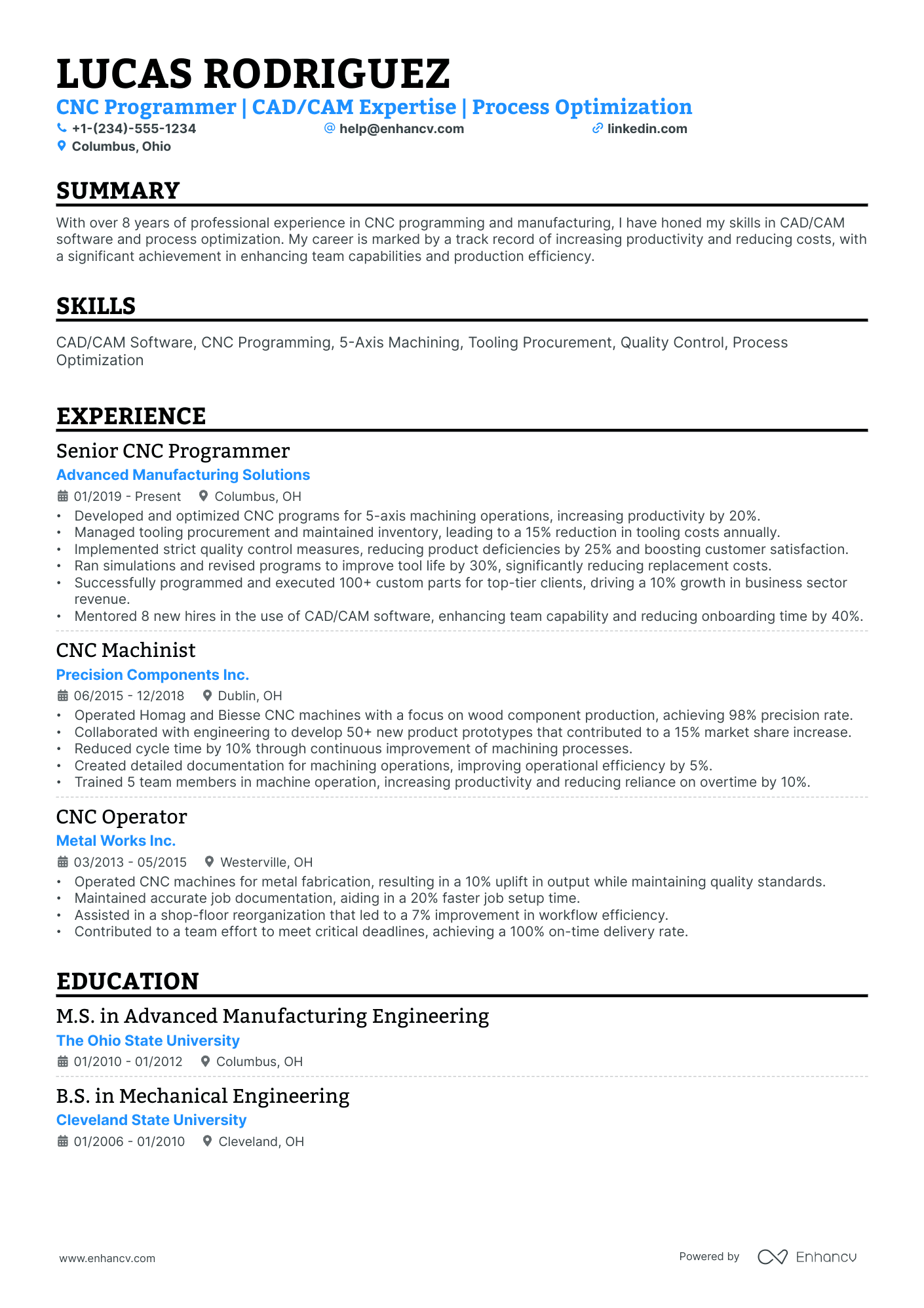
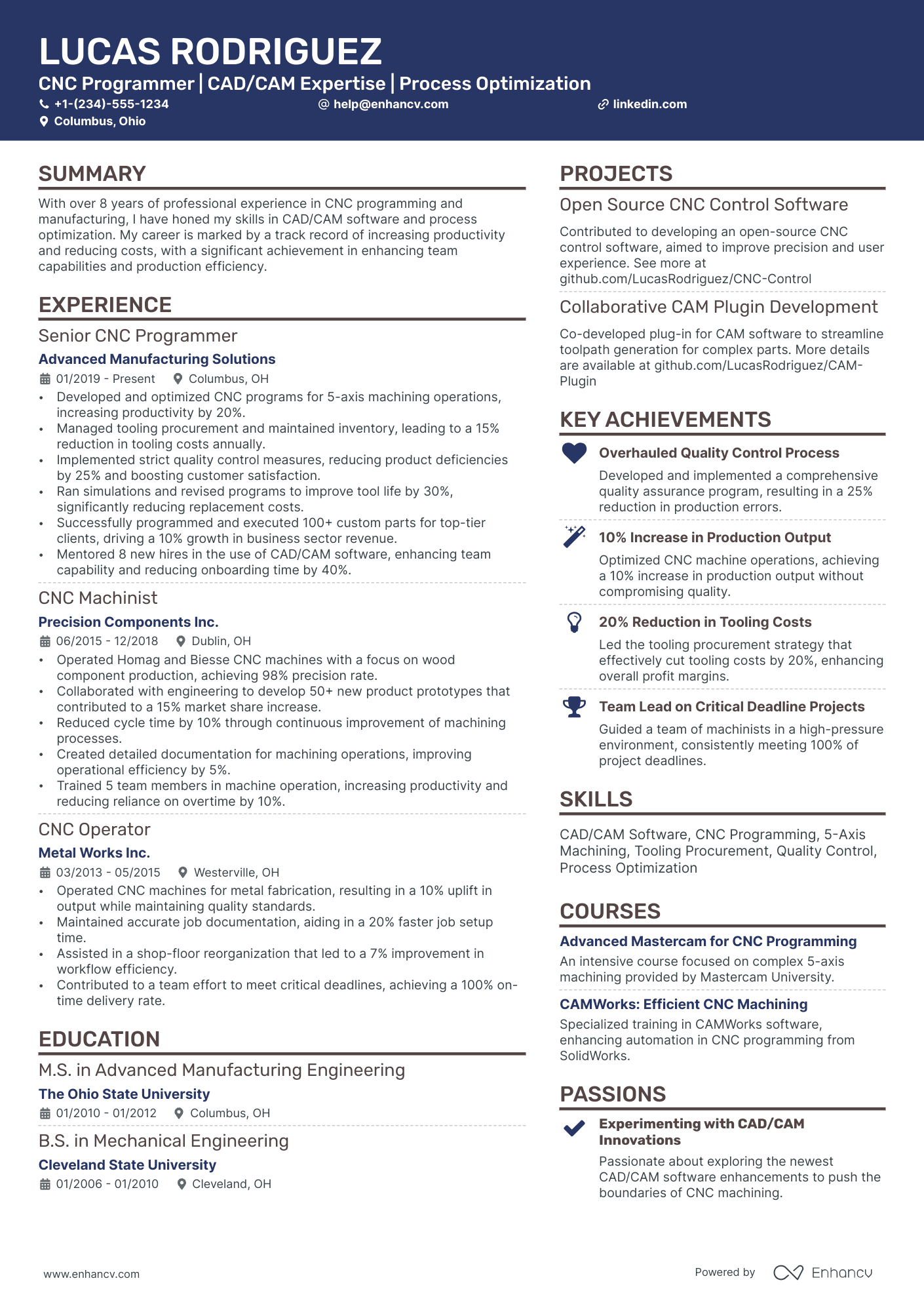
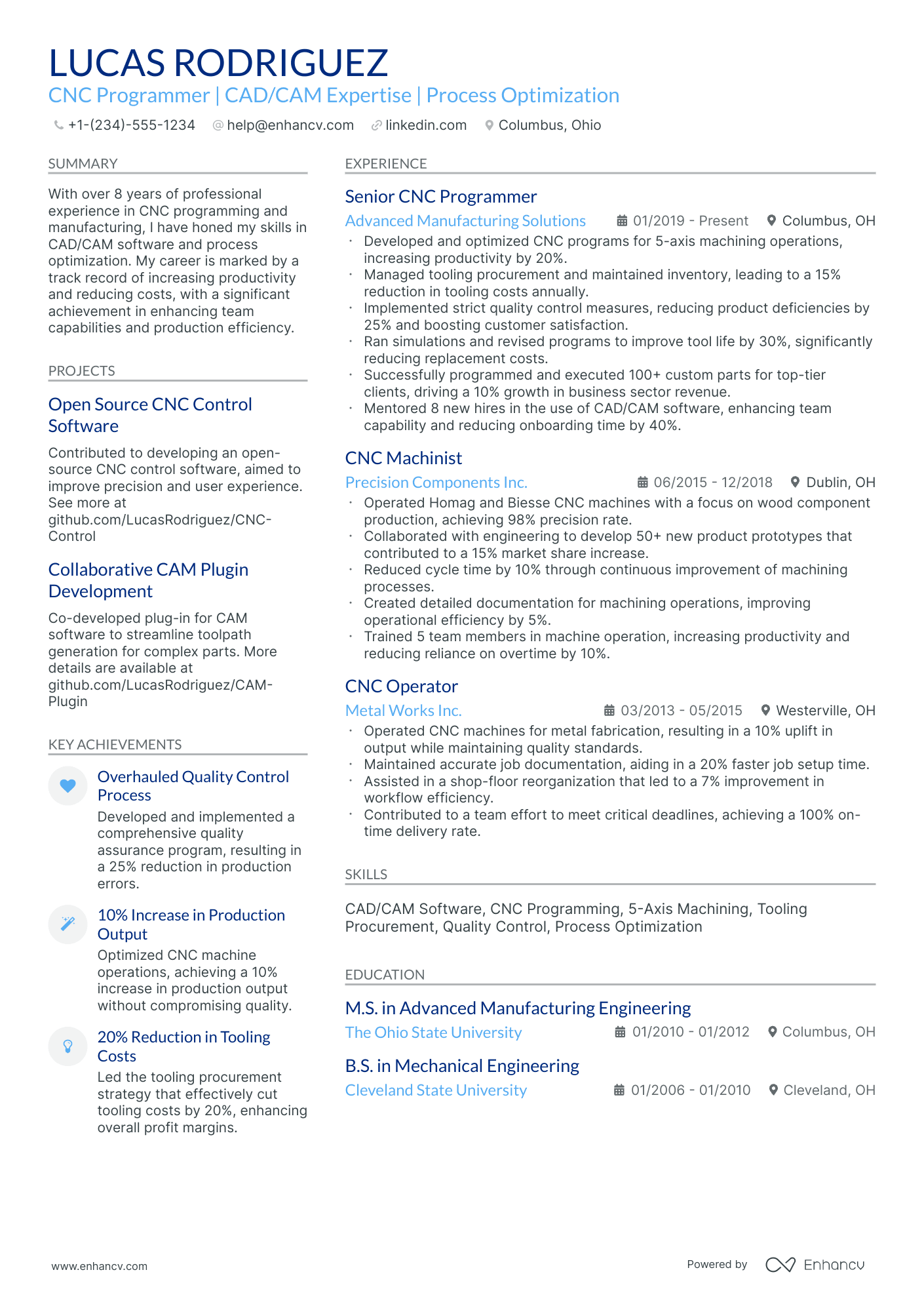
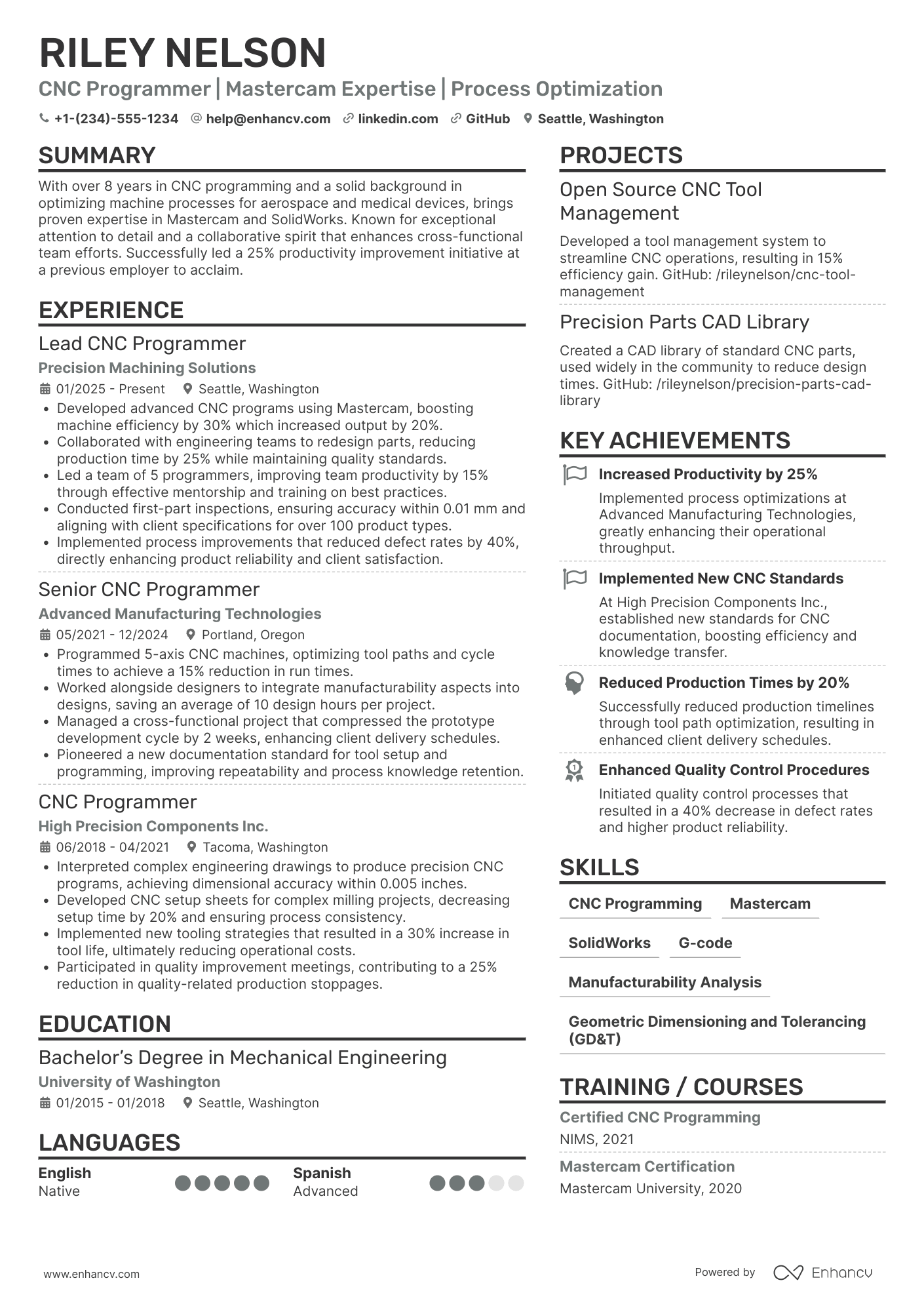
Most CNC programmer resume drafts fail because they list machines and codes but skip measurable production results. That hurts in applicant tracking system screening and fast recruiter scans, where high-volume competition rewards clear impact.
A strong resume shows what you improved, not just what you ran. Knowing how to make your resume stand out means highlighting cycle time reductions, scrap rate drops, on-time delivery gains, tighter tolerances, faster setups, successful first-article approvals, and throughput increases across multi-part jobs.

Key takeaways
- Quantify CNC achievements with cycle time, scrap rate, and cost savings instead of listing tasks.
- Match your resume's CAM software, controllers, and terminology to each job posting.
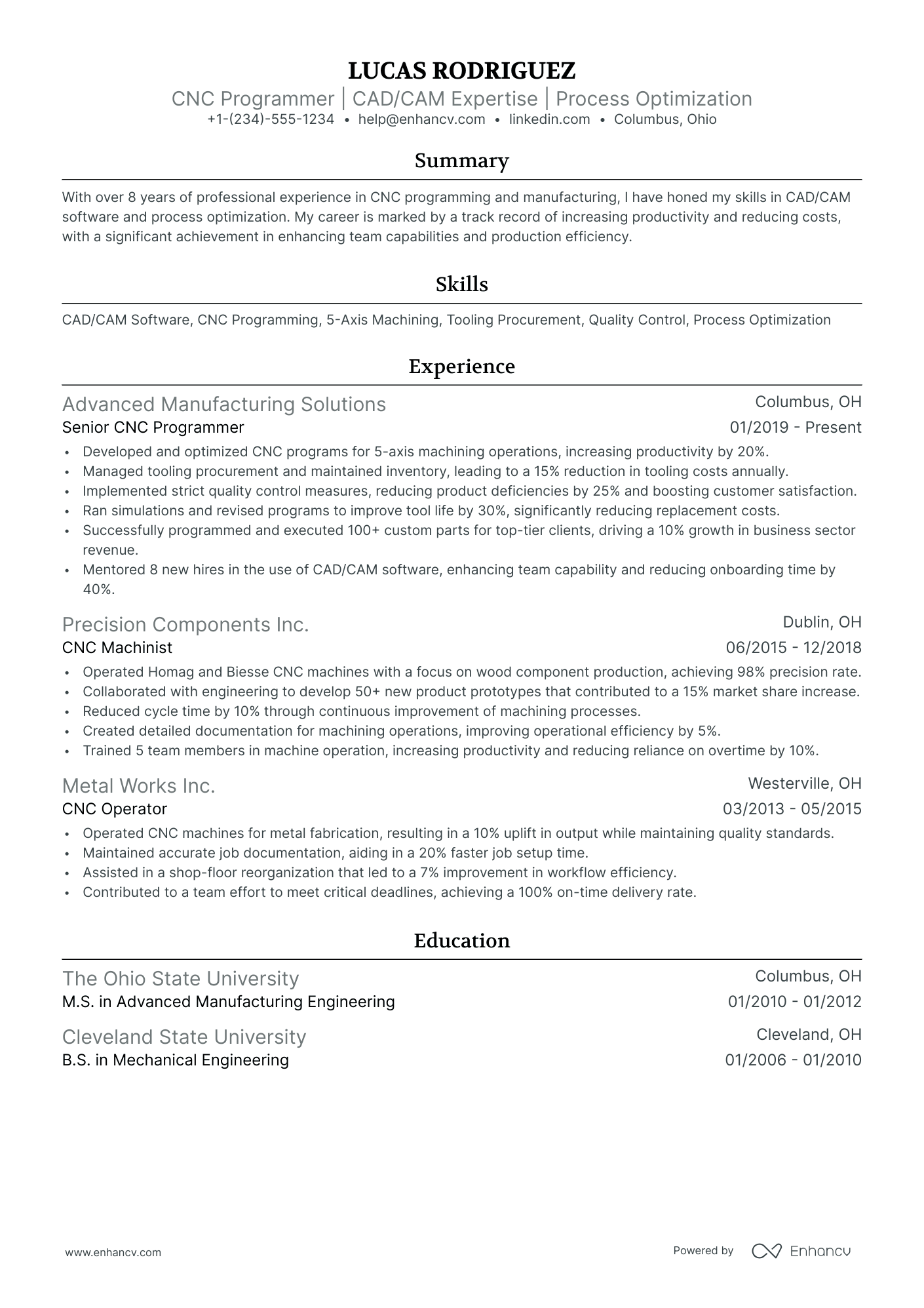
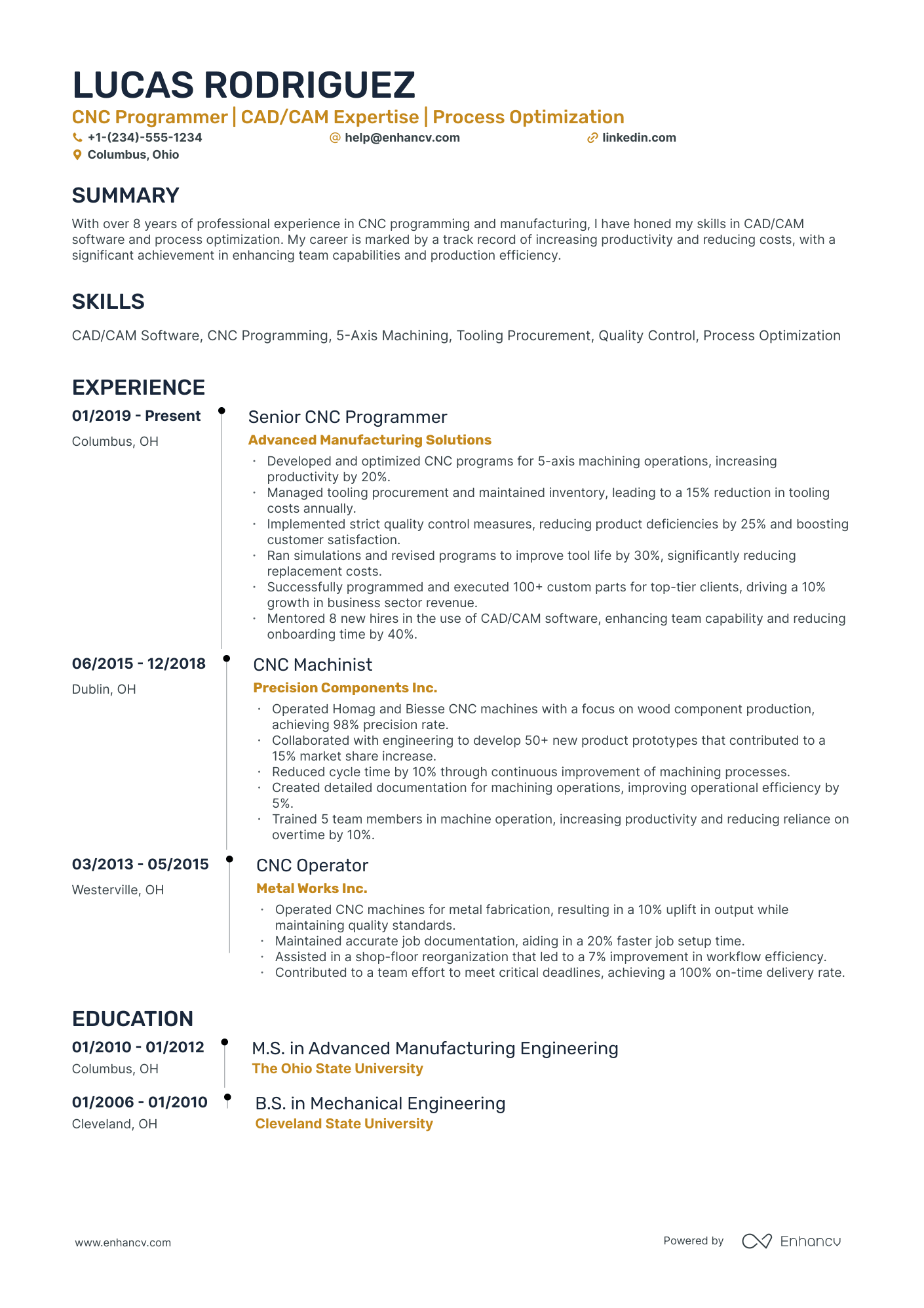
- Use reverse-chronological format for experienced programmers and hybrid format for career changers.
- Anchor every listed skill to a specific machine, project, or measurable outcome.
- Place certifications above education when they're recent or required by the posting.
- Write a three- to four-line summary naming your tools, industry, and strongest metric.
- Build polished, results-driven bullet points faster using Enhancv's resume tools.
Job market snapshot for CNC programmers
We analyzed 149 recent CNC programmer job ads across major US job boards. These numbers help you understand top companies hiring, salary landscape, career growth patterns at a glance.
What level of experience employers are looking for CNC programmers
| Years of Experience | Percentage found in job ads |
|---|---|
| 1–2 years | 7.4% (11) |
| 3–4 years | 12.1% (18) |
| 5–6 years | 10.1% (15) |
| 7–8 years | 4.0% (6) |
| 9–10 years | 0.7% (1) |
| 10+ years | 4.7% (7) |
| Not specified | 61.1% (91) |
CNC programmer ads by area of specialization (industry)
| Industry (Area) | Percentage found in job ads |
|---|---|
| Finance & Banking | 52.3% (78) |
| Manufacturing | 17.4% (26) |
| Healthcare | 15.4% (23) |
| Retail & E-commerce | 10.1% (15) |
Top companies hiring CNC programmers
| Company | Percentage found in job ads |
|---|---|
| Actalent | 16.8% (25) |
Role overview stats
These tables show the most common responsibilities and employment types for CNC programmer roles. Use them to align your resume with what employers expect and to understand how the role is structured across the market.
Day-to-day activities and top responsibilities for a CNC programmer
| Responsibility | Percentage found in job ads |
|---|---|
| Cnc programming | 73.8% (110) |
| Mastercam | 37.6% (56) |
| Gd&t | 27.5% (41) |
| Cad/cam | 20.8% (31) |
| Solidworks | 16.1% (24) |
| Cad | 12.8% (19) |
| G-code | 12.8% (19) |
| Blueprints | 12.1% (18) |
| Cam | 9.4% (14) |
| Fanuc | 8.1% (12) |
| Milling | 8.1% (12) |
| Okuma | 7.4% (11) |
How to format a CNC programmer resume
Recruiters evaluating CNC programmer resumes prioritize hands-on programming proficiency with specific control systems (Fanuc, Siemens, Mazak), material and machining process knowledge, and a track record of reducing cycle times or scrap rates. Choosing the right resume format ensures these technical signals surface immediately during both automated screening and the recruiter's initial scan.

I have significant experience in this role—which format should I use?
Use a reverse-chronological format to present your deepest CNC programming experience with clear job-by-job progression. Do:
- Lead each role entry with your scope of ownership: number of machines programmed, shop floor size, or team oversight responsibilities.
- List specific control languages, CAD/CAM platforms (Mastercam, SolidCAM, GibbsCAM), and material types (aluminum, titanium, composites) relevant to each position.
- Quantify outcomes tied to efficiency, quality, or cost—cycle time reductions, first-pass yield improvements, or scrap rate decreases.
- "Developed and optimized G-code programs for a 12-machine CNC turning cell running Fanuc 0i-TF controls, reducing average cycle time by 18% and cutting annual scrap costs by $74,000."
I'm junior or switching into this role—what format works best?
A hybrid format works best because it lets you lead with relevant CNC skills and technical training before a shorter work history section. Do:
- Place a dedicated skills section near the top listing G-code/M-code proficiency, CAD/CAM software, GD&T knowledge, and any control systems you've trained on.
- Include coursework projects, personal machining projects, or apprenticeship tasks that demonstrate real programming and setup experience.
- Connect every listed skill to a specific action and a measurable or observable result.
- Mastercam proficiency → programmed 3-axis toolpaths for six aluminum fixture components during a manufacturing technology capstone → achieved ±0.002" tolerance on all parts with zero rework.
Why not use a functional resume?
A functional resume strips away the job-by-job context that hiring managers need to verify your hands-on machine time, control system familiarity, and shop floor problem-solving history—making it harder to trust that your skills were applied in real production environments. A functional format might make sense in a narrow set of circumstances:
- You're transitioning from a manual machinist or mechanical design role and need to highlight transferable CNC programming skills before limited direct job history.
- You have a gap in employment but completed relevant CNC certification programs, bootcamps, or freelance programming projects during that time.
- You gained CNC programming experience across short-term contract roles and want to consolidate overlapping skill sets.
With your format establishing a clean, readable structure, the next step is filling it with the right sections to showcase your qualifications effectively.
What sections should go on a CNC programmer resume
Recruiters expect to see clear evidence that you can program, set up, and optimize CNC machining to meet quality, cost, and delivery targets. Knowing what to put on a resume for this role is critical. Use this structure for maximum clarity:
- Header
- Summary
- Experience
- Skills
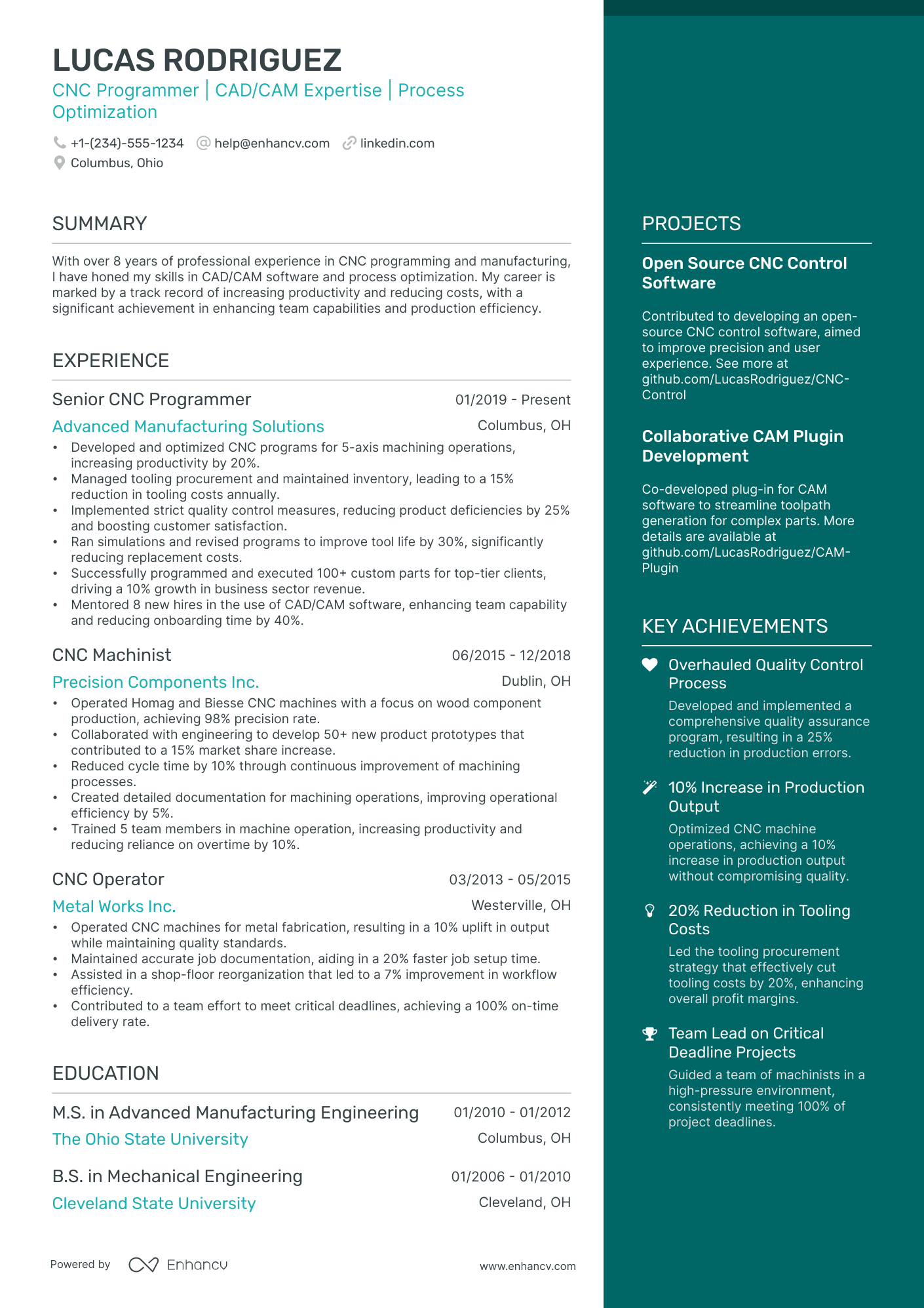
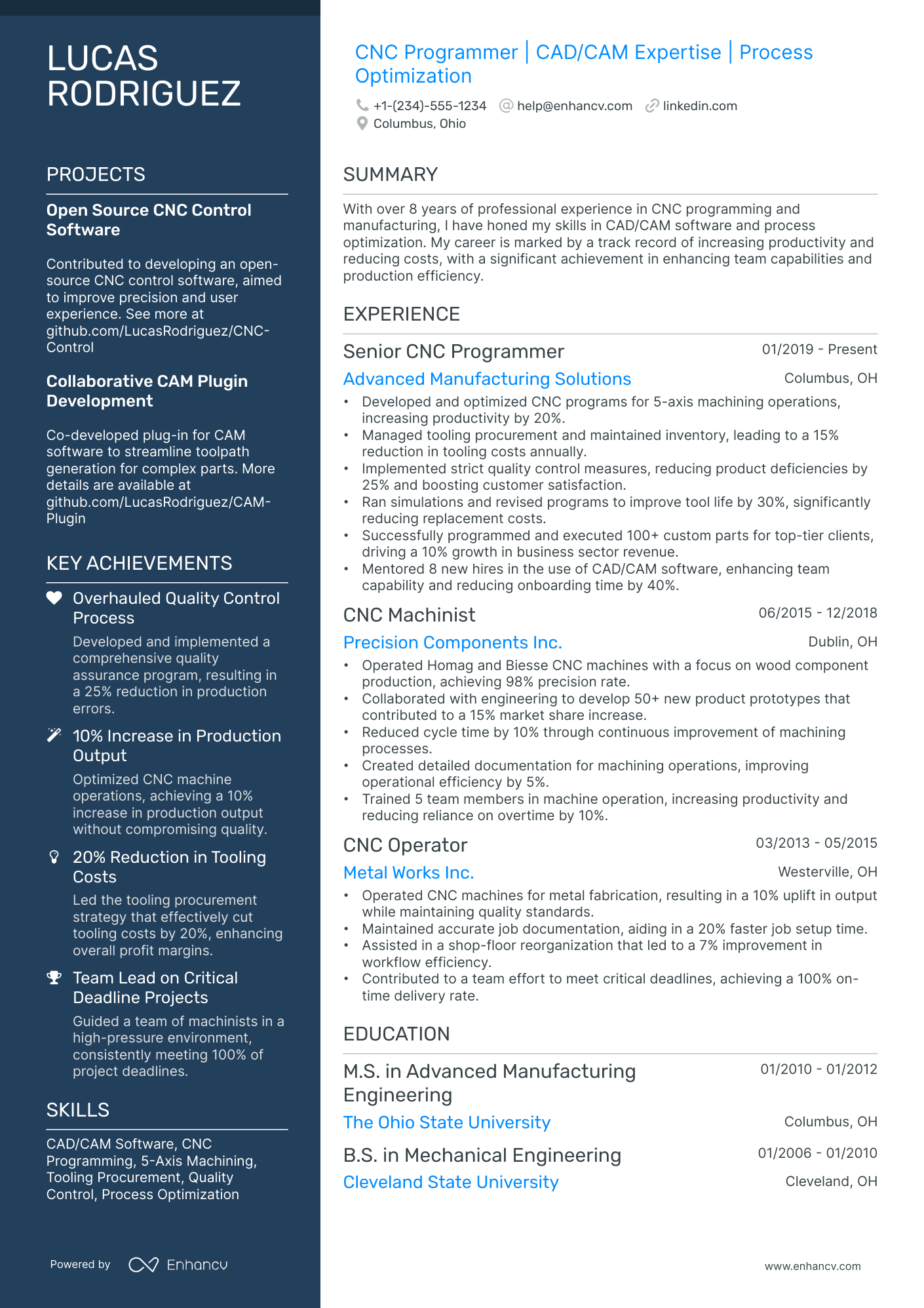
- Projects
- Education
- Certifications
- Optional sections: Awards, Leadership, Languages
Strong experience bullets should emphasize measurable outcomes, programming scope, machining results, and improvements to cycle time, scrap, and throughput.
Is your resume good enough?
Drop your resume here or choose a file. PDF & DOCX only. Max 2MB file size.
Once you’ve organized your resume with the right core components, the next step is to write your CNC programmer resume experience so each section supports your qualifications with clear, job-relevant detail.
How to write your CNC programmer resume experience
The experience section is where you prove you've delivered real results—not just operated machines. Hiring managers prioritize demonstrated impact through role-relevant programming tools, machining methods, and measurable outcomes over generic task descriptions.
Each entry should include:
- Job title
- Company and location (or remote)
- Dates of employment (month and year)
Three to five concise bullet points showing what you owned, how you executed, and what outcomes you delivered:
- Ownership scope: the specific machines, production lines, part families, or programming workflows you were directly accountable for as a CNC programmer.
- Execution approach: the CAD/CAM software, G-code and M-code languages, simulation tools, or machining strategies you applied to develop, test, and optimize programs.
- Value improved: the gains you drove in cycle time, dimensional accuracy, surface finish quality, scrap reduction, machine uptime, or operational safety within your CNC environment.
- Collaboration context: how you coordinated with machinists, manufacturing engineers, quality inspectors, tooling suppliers, or maintenance teams to resolve programming challenges and refine production processes.
- Impact delivered: the tangible results your programming decisions produced—expressed through production throughput, cost savings, reject rate changes, or successful launch of new part programs at scale.
Experience bullet formula
A CNC programmer experience example
✅ Right example - modern, quantified, specific.
CNC Programmer
Apex Precision Machining | Dayton, OH
2021–Present
ISO 9001-certified job shop producing tight-tolerance aerospace and medical components in low-to-mid volume runs.
- Programmed three-axis and five-axis toolpaths in Mastercam and Fusion 360, cutting average cycle time 18% across twenty-five recurring parts while holding ±0.0005-inch tolerances.
- Optimized setups and tooling using G-code edits, probing macros, and tool life management in a Haas and Mazak environment, reducing scrap 32% and saving $84K annually in material and rework.
- Standardized post processors, tool libraries, and revision control in an ERP (enterprise resource planning) and document control workflow, improving first-pass yield from 91% to 97% and eliminating eight recurring nonconformances.
- Collaborated with design engineers and quality to implement GD&T-driven inspection plans and in-process probing on CMM (coordinate measuring machine)-validated features, cutting inspection time 22% and shortening lead time by two days per order.
- Led DFM reviews with customers and production leads, redesigning fixtures and workholding to enable lights-out machining on two families of parts, increasing spindle utilization 15% and adding $210K in annual capacity.
Now that you've seen how a strong experience section comes together, let's look at how to adapt yours to match the specific job you're targeting.
How to tailor your CNC programmer resume experience
Recruiters evaluate your CNC programmer resume through both applicant tracking systems and manual review. Tailoring your resume to the job description ensures your qualifications register with both.
Ways to tailor your CNC programmer experience:
- Match the exact CAM software and CNC controllers listed in the posting.
- Use the same terminology for machining processes the employer specifies.
- Mirror tolerance standards or precision metrics the job description references.
- Highlight experience with specific material types the role requires.
- Emphasize G-code and M-code proficiency when the posting calls for it.
- Include relevant industry experience such as aerospace or medical manufacturing.
- Reference quality systems like ISO or GD&T compliance when mentioned.
- Align your workflow descriptions with the production environment they describe.
Tailoring means aligning your real accomplishments with what the employer asks for, not forcing keywords where they don't belong.
Resume tailoring examples for CNC programmer
| Job description excerpt | Untailored | Tailored |
|---|---|---|
| "Program and operate Fanuc and Haas CNC machines for high-volume aerospace component production with tolerances of ±0.0005\"." | Operated CNC machines to produce parts according to specifications. | Programmed and operated Fanuc and Haas CNC mills and lathes to manufacture aerospace-grade aluminum and titanium components, maintaining tolerances of ±0.0005" across production runs of 10,000+ units per month. |
| "Develop and optimize G-code and M-code programs using Mastercam, reducing cycle times while maintaining quality standards per AS9100." | Created programs for CNC equipment and helped improve production efficiency. | Developed and optimized G-code and M-code programs in Mastercam X9, reducing average cycle times by 18% on multi-axis milling operations while maintaining full compliance with AS9100 Rev D quality standards. |
| "Perform first-article inspections using CMM equipment and collaborate with engineering to resolve dimensional non-conformances." | Inspected finished parts and communicated with other departments about quality issues. | Conducted first-article inspections using Zeiss CMM equipment, interpreting GD&T callouts on engineering drawings and collaborating directly with design engineers to resolve dimensional non-conformances—reducing scrap rates by 12% over six months. |
Once you’ve aligned your experience with the role’s requirements, the next step is to quantify your CNC programmer achievements so hiring teams can see the measurable impact of your work.
How to quantify your CNC programmer achievements
Quantifying your achievements proves you improved output, quality, and delivery. Track cycle time, scrap rate, first-pass yield, machine uptime, setup time, and cost savings from tooling, feeds, speeds, and program reuse.
Quantifying examples for CNC programmer
| Metric | Example |
|---|---|
| Cycle time | "Reduced cycle time by 18% on a 6061 aluminum housing by optimizing toolpaths in Mastercam and tuning feeds and speeds on a Haas VF-2." |
| Scrap rate | "Cut scrap from 4.2% to 1.1% by adding probing routines and tighter tool wear offsets using Renishaw macros on a Fanuc control." |
| Setup time | "Decreased setup time by 35 minutes per job by standardizing workholding and creating reusable program templates for twenty recurring part numbers." |
| On-time delivery | "Improved on-time delivery from 86% to 96% by sequencing programs to reduce changeovers and releasing proven revisions through the job traveler." |
| Tooling cost | "Saved $24,000 annually by switching to indexable end mills and extending tool life 30% through optimized stepovers and coolant strategy." |
Turn your everyday tasks into measurable, recruiter-ready resume bullets in seconds with Enhancv's Bullet Point Generator.
With your bullet points clearly showcasing measurable achievements, it's equally important to highlight the specific hard and soft skills that qualify you for a CNC programmer role.
How to list your hard and soft skills on a CNC programmer resume
Your skills section shows you can program, prove out, and optimize CNC work safely and repeatably, and recruiters and an ATS (applicant tracking system) scan this section for job-match keywords—aim for a hard-skill-heavy mix with targeted soft skills. CNC programmer roles require a blend of:
- Product strategy and discovery skills
- Data, analytics, and experimentation skills
- Delivery, execution, and go-to-market discipline
- Soft skills
Your skills section should be:
- Scannable (bullet-style grouping).
- Relevant to the job post.
- Backed by proof in experience bullets.
- Updated with current tools.
Place your skills section:
- Above experience if you're junior or switching careers.
- Below experience if you're mid/senior with strong achievements.

Hard skills
- G-code, M-code programming
- CAM programming: Mastercam, Fusion 360
- CNC controls: Fanuc, Haas
- Multi-axis machining (three-, four-, five-axis)
- Toolpath optimization, cycle-time reduction
- GD&T interpretation, blueprint reading
- Workholding and fixturing design
- Cutting tool selection, speeds and feeds
- Post-processor setup and troubleshooting
- Probing and tool setting (Renishaw)
- First article inspection, CMM basics
- DFM for machinability
Soft skills
- Clarify requirements with engineering
- Translate prints into operations
- Catch tolerance and stack-up risks
- Document setups for repeatability
- Communicate tool and fixture needs
- Coordinate with machinists on prove-outs
- Prioritize jobs under schedule pressure
- Troubleshoot issues at the machine
- Escalate quality concerns early
- Manage revision control and changes
- Balance speed with safety and quality
- Own continuous improvement actions
How to show your CNC programmer skills in context
Skills shouldn't live only in a bulleted list on your resume.
They should be demonstrated in:
- Your summary (high-level professional identity)
- Your experience (proof through outcomes)
Here's what that looks like in practice. You can also explore resume skills examples to see how other professionals present their abilities effectively.
Summary example
Senior CNC programmer with 12 years in aerospace manufacturing. Skilled in Mastercam, G-code optimization, and multi-axis machining. Reduced cycle times by 18% across 30+ part families through toolpath refinement and cross-functional process collaboration.
- Reflects senior-level expertise immediately
- Names industry-relevant tools and software
- Leads with a measurable productivity gain
- Signals collaboration and process thinking
Experience example
Senior CNC Programmer
Vantage Precision Manufacturing | Grand Rapids, MI
June 2018–March 2024
- Programmed 5-axis Mastercam toolpaths for titanium components, reducing scrap rates by 22% over two years.
- Collaborated with quality engineers to refine in-process inspection routines, improving first-pass yield to 96%.
- Standardized G-code templates across 15 machine centers, cutting average setup time by 30 minutes per job.
- Every bullet includes a measurable outcome.
- Skills surface naturally through real achievements.
Once you’ve demonstrated your CNC programming abilities through relevant projects and outcomes, the next step is translating that evidence into a CNC programmer resume when you don’t have formal work experience.
How do I write a CNC programmer resume with no experience
Even without full-time experience, you can demonstrate readiness through building a resume without work experience that focuses on:
- CNC coursework with lab machining
- CAM toolpath projects and simulations
- Personal G-code programming practice
- Shop internship or job shadowing
- CNC setup assistant volunteer hours
- Machining club or makerspace builds
- Blueprint reading and GD&T exercises
- Tooling selection and feeds research
Focus on:
- CAM software projects with outputs
- G-code safety and validation steps
- Blueprint reading and tolerances
- Measured parts meeting specifications
Resume format tip for entry-level CNC programmer
Use a combination resume format because it highlights CNC programmer skills and projects first, while still showing education and work history. Do:
- Put a "Projects" section near the top.
- List CAM software, controllers, and metrology tools.
- Quantify results with tolerances, cycle time, and scrap rate.
- Describe your process: setup sheets, offsets, and prove-outs.
- Add links to toolpaths, code, or drawings.
- Programmed and simulated three-axis milling toolpaths in Fusion 360, then posted Fanuc-compatible G-code that held ±0.002 in tolerance on five test parts.
Even without hands-on experience, your education section can demonstrate the technical foundation and relevant training that qualify you for a CNC programmer role.
How to list your education on a CNC programmer resume
Your education section helps hiring teams confirm you have the technical foundation for CNC programming. It validates your knowledge of machining principles, mathematics, and manufacturing processes.
Include:
- Degree name
- Institution
- Location
- Graduation year
- Relevant coursework (for juniors or entry-level candidates)
- Honors & GPA (if 3.5 or higher)
Skip month and day details—list the graduation year only.
Here's a strong education entry tailored to a CNC programmer resume:
Example education entry
Associate of Applied Science in CNC Machining Technology
Lake Michigan College, Benton Harbor, MI
Graduated 2021
GPA: 3.7/4.0
- Relevant coursework: Blueprint Reading, CAD/CAM Applications, Geometric Dimensioning & Tolerancing, CNC Mill and Lathe Operations
- Honors: Dean's List, four consecutive semesters
How to list your certifications on a CNC programmer resume
Certifications on a resume show a CNC programmer's commitment to learning, proficiency with key tools, and alignment with current industry standards and processes.
Include:
- Certificate name
- Issuing organization
- Year
- Optional: credential ID or URL
- Place certifications below education when they are older, less relevant to the CNC programmer role, or your degree is your strongest qualification.
- Place certifications above education when they are recent, role-critical for a CNC programmer, or required by the job posting.
Best certifications for your CNC programmer resume
- National Institute for Metalworking Skills (NIMS) CNC Milling: Programming, Setup, and Operations
- National Institute for Metalworking Skills (NIMS) CNC Turning: Programming, Setup, and Operations
- Mastercam Certified Professional
- SOLIDWORKS Certified Associate (CSWA)
- Autodesk Certified Professional: Fusion 360
- Certified Manufacturing Technologist (CMfgT)
Once you’ve included your credentials in a way that supports your CNC programming qualifications, you can use that foundation to write your CNC programmer resume summary that highlights your value upfront.
How to write your CNC programmer resume summary
Your resume summary is the first thing a recruiter reads, so it needs to prove your value fast. A strong opening tied to CNC programming signals you're worth a closer look.
Keep it to three to four lines, with:
- Your title and total years of CNC programming experience.
- The industry or production environment you know best.
- Core tools like G-code, M-code, Mastercam, or Fanuc controls.
- One or two measurable wins, such as reduced cycle times or scrap rates.
- Practical soft skills shown through real results, like cross-team coordination or training new operators.

PRO TIP
At this level, lead with specific technical skills and tangible contributions rather than vague ambition. Highlight the machines, software, and materials you've worked with. Avoid phrases like "passionate self-starter" or "eager to grow." Recruiters want proof you can program parts accurately and keep production moving.
Example summary for a CNC programmer
CNC programmer with three years of experience writing G-code and Mastercam programs for aerospace milling operations. Reduced average cycle time by 14% while maintaining zero-defect output across 12,000 parts annually.
Optimize your resume summary and objective for ATS
Drop your resume here or choose a file.
PDF & DOCX only. Max 2MB file size.
Now that your summary captures your CNC programming expertise at a glance, make sure your header provides the essential contact details recruiters need to reach you.
What to include in a CNC programmer resume header
Your resume header is the top section with your key contact details, and it boosts visibility, credibility, and recruiter screening for a CNC programmer.
Essential resume header elements
- Full name
- Tailored job title and headline
- Location
- Phone number
- Professional email
- GitHub link
- Portfolio link
A LinkedIn link helps recruiters verify experience quickly and supports screening.
Do not include a photo on a CNC programmer resume unless the role is explicitly front-facing or appearance-dependent.
Use a job title that matches the posting and add one skills-focused headline that aligns with the shop's machines and materials.
Example
CNC programmer resume header
Jordan Miller
CNC programmer — 5-axis milling, Mastercam, and GD&T
Phoenix, AZ
(602) 555-01XX
your.name@enhancv.com
github.com/yourname
yourwebsite.com
linkedin.com/in/yourname
Once your contact details and role identifiers are clear and accurate, add targeted additional sections to strengthen your CNC programmer resume and support the information at the top.
Additional sections for CNC programmer resumes
When your core qualifications match other applicants, well-chosen additional sections can set your CNC programmer resume apart with relevant credibility. For example, listing language skills can be valuable if you work in multilingual manufacturing environments.
- Languages
- Certifications and licenses
- Professional affiliations
- Technical projects
- Hobbies and interests
- Publications
- Continuing education
Once you've strengthened your resume with relevant additional sections, the next step is pairing it with a cover letter to give hiring managers a fuller picture of your qualifications.
Do CNC programmer resumes need a cover letter
A cover letter isn't required for a CNC programmer, but it helps in competitive roles or shops that expect one. If you're unsure where to start, understanding what a cover letter is and how it complements your resume can help you decide. It can make a difference when your resume doesn't fully show fit, context, or a clear match to the team.
Use a cover letter when it adds specific context:
- Explain role and team fit: match your programming approach to their machines, materials, tolerances, shift needs, and quality process.
- Highlight one or two outcomes: cite a cycle time reduction, scrap decrease, setup time improvement, or first-pass yield gain tied to your programming work.
- Show product and business understanding: connect your programming choices to end-use requirements, inspection needs, delivery targets, and cost constraints.
- Address transitions or non-obvious experience: link related work to CNC programmer tasks, and explain gaps, industry changes, or a move from operator to programmer.
Drop your resume here or choose a file.
PDF & DOCX only. Max 2MB file size.
Once you’ve decided whether an extra document adds value to your CNC programmer application, you can use AI to improve your CNC programmer resume to strengthen what hiring teams see first.
Using AI to improve your CNC programmer resume
AI can sharpen your resume's clarity, structure, and impact. It helps tighten language and highlight relevant skills. But overuse makes resumes sound robotic. Once your content is clear and role-aligned, step away from AI. If you're exploring tools, check out which AI is best for writing resumes to find the right fit for your needs.
Here are 10 practical prompts to strengthen specific sections of your CNC programmer resume:
Strengthen your summary
Quantify experience bullets
Tighten skills formatting
Align with job postings
Improve action verbs
Clarify project descriptions
Refine certifications section
Remove filler language
Highlight education relevance
Tailor for ATS (applicant tracking systems)
Conclusion
A strong CNC programmer resume proves impact with numbers, shows role-specific skills, and stays easy to scan. Use measurable outcomes like cycle time reduction, scrap rate improvement, and on-time delivery. Highlight programming, setup support, inspection methods, and safe, consistent documentation.
Keep the structure clean with a clear summary, focused skills, and results-led experience. This format shows you can meet today’s production demands and adapt to new machines and tighter tolerances. It helps hiring teams see readiness fast.