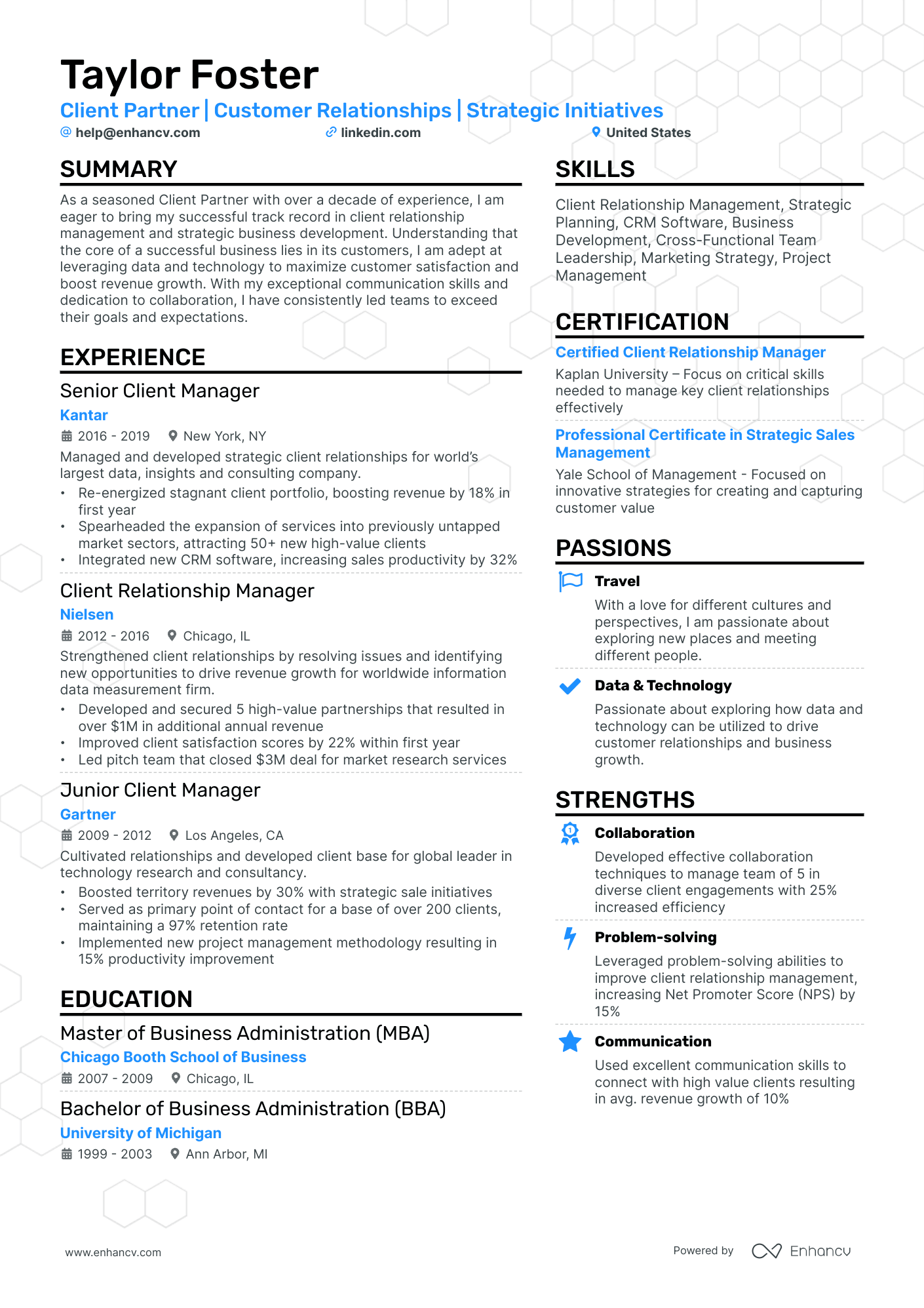
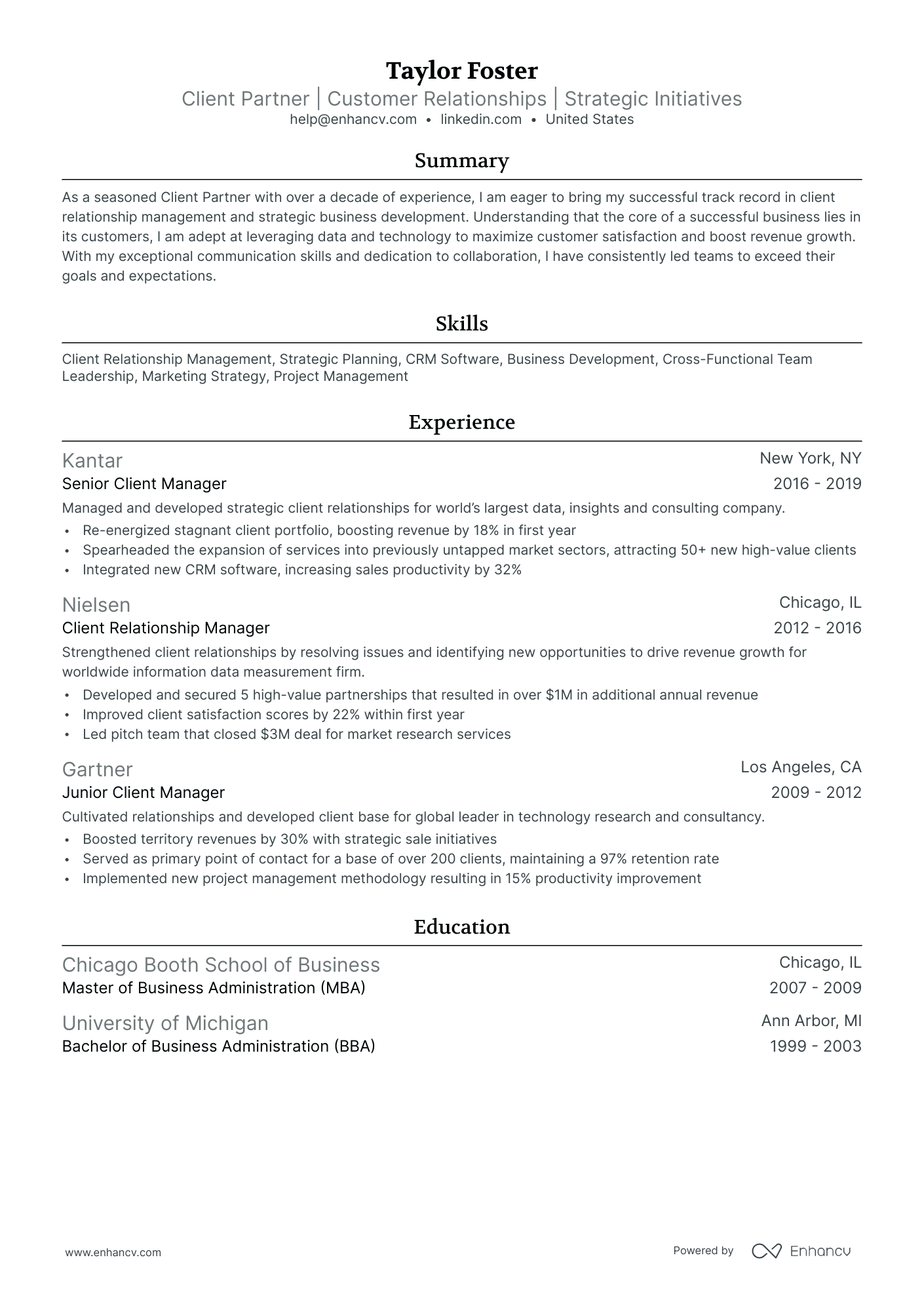
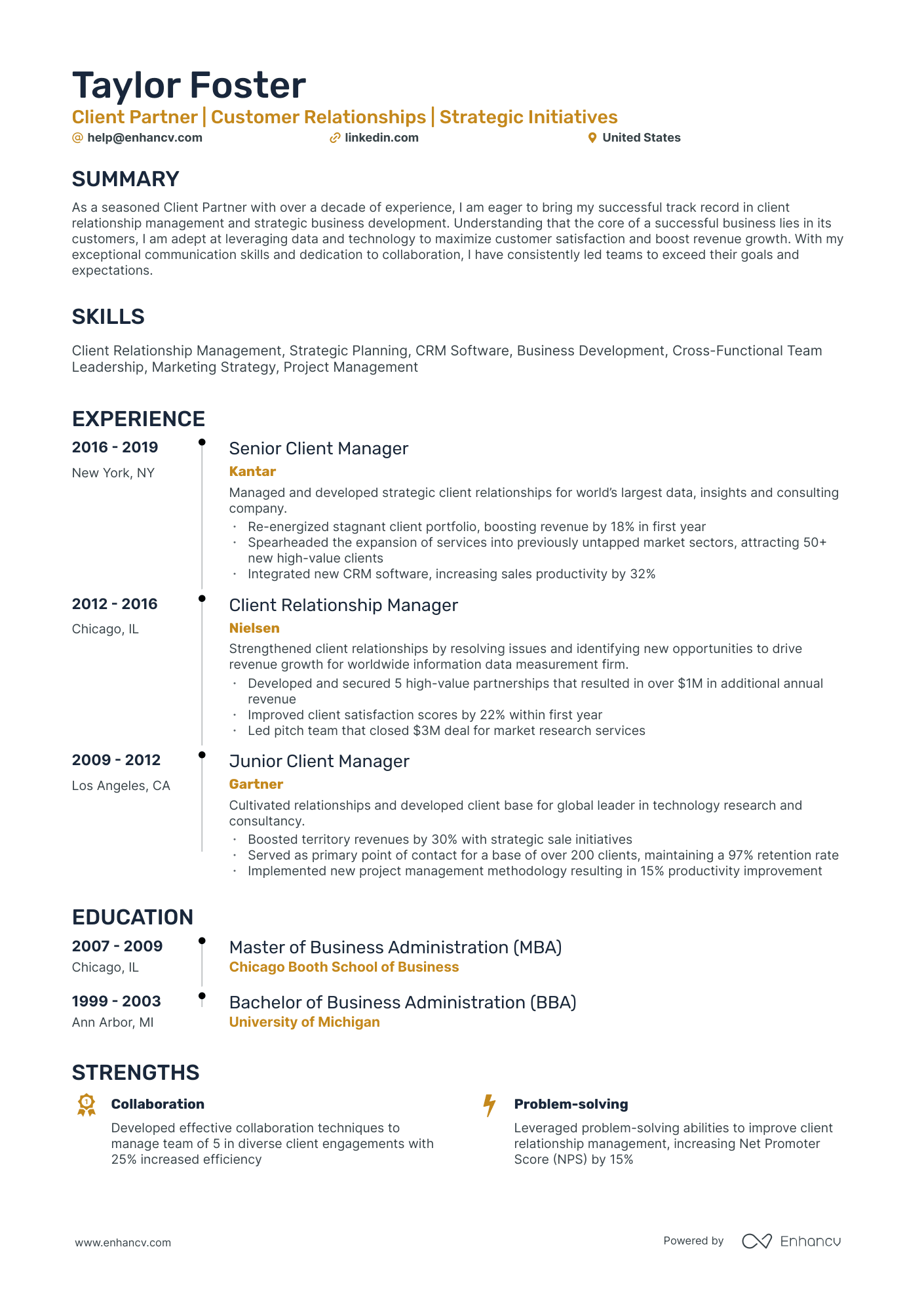
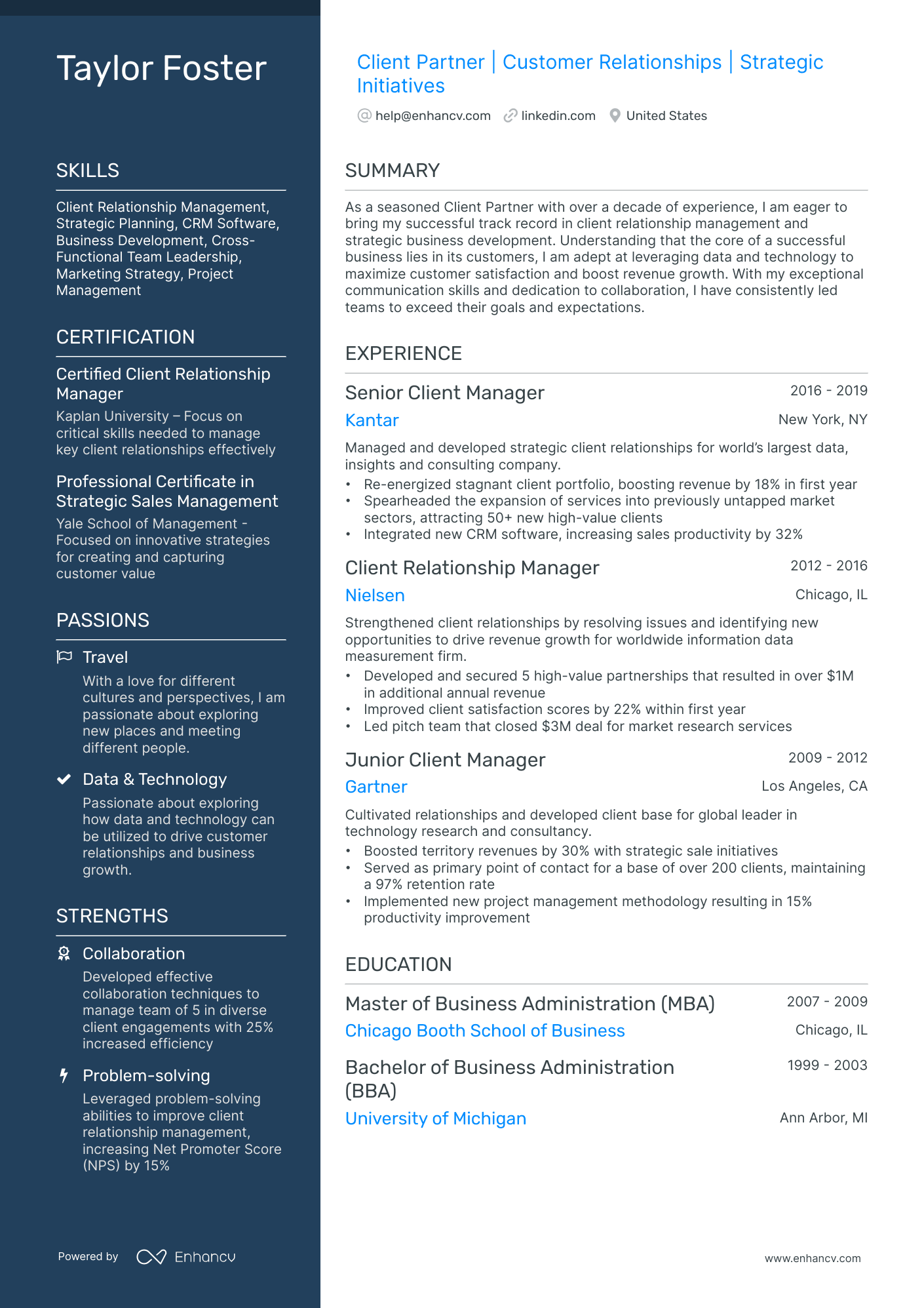
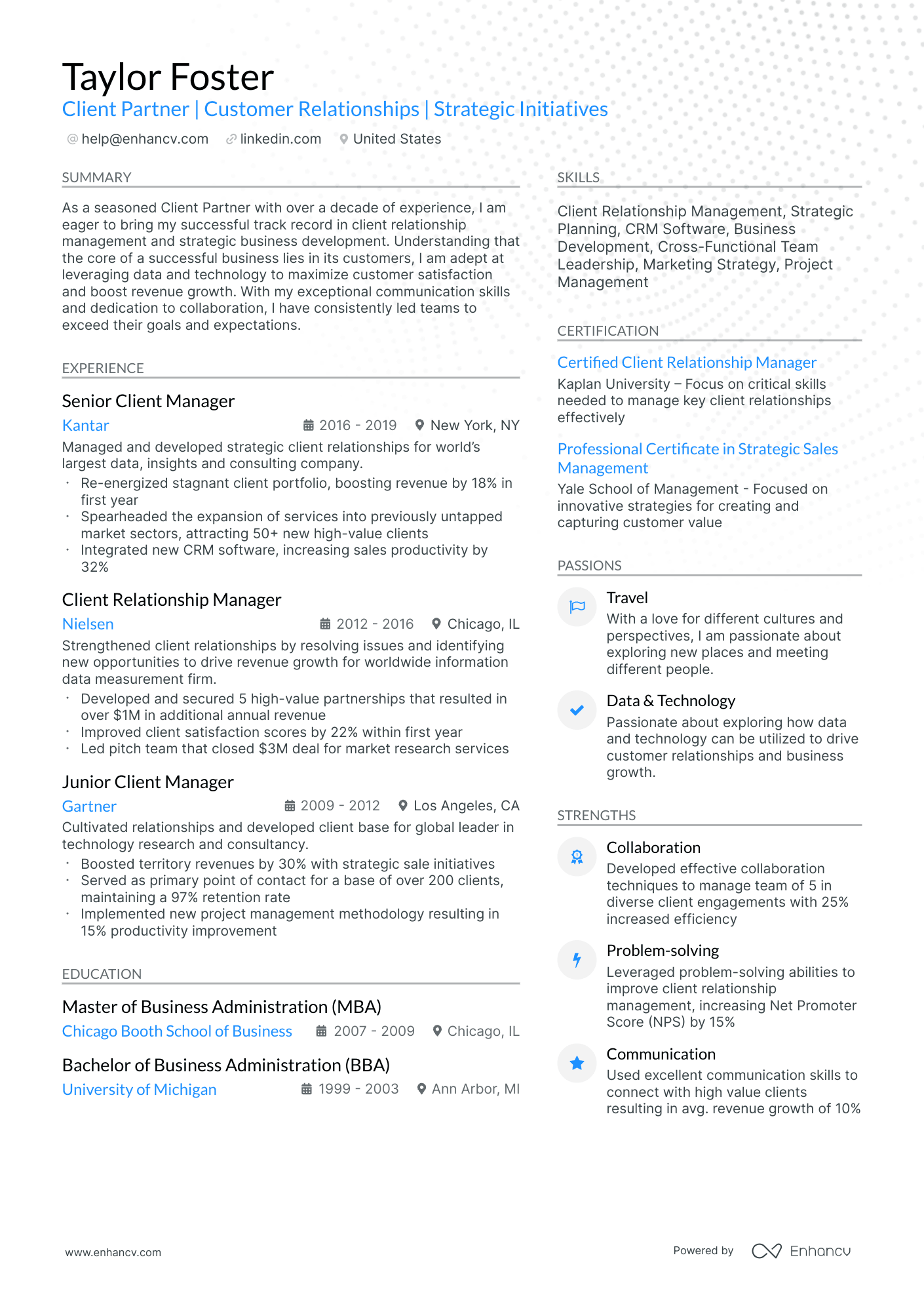
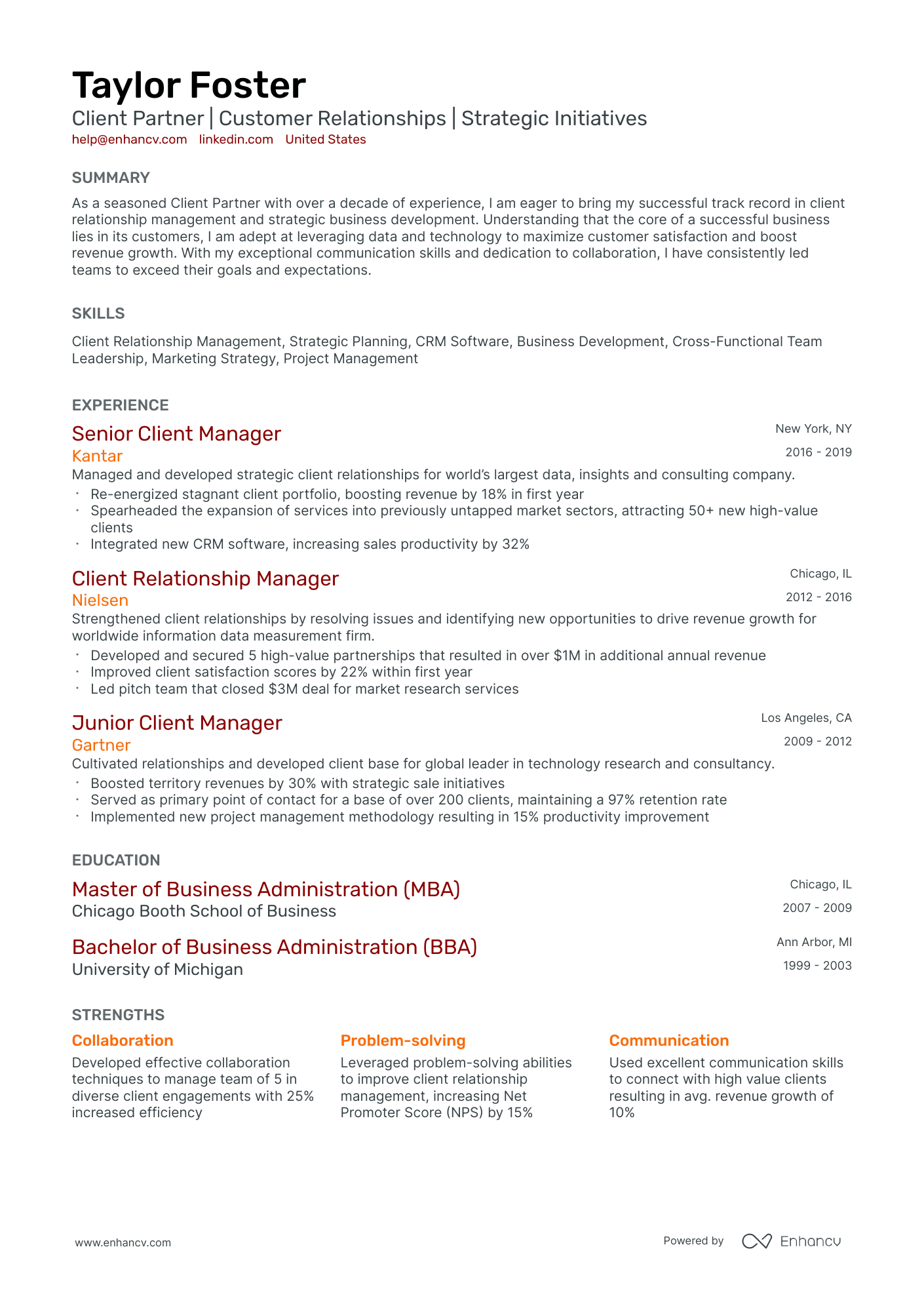
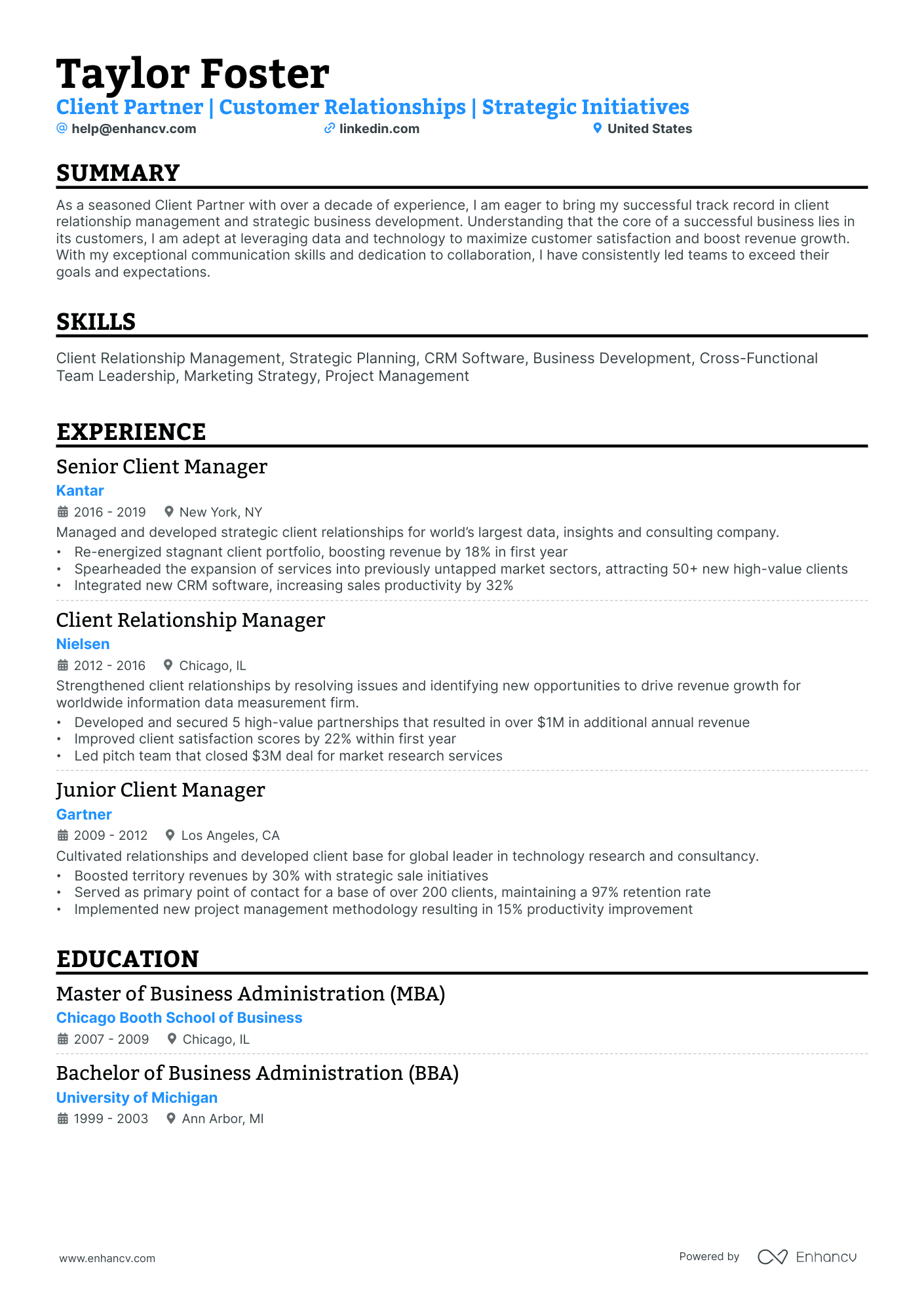
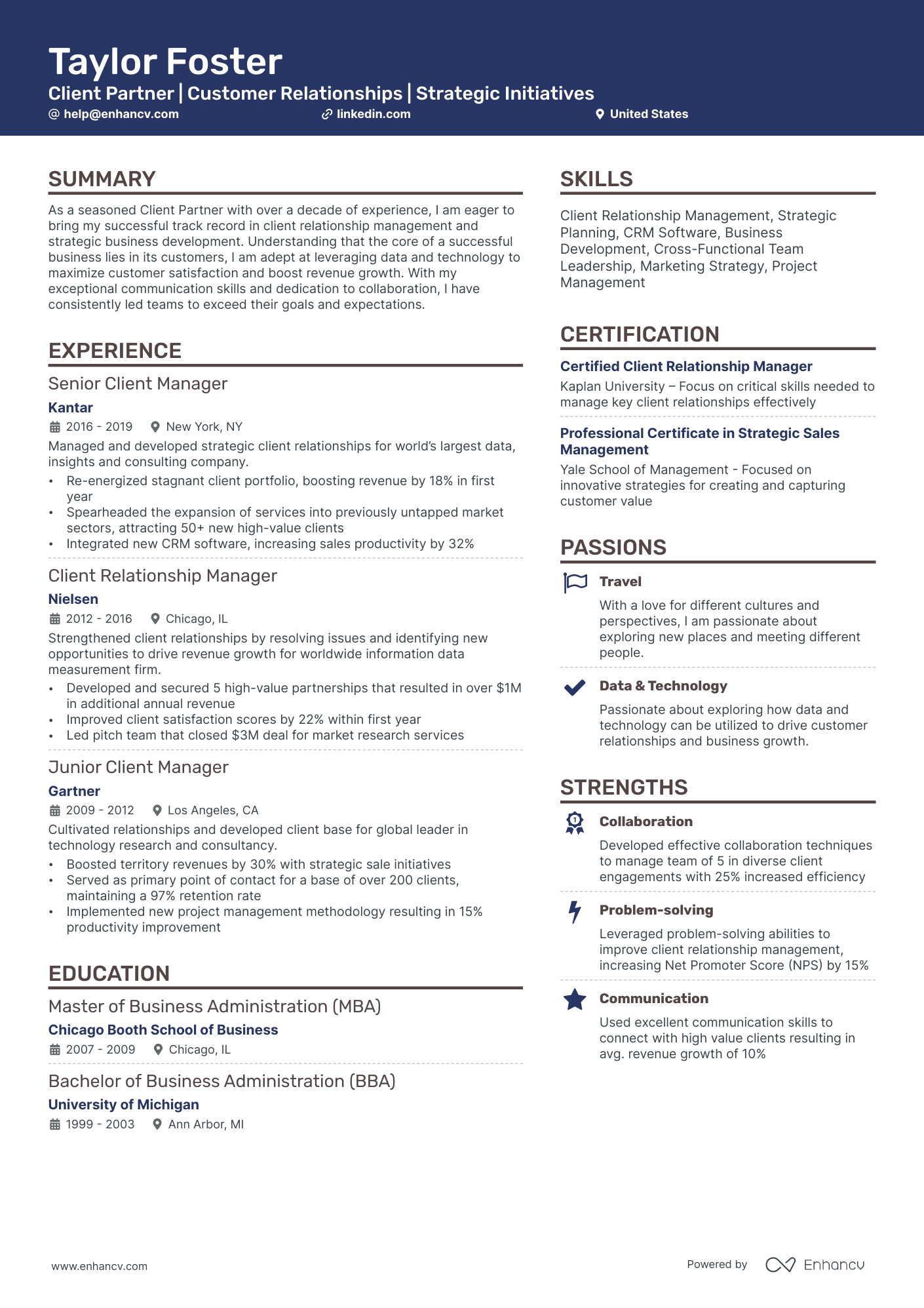
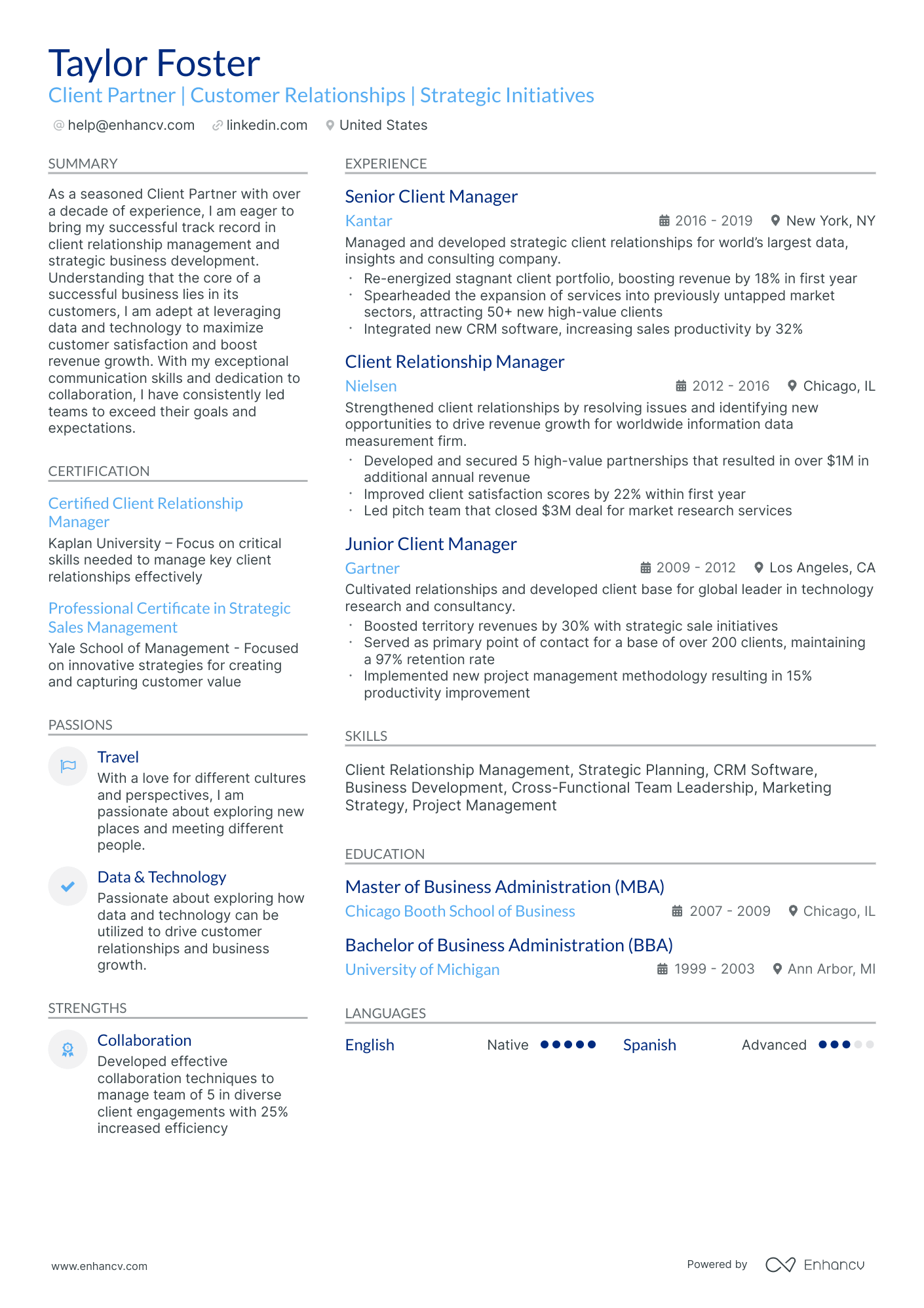
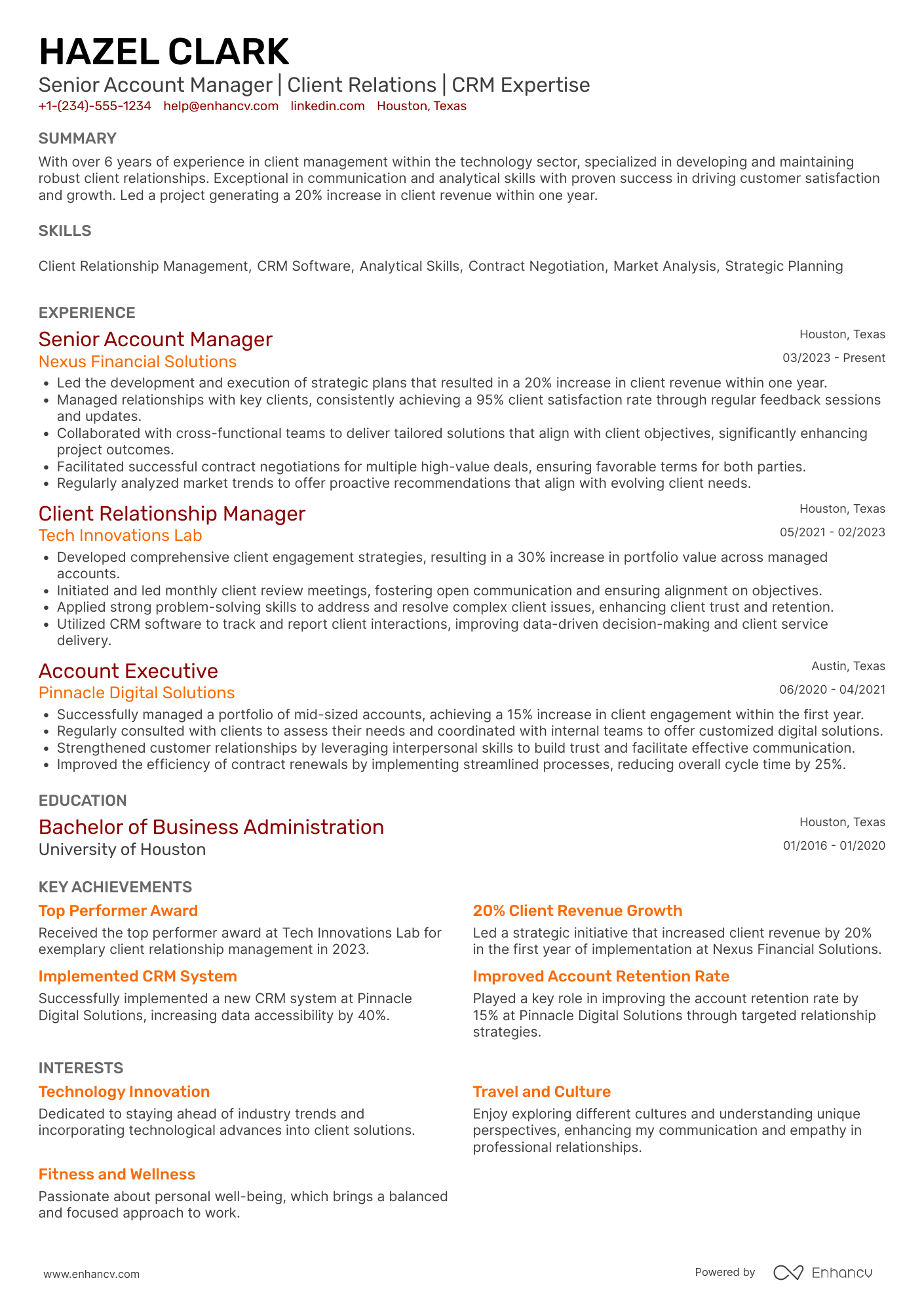
Many client partner resumes fail because they read like account summaries, not business cases. This client partner resume guide fixes that. In today's hiring process, ATS screening and rapid recruiter scans punish vague scope, unclear ownership, and missing revenue impact.
A strong resume shows what changed because of you. Lead with outcomes like revenue retained or expanded, portfolio size, renewal rate lift, churn reduction, and executive stakeholder alignment. Quantify delivery impact, escalations resolved, adoption gains, and customer health improvements across regions or segments. If you're unsure where to begin, learning how to write a resume that centers on measurable impact is the essential first step.

Key takeaways
- Anchor every experience bullet to measurable outcomes like revenue retained, accounts expanded, or churn reduced.
- Use reverse-chronological format for senior roles and hybrid format for career changers.
- Mirror the exact CRM tools, KPIs, and terminology from each job posting you target.
- Demonstrate skills through quantified results in your experience section, not just a standalone list.
- Write a three- to four-line summary that leads with portfolio size, revenue impact, and ownership scope.
- Use AI prompts to tighten language and add metrics, but stop before it invents experience.
- Build your resume faster with Enhancv, then tailor each version to the specific client partner role.
Job market snapshot for client partners
We analyzed 316 recent client partner job ads across major US job boards. These numbers help you understand career growth patterns, experience requirements, skills in demand at a glance.
What level of experience employers are looking for client partners
| Years of Experience | Percentage found in job ads |
|---|---|
| 1–2 years | 1.6% (5) |
| 3–4 years | 9.8% (31) |
| 5–6 years | 7.9% (25) |
| 7–8 years | 4.1% (13) |
| 9–10 years | 5.7% (18) |
| 10+ years | 36.4% (115) |
| Not specified | 40.2% (127) |
Client partner ads by area of specialization (industry)
| Industry (Area) | Percentage found in job ads |
|---|---|
| Finance & Banking | 49.4% (156) |
| Healthcare | 19.0% (60) |
| Telecommunications | 12.0% (38) |
| Professional Services | 7.0% (22) |
| Education | 4.7% (15) |
| Retail & E-commerce | 3.5% (11) |
Top companies hiring client partners
| Company | Percentage found in job ads |
|---|---|
| Infosys LTD | 19.3% (61) |
| T-Mobile | 8.5% (27) |
| Ibotta, Inc. | 5.7% (18) |
| TATA Consulting Services | 4.7% (15) |
| DEPT | 4.1% (13) |
| Capgemini Holding Inc | 3.5% (11) |
| Snapchat | 3.5% (11) |
| Apex Systems | 3.2% (10) |
| Verizon Communications | 3.2% (10) |
Role overview stats
These tables show the most common responsibilities and employment types for client partner roles. Use them to align your resume with what employers expect and to understand how the role is structured across the market.
Day-to-day activities and top responsibilities for a client partner
| Responsibility | Percentage found in job ads |
|---|---|
| Account management | 15.5% (49) |
| Business development | 14.6% (46) |
| Ai | 12.7% (40) |
| Crm | 11.7% (37) |
| Project management | 9.8% (31) |
| Sales | 9.5% (30) |
| Negotiation | 8.2% (26) |
| Presentation skills | 6.6% (21) |
| Enterprise sales | 6.3% (20) |
| Client relationship management | 6.0% (19) |
| G suite | 5.7% (18) |
| Looker | 5.7% (18) |
Type of employment (remote vs on-site vs hybrid)
| Employment type | Percentage found in job ads |
|---|---|
| On-site | 58.2% (184) |
| Hybrid | 26.3% (83) |
| Remote | 15.5% (49) |
How to format a client partner resume
Recruiters evaluating client partner resumes prioritize evidence of revenue ownership, strategic account growth, and cross-functional leadership across complex client portfolios. A well-chosen resume format ensures these signals surface immediately, both for human reviewers scanning in seconds and for applicant tracking systems parsing your experience.

I have significant experience in this role—which format should I use?
Use a reverse-chronological format—it's the strongest choice for experienced client partners. Do:
- Lead each role entry with scope indicators: portfolio size, number of accounts managed, team oversight, and P&L responsibility.
- Highlight domain expertise in client strategy, contract negotiation, CRM platforms (Salesforce, HubSpot), and cross-sell/upsell methodologies relevant to your industry vertical.
- Anchor every bullet to measurable business impact—revenue growth, retention rates, expansion revenue, or client satisfaction scores.
I'm junior or switching into this role—what format works best?
A hybrid format works best, letting you lead with transferable skills while still showing a clear work history. Do:
- Place a skills section near the top featuring client relationship management, stakeholder communication, account planning, and relevant CRM or analytics tools.
- Include project-based experience, consulting engagements, or cross-functional initiatives that demonstrate client-facing ownership, even if your previous title wasn't "client partner."
- Connect every skill claim to a specific action and a concrete result so recruiters can assess your readiness.
Why hybrid and functional resumes don't work for senior roles
Hybrid formats fragment your career progression, making it harder for reviewers to trace how your leadership scope, account ownership, and strategic influence expanded over time. Functional formats are worse—they strip away the accountability context that senior client partner roles demand, burying critical details like portfolio growth trajectories and executive-level relationship management. Avoid both formats entirely if you have five or more years of progressive client partner or strategic account leadership experience.
- Edge-case exception: A functional format may be acceptable only if you're transitioning into client partnership from a deeply adjacent discipline (e.g., management consulting or enterprise sales leadership) with a significant employment gap—but even then, every listed skill must be tied to a specific project, client outcome, or revenue figure rather than presented as a standalone claim.
Once you've established a clean, readable format, the next step is deciding which sections to include so each one earns its place on the page.
What sections should go on a client partner resume
Recruiters expect a client partner resume to clearly show how you grow and retain accounts, expand revenue, and lead client relationships. Understanding what to put on a resume for this role helps you prioritize the sections that matter most.
Use this structure for maximum clarity:
- Header
- Summary
- Experience
- Skills
- Projects
- Education
- Certifications
- Optional sections: Awards, Leadership, Languages
Your experience bullets should emphasize measurable revenue impact, renewal and expansion outcomes, deal size and scope, and the business results you delivered for clients.
Is your resume good enough?
Drop your resume here or choose a file. PDF & DOCX only. Max 2MB file size.
Once you’ve organized your resume with the right structure and supporting sections, the next step is writing your client partner experience in a way that fits that framework and highlights your impact.
How to write your client partner resume experience
The work experience section is where you prove you can drive revenue, retain key accounts, and deliver measurable business outcomes for both your clients and your employer. Hiring managers prioritize demonstrated impact—closed deals, expanded partnerships, and strategic account growth—over descriptive task lists that simply catalog daily activities.
Each entry should include:
- Job title
- Company and location (or remote)
- Dates of employment (month and year)
Three to five concise bullet points showing what you owned, how you executed, and what outcomes you delivered:
- Ownership scope: the client portfolios, strategic accounts, revenue targets, or partnership programs you were directly accountable for as a client partner.
- Execution approach: the relationship management frameworks, CRM platforms, consultative selling methodologies, or negotiation strategies you used to identify opportunities and close business.
- Value improved: changes to client retention, account growth, renewal rates, satisfaction scores, or time-to-close that resulted from your direct involvement.
- Collaboration context: how you coordinated with internal teams—sales, product, marketing, delivery, and executive leadership—alongside external client stakeholders to align solutions with business needs.
- Impact delivered: outcomes expressed through revenue generated, accounts expanded, partnerships secured, or strategic goals achieved rather than a summary of meetings held or proposals sent.
Experience bullet formula
A client partner experience example
✅ Right example - modern, quantified, specific.
Client Partner
Nimbus Analytics | Remote
2022–Present
B2B software-as-a-service platform serving 250+ mid-market and enterprise customers across retail and financial services.
- Owned a $6.8M book of business across forty-two accounts, improving net revenue retention from 104% to 118% through quarterly business reviews, executive alignment, and expansion road maps tracked in Salesforce.
- Led cross-functional account plans with product managers, solutions engineers, and customer success managers, cutting average time-to-value from eight weeks to five weeks by standardizing onboarding in Gainsight and documenting workflows in Confluence.
- Negotiated eight renewals and six expansions using value-based proposals and procurement-ready security packets, increasing annual recurring revenue by $1.4M while holding discounting under 6%.
- Resolved escalations by running weekly risk reviews and root-cause analysis with engineering and support, reducing high-severity tickets by 31% and improving customer satisfaction score from 4.2 to 4.6 in Zendesk.
- Built an executive dashboard in Tableau connected to product usage telemetry and Net Promoter Score data, increasing feature adoption by 22% and reducing churn risk in the top ten accounts by 15%.
Now that you've seen how a strong client partner experience section looks in practice, let's break down how to tailor each element to match the specific role you're targeting.
How to tailor your client partner resume experience
Recruiters assess client partner resumes through both human review and applicant tracking systems, so tailoring your resume to the job description increases your chances of advancing. Tailoring means reshaping how you present real work to match what each employer prioritizes.
Ways to tailor your client partner experience:
- Mirror the CRM platforms and sales tools named in the posting.
- Use the exact terminology the employer applies to account management processes.
- Reflect revenue growth or retention KPIs the job description highlights.
- Include industry or vertical experience that matches the target client base.
- Emphasize strategic partnership frameworks referenced in the role requirements.
- Highlight cross-functional collaboration models the posting specifically describes.
- Align your stakeholder engagement approach with their stated relationship methodology.
- Showcase contract negotiation or renewal workflows the employer values most.
Tailoring means aligning your actual achievements with what the role requires, not forcing disconnected keywords into your experience section.
Resume tailoring examples for client partner
| Job description excerpt | Untailored | Tailored |
|---|---|---|
| "Own end-to-end relationship management for enterprise accounts, driving retention and upsell through quarterly business reviews (QBRs) and success planning in Salesforce." | Managed client relationships and helped grow accounts. | Owned end-to-end relationship management for 12 enterprise accounts totaling $18M in annual recurring revenue, conducting quarterly business reviews and maintaining success plans in Salesforce that drove 94% retention and $3.2M in upsell revenue over two years. |
| "Collaborate cross-functionally with product, engineering, and marketing teams to translate client feedback into roadmap priorities and co-develop go-to-market strategies for new verticals." | Worked with internal teams to support client needs and business goals. | Partnered with product, engineering, and marketing stakeholders to translate feedback from 15 strategic clients into three roadmap priorities, co-developing a go-to-market strategy that launched a new healthcare vertical generating $4.5M in first-year pipeline. |
| "Serve as a trusted advisor to C-suite stakeholders, leveraging data from Tableau dashboards and NPS insights to deliver strategic recommendations that accelerate client time-to-value." | Provided strategic advice to senior leaders and presented performance updates. | Served as trusted advisor to C-suite stakeholders across eight accounts, using Tableau dashboards and NPS trend analysis to deliver strategic recommendations that reduced average client time-to-value from 90 days to 58 days within the first contract year. |
Once you’ve aligned your experience with the role’s priorities, the next step is to quantify your client partner achievements so hiring managers can see the impact you delivered.
How to quantify your client partner achievements
Quantifying your achievements proves business impact beyond relationships. For client partners, focus on revenue retention, renewal growth, customer satisfaction, response speed, and risk reduction across your book of business.
Quantifying examples for client partner
| Metric | Example |
|---|---|
| Renewal revenue | "Protected $1.8M in annual recurring revenue by leading renewal strategy for 12 enterprise accounts and closing renewals 45 days before contract end dates." |
| Retention rate | "Improved logo retention from 88% to 95% across a 40-account portfolio by running quarterly business reviews and executing churn playbooks in Gainsight." |
| Customer satisfaction | "Raised customer satisfaction score from 4.1 to 4.6 within two quarters by aligning success plans, tracking action items in Salesforce, and tightening escalation follow-ups." |
| Cycle time | "Cut issue-to-resolution time from five days to two days by implementing a triage workflow with service-level agreements and weekly cross-functional standups." |
| Risk reduction | "Reduced contract compliance exceptions by 30% by standardizing statements of work, adding legal review checkpoints, and auditing deliverables before invoicing." |
Turn vague job duties into measurable, recruiter-ready resume bullets in seconds with Enhancv's Bullet Point Generator.
With strong bullet points in place, the next step is ensuring your skills section highlights the right mix of hard and soft skills for a client partner role.
How to list your hard and soft skills on a client partner resume
Your skills section matters in client partner roles because recruiters and ATS scan it to confirm you can grow accounts, manage stakeholders, and drive delivery—aim for a balanced mix of role-specific hard skills and execution-focused soft skills. client partner roles require a blend of:
- Product strategy and discovery skills.
- Data, analytics, and experimentation skills.
- Delivery, execution, and go-to-market discipline.
- Soft skills.
Your skills section should be:
- Scannable (bullet-style grouping).
- Relevant to the job post.
- Backed by proof in experience bullets.
- Updated with current tools.
Place your skills section:
- Above experience if you're junior or switching careers.
- Below experience if you're mid/senior with strong achievements.

Hard skills
- Customer relationship management: Salesforce, HubSpot
- Account planning and QBRs
- Pipeline management and forecasting
- Contracting, MSAs, SOWs
- Pricing, packaging, renewals
- Customer success platforms: Gainsight, Totango
- Product discovery and roadmapping
- KPI design and reporting
- SQL basics, Excel modeling
- A/B testing and experimentation
- Project delivery: Jira, Asana
- Stakeholder mapping and RACI
Soft skills
- Lead executive stakeholder meetings
- Translate goals into clear plans
- Negotiate scope, timelines, and tradeoffs
- Run tight cross-functional alignment
- Escalate risks early with options
- Influence without formal authority
- Ask sharp discovery questions
- Present data-driven recommendations
- Drive accountable follow-through
- Resolve conflict and unblock delivery
- Communicate status with clarity
- Own outcomes through renewal cycles
How to show your client partner skills in context
Skills shouldn't live only in a bulleted list on your resume. Explore resume skills examples to see how top candidates weave competencies throughout their documents.
They should be demonstrated in:
- Your summary (high-level professional identity)
- Your experience (proof through outcomes)
Here's what that looks like in practice.
Summary example
Client partner with 12 years in B2B SaaS, skilled in strategic account planning, Salesforce CRM, and executive stakeholder management. Grew a portfolio from $9M to $18M ARR by leading cross-functional retention and expansion initiatives.
- Signals senior-level depth immediately
- Names specific tools and methods
- Quantifies revenue growth clearly
- Highlights relationship-driven leadership
Experience example
Senior Client Partner
Crestline Digital Solutions | Remote
March 2019–Present
- Managed a $22M portfolio across 14 enterprise accounts, increasing net revenue retention to 118% through proactive strategic planning in Gainsight.
- Partnered with product and engineering teams to launch a custom onboarding workflow, reducing client time-to-value by 35%.
- Led quarterly business reviews using Tableau dashboards, strengthening executive alignment and securing three multi-year contract renewals worth $6.4M.
- Every bullet includes measurable proof.
- Skills surface naturally through outcomes.
Once you’ve tied your relationship-building and account-impact strengths to real outcomes, the next step is structuring a client partner resume with no experience so those examples still read as credible and relevant.
How do I write a client partner resume with no experience
Even without full-time experience, you can demonstrate readiness through:
- Sales internship pipeline management
- Account management class project
- Customer success volunteer support
- Campus consulting club client work
- Freelance business development outreach
- CRM certification and practice builds
- Retail upselling and retention metrics
- Event sponsorship partnership coordination
If you're starting out, this guide on building a resume without work experience shows how to position projects and transferable skills effectively.
Focus on:
- Revenue impact with clear metrics
- CRM usage and pipeline hygiene
- Client communication samples and outcomes
- Industry knowledge tied to results
Resume format tip for entry-level client partner
Use a combination resume format. It highlights measurable projects and relevant skills while keeping education and limited work history credible. Do:
- Lead with a targeted summary and role keywords.
- Add two to three projects with metrics.
- Show CRM work, stages, and next steps.
- Quantify outreach, meetings, and conversion rates.
- Tailor bullets to each job posting.
- Built a HubSpot pipeline for a campus consulting client partner project, tracked forty leads, and increased meeting bookings by twenty-five percent in four weeks.
Even without direct experience, your education section can demonstrate the foundational knowledge and relevant skills that qualify you for a client partner role.
How to list your education on a client partner resume
Your education section helps hiring teams confirm you have the foundational knowledge needed for a client partner role. It validates your academic background in business, communications, or related fields.
Include:
- Degree name
- Institution
- Location
- Graduation year
- Relevant coursework (for juniors or entry-level candidates)
- Honors & GPA (if 3.5 or higher)
Skip month and day details—list the graduation year only.
Here's a strong education entry tailored for a client partner resume.
Example education entry
Bachelor of Science in Business Administration
Georgetown University, Washington, D.C.
Graduated 2018
GPA: 3.7/4.0
- Relevant Coursework: Strategic Account Management, Negotiation & Conflict Resolution, Consumer Behavior, Business Analytics
- Honors: Dean's List (six semesters), Beta Gamma Sigma Honor Society
How to list your certifications on a client partner resume
Certifications on your resume show a client partner's commitment to learning, proficiency with key tools, and relevance to your industry, which helps hiring teams trust your expertise faster. Include:
- Certificate name
- Issuing organization
- Year
- Optional: credential ID or URL
- List certifications below education when they're older, less relevant, or you already have strong, recent client partner experience.
- List certifications above education when they're recent, highly relevant, or they support a pivot into a new client partner industry.
Best certifications for your client partner resume
- Certified Customer Success Manager (CCSM)
- ITIL 4 Foundation
- Salesforce Certified Administrator
- HubSpot Service Hub Software Certification
- Pragmatic Institute Certified (PMC)
- Project Management Professional (PMP)
- Certified ScrumMaster (CSM)
Once you’ve positioned your credentials where hiring managers can quickly verify them, focus next on writing your client partner resume summary to connect those qualifications to the role’s value.
How to write your client partner resume summary
Your resume summary is the first thing a recruiter reads, and it sets the tone for everything that follows. A strong client partner summary signals strategic value and positions you as a revenue driver from the start.
Keep it to three to four lines, with:
- Your title and total years of experience in client partnerships or account management.
- The industries or domains you've worked in, such as SaaS, advertising, or professional services.
- Core skills like strategic planning, contract negotiation, or CRM platforms such as Salesforce.
- One or two quantified achievements, such as revenue growth percentages or retention rates.
- Soft skills tied to real outcomes, like cross-functional collaboration that shortened sales cycles.

PRO TIP
At this level, lead with outcomes and ownership. Highlight portfolio size, revenue impact, and executive-level relationship management. Avoid generic phrases like "results-driven professional" or "passionate team player." Instead, show scope—how many accounts you managed, what dollar figures you influenced, and which strategic decisions you owned.
Example summary for a client partner
Client partner with 10+ years managing enterprise accounts across SaaS and digital media. Grew a $30M portfolio by 22% year-over-year through strategic upselling and C-suite relationship development.
Optimize your resume summary and objective for ATS
Drop your resume here or choose a file.
PDF & DOCX only. Max 2MB file size.
Now that your summary communicates your value as a client partner, make sure your header presents accurate, professional contact details so recruiters can easily reach you.
What to include in a client partner resume header
A resume header is the top section with your key identifiers, and it boosts visibility, credibility, and fast recruiter screening for a client partner.
Essential resume header elements
- Full name
- Tailored job title and headline
- Location
- Phone number
- Professional email
- GitHub link
- Portfolio link
A LinkedIn link helps recruiters verify your experience quickly and supports screening.
Don't include a photo on a client partner resume unless the role is explicitly front-facing or appearance-dependent.
Keep the header on one or two lines, match your job title to the posting, and use links that open to complete, updated profiles.
Example
Client partner resume header
Jordan Taylor
Client Partner | Account Growth and Client Retention
Austin, TX
(512) 555-01XX
jordan.taylor@enhancv.com
github.com/jordantaylor yourwebsite.com linkedin.com/in/jordantaylor
Once your header clearly identifies your role, value, and contact details, you can strengthen the rest of the document by adding targeted additional sections that support those essentials.
Additional sections for client partner resumes
Beyond core experience and skills, additional sections can set you apart by showcasing unique qualifications that strengthen your credibility as a client partner. For example, listing language skills can signal your ability to manage international accounts and communicate with global stakeholders.
- Languages
- Industry certifications
- Awards and recognition
- Professional affiliations and memberships
- Publications and thought leadership
- Volunteer experience and board positions
- Speaking engagements
Once you've strengthened your resume with relevant additional sections, the next step is pairing it with a cover letter that adds context and personality to your application.
Do client partner resumes need a cover letter
A cover letter isn't required for a client partner, but it helps in competitive searches or when hiring managers expect one. It can make a difference when your resume needs context, or when you're targeting a specific team. If you're unsure where to start, understanding what a cover letter is and how it complements your resume will help you decide.
Use a cover letter to add clarity your resume can't:
- Explain role and team fit by tying your client partner approach to the company's client segment, sales cycle, and cross-functional partners.
- Highlight one or two outcomes with numbers, including retention, expansion, adoption, or time-to-value, and connect them to your day-to-day client partner work.
- Show you understand the product, users, and business context by naming a relevant use case, stakeholder group, and success metric.
- Address career transitions or non-obvious experience by mapping transferable skills to client partner responsibilities and explaining any timeline gaps briefly.
Drop your resume here or choose a file.
PDF & DOCX only. Max 2MB file size.
After you decide whether to include a cover letter based on the role and application requirements, you can use AI to improve your client partner resume by refining its content and alignment with the job posting.
Using AI to improve your client partner resume
AI can sharpen your resume's clarity, structure, and impact. It helps tighten language and highlight results. But overuse strips away authenticity. Once your content feels clear and aligned with the client partner role, step back. If you're exploring AI tools, this guide on which AI is best for writing resumes can help you choose the right one.
Here are 10 practical prompts to strengthen specific sections of your client partner resume:
- Sharpen your summary: "Rewrite my client partner resume summary to emphasize strategic relationship management and measurable revenue outcomes in under four sentences."
- Quantify experience bullets: "Review my client partner experience bullets and suggest specific metrics, percentages, or dollar figures to replace vague achievement language."
- Align skills section: "Compare my skills section against current client partner job postings and recommend missing keywords related to account growth and retention."
- Tighten action verbs: "Replace weak or repetitive verbs in my client partner experience section with stronger alternatives that convey leadership and ownership."
- Refine project descriptions: "Rewrite my project descriptions to clearly show my client partner role, the business challenge addressed, and the measurable result delivered."
- Improve education relevance: "Suggest how to reframe my education section to highlight coursework or training directly relevant to a client partner career path."
- Strengthen certification entries: "Rewrite my certifications section to explain how each credential supports my effectiveness as a client partner managing enterprise accounts."
- Eliminate redundancy: "Identify and remove redundant phrases across my client partner resume without losing key accomplishments or context."
- Tailor for specific roles: "Adjust my client partner resume bullets to better match this job description, prioritizing cross-functional collaboration and stakeholder engagement skills."
- Fix inconsistent formatting: "Standardize tense, punctuation, and structure across all experience entries on my client partner resume for a polished, consistent presentation."
Stop using AI once your resume sounds accurate, specific, and grounded in real experience. AI should never invent experience or inflate claims—if it didn't happen, it doesn't belong here.
Conclusion
A strong client partner resume proves impact with measurable outcomes, highlights role-specific skills, and uses a clear structure that’s easy to scan. It connects your work to client growth, retention, and revenue, with results that hiring teams can verify.
This approach shows you’re ready for today’s hiring market and the near-future market. Keep each section focused, keep your metrics visible, and let your experience tell a clear story of value as a client partner.