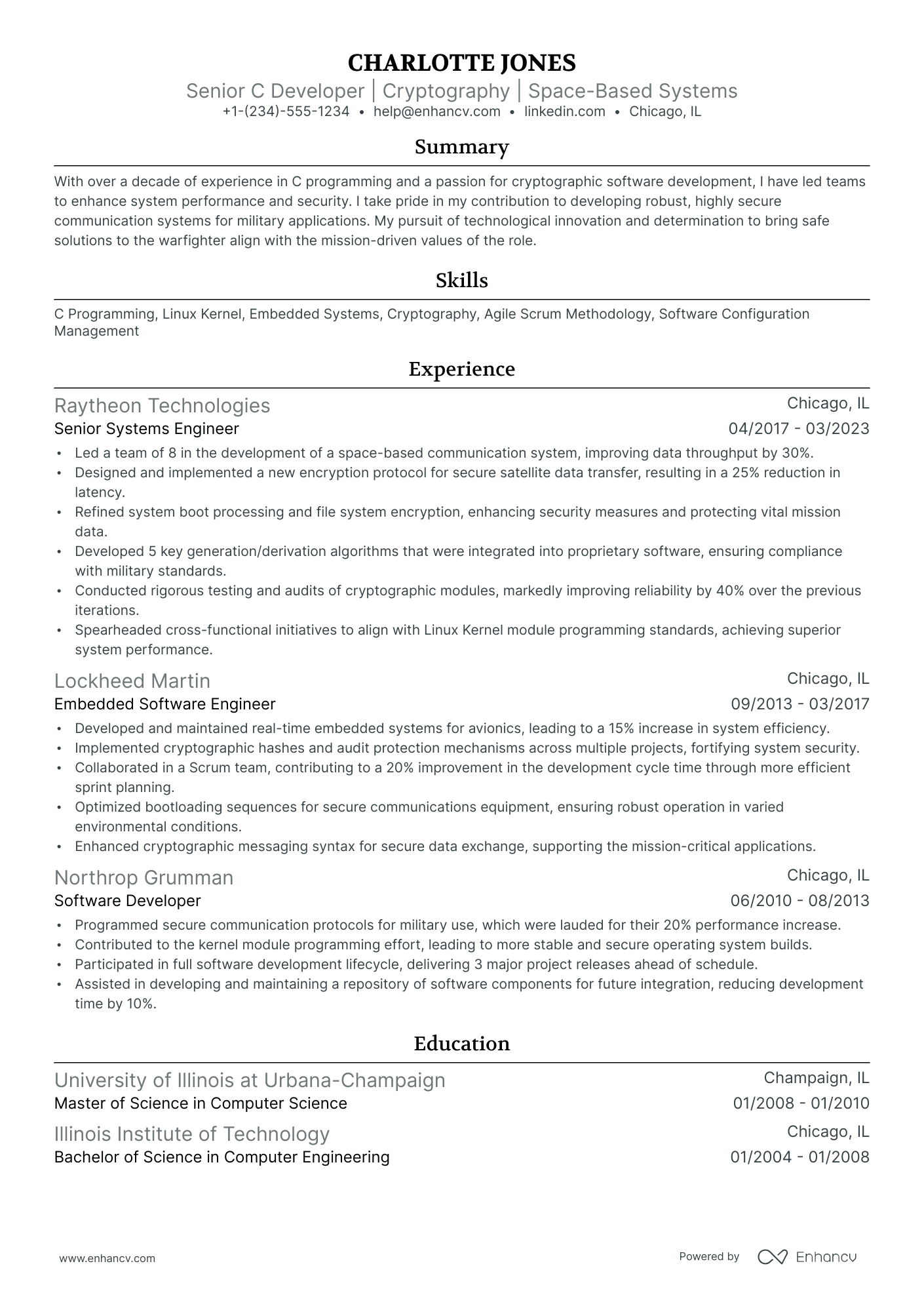
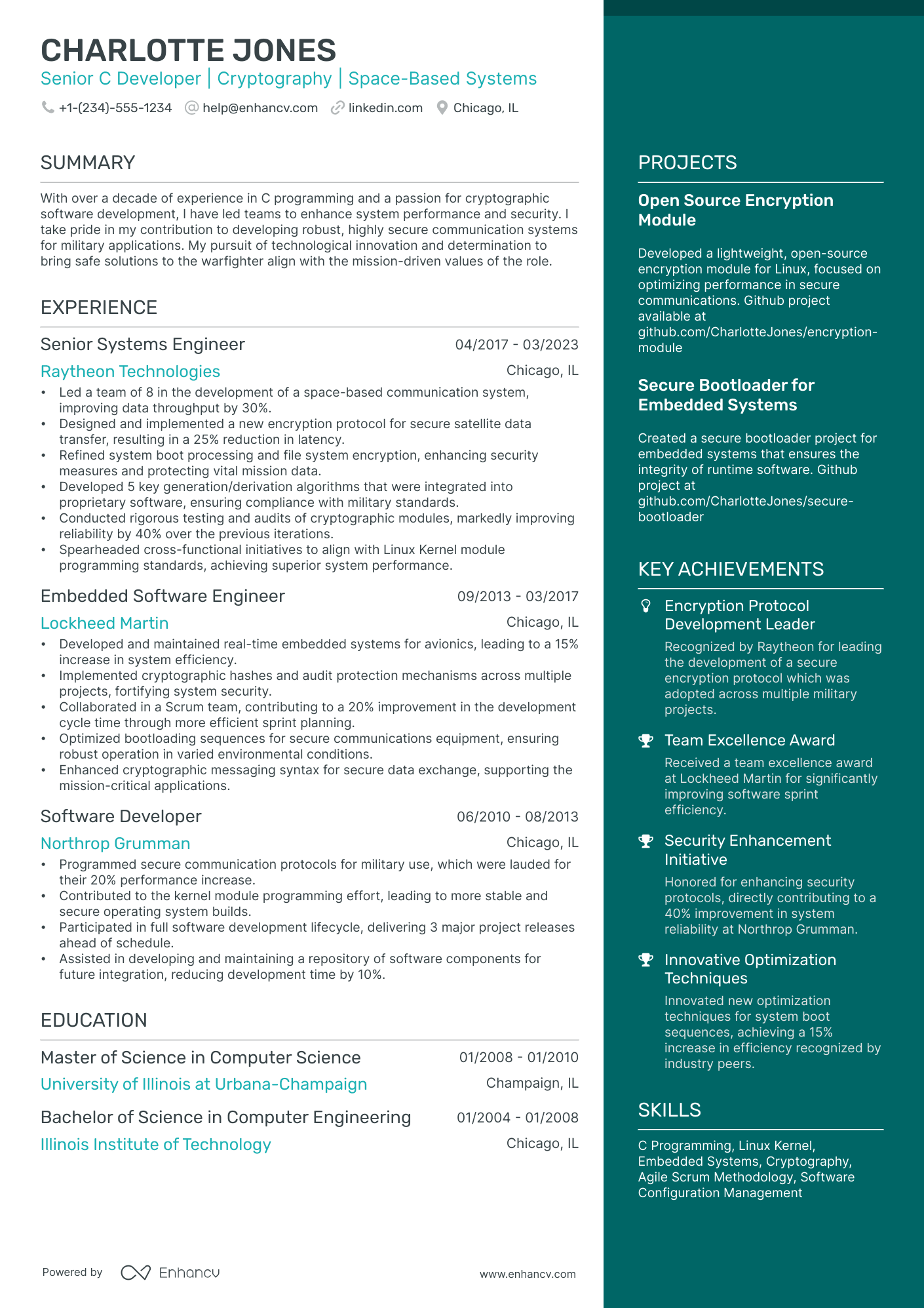
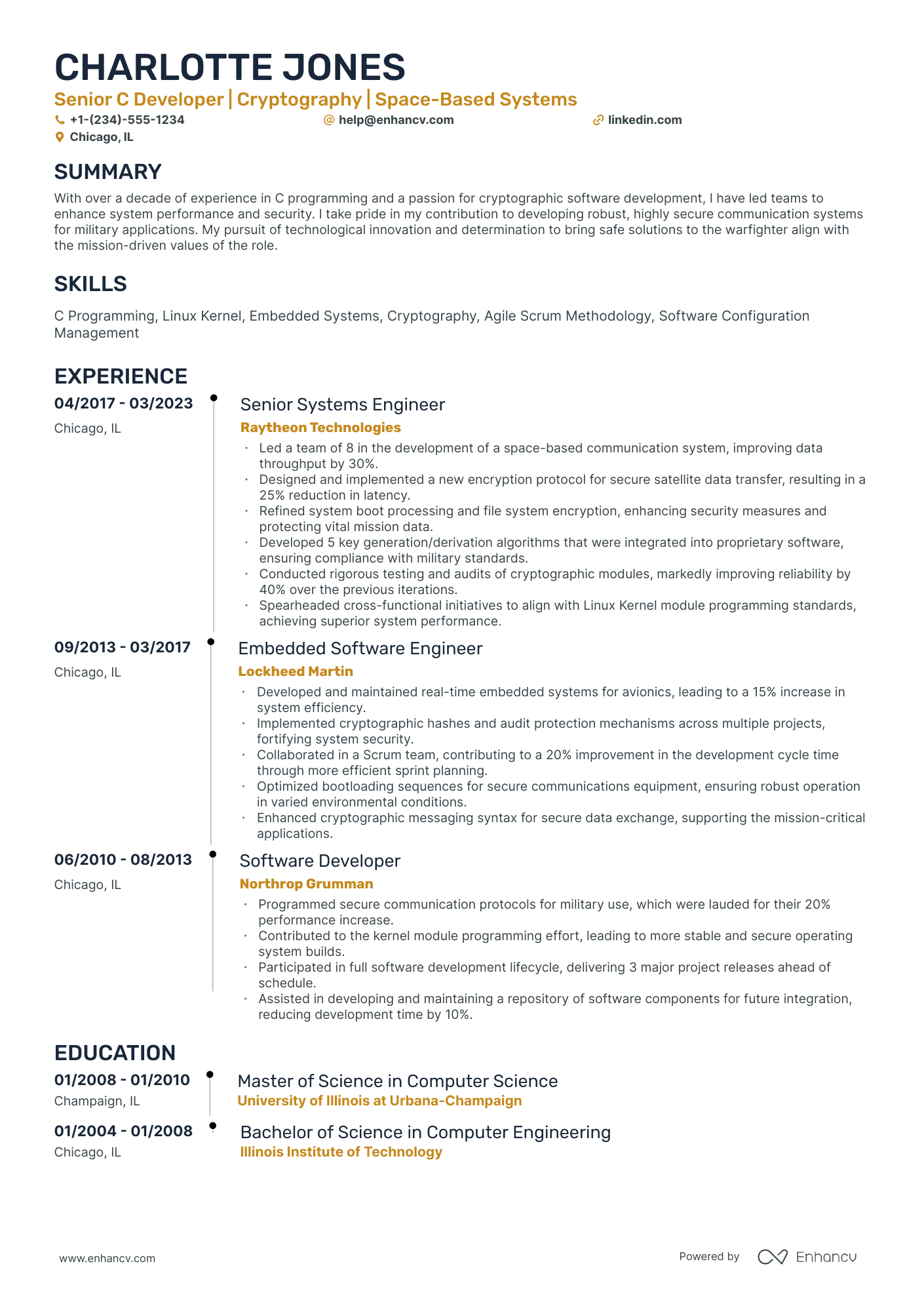
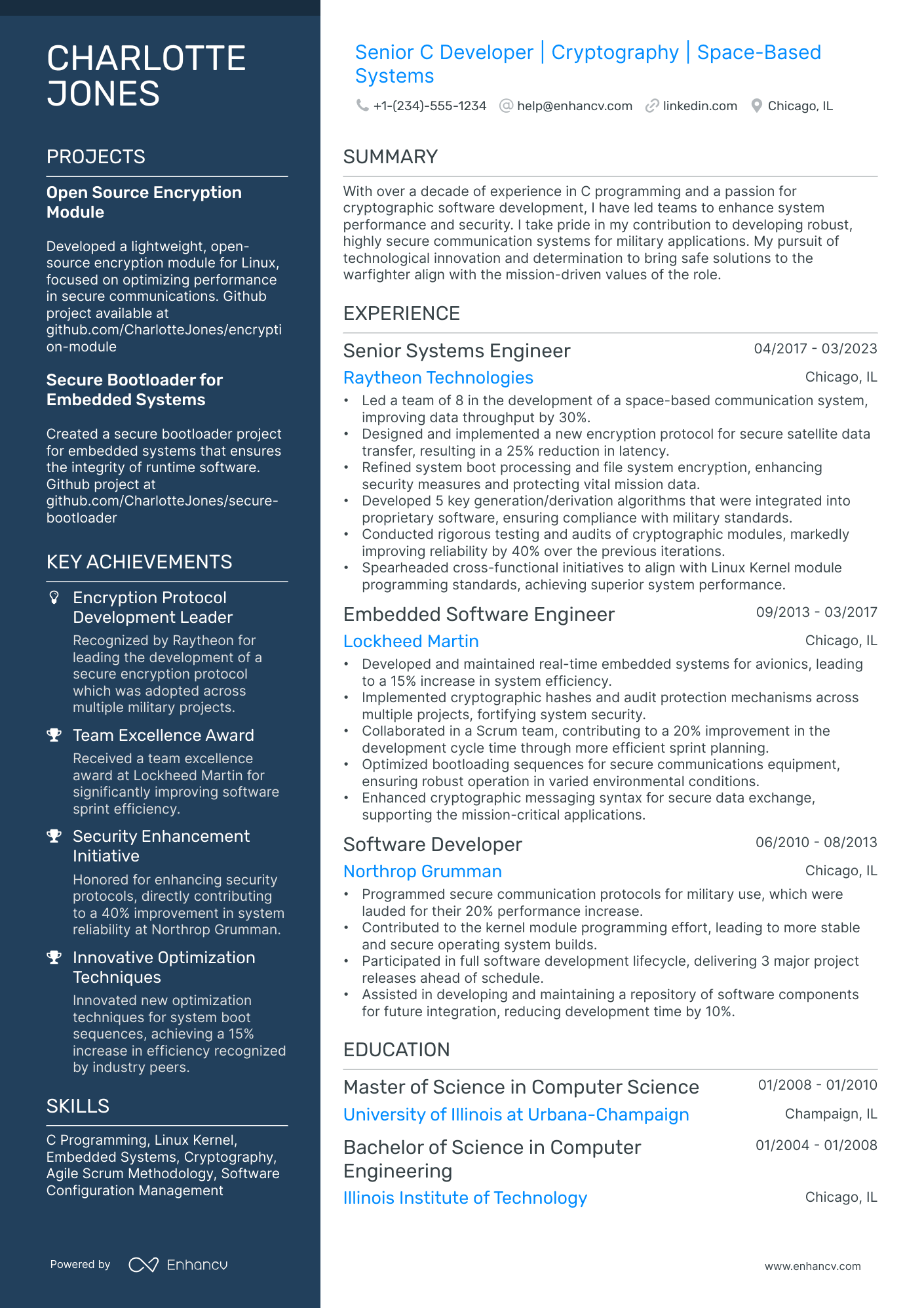
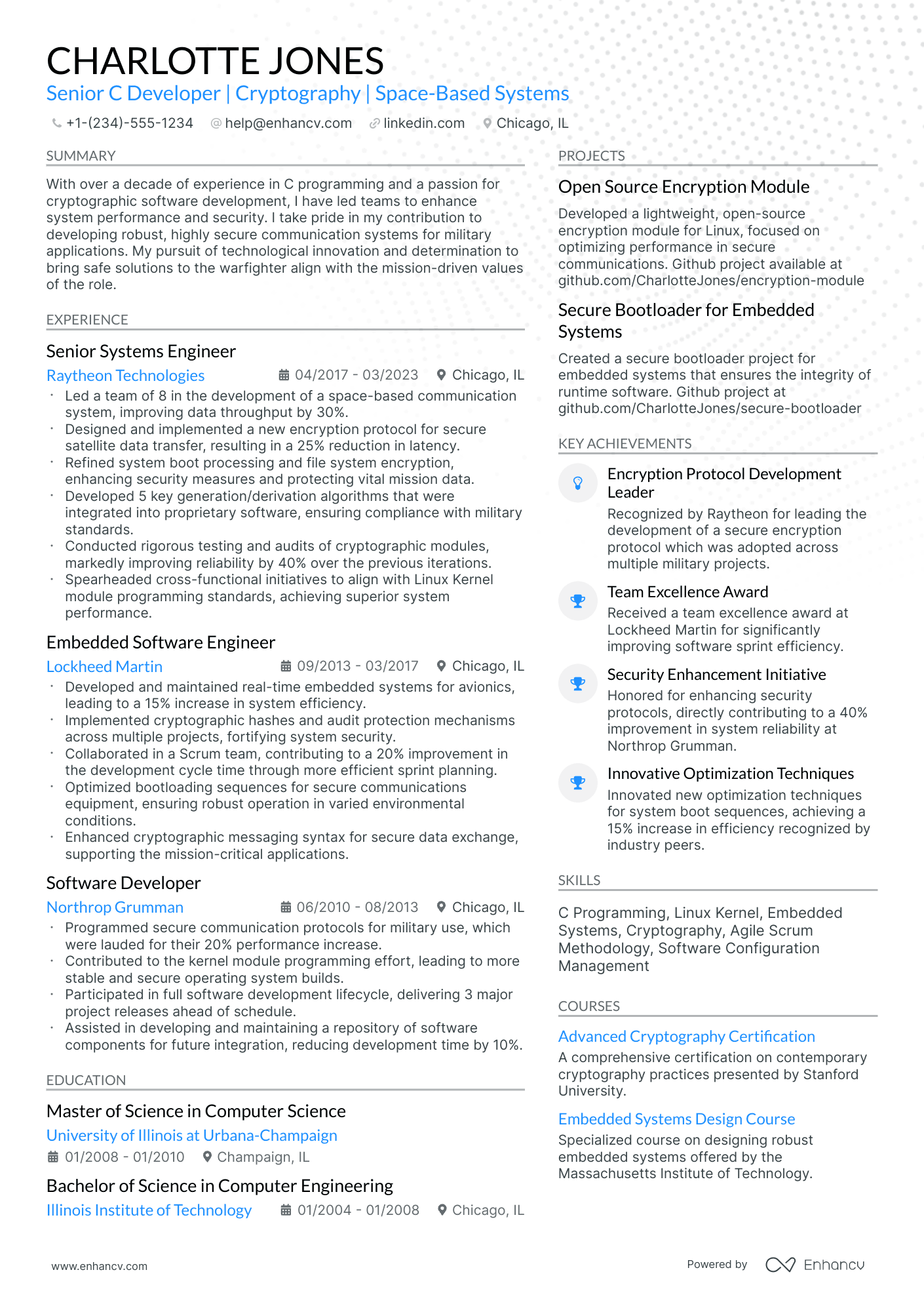
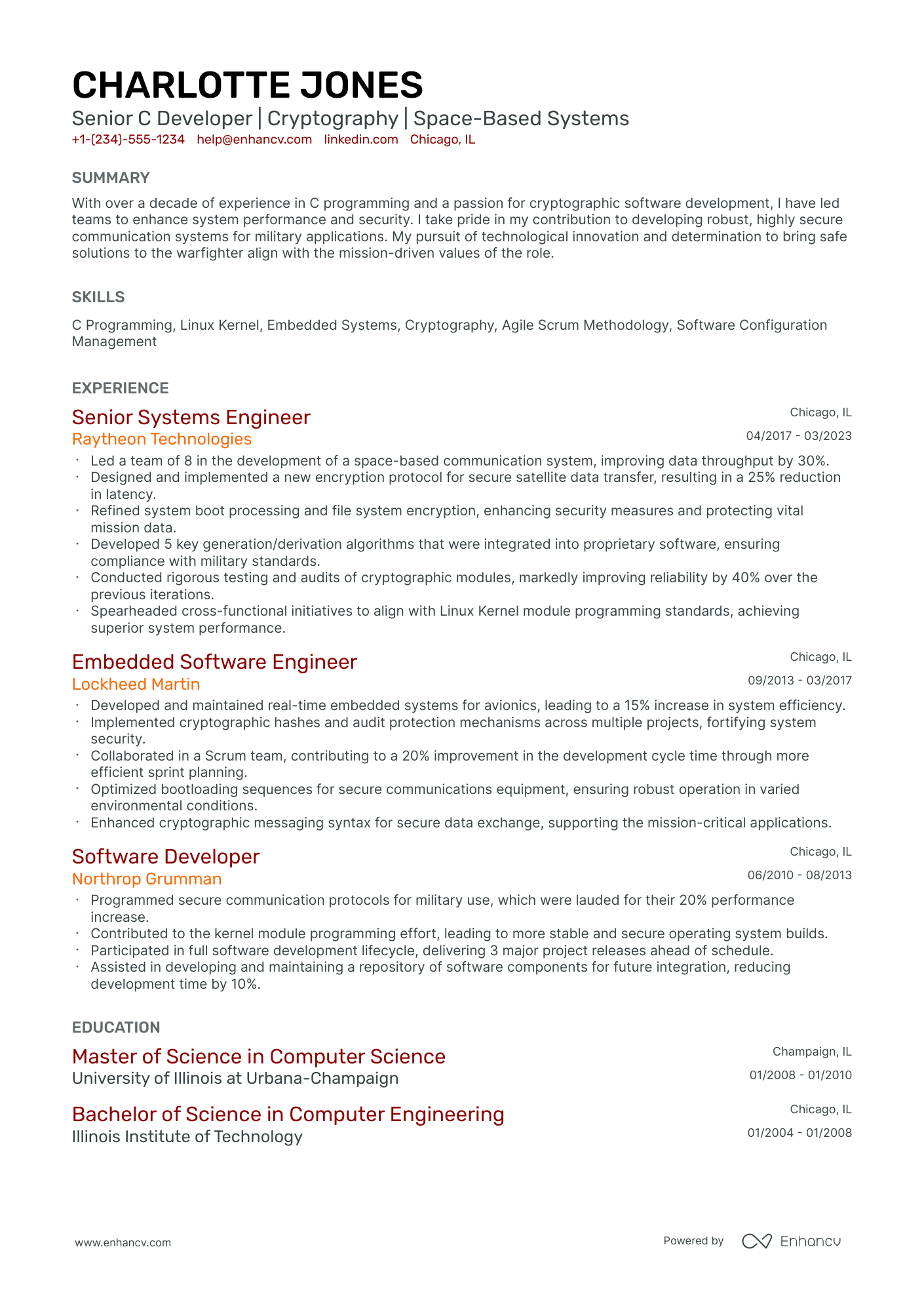
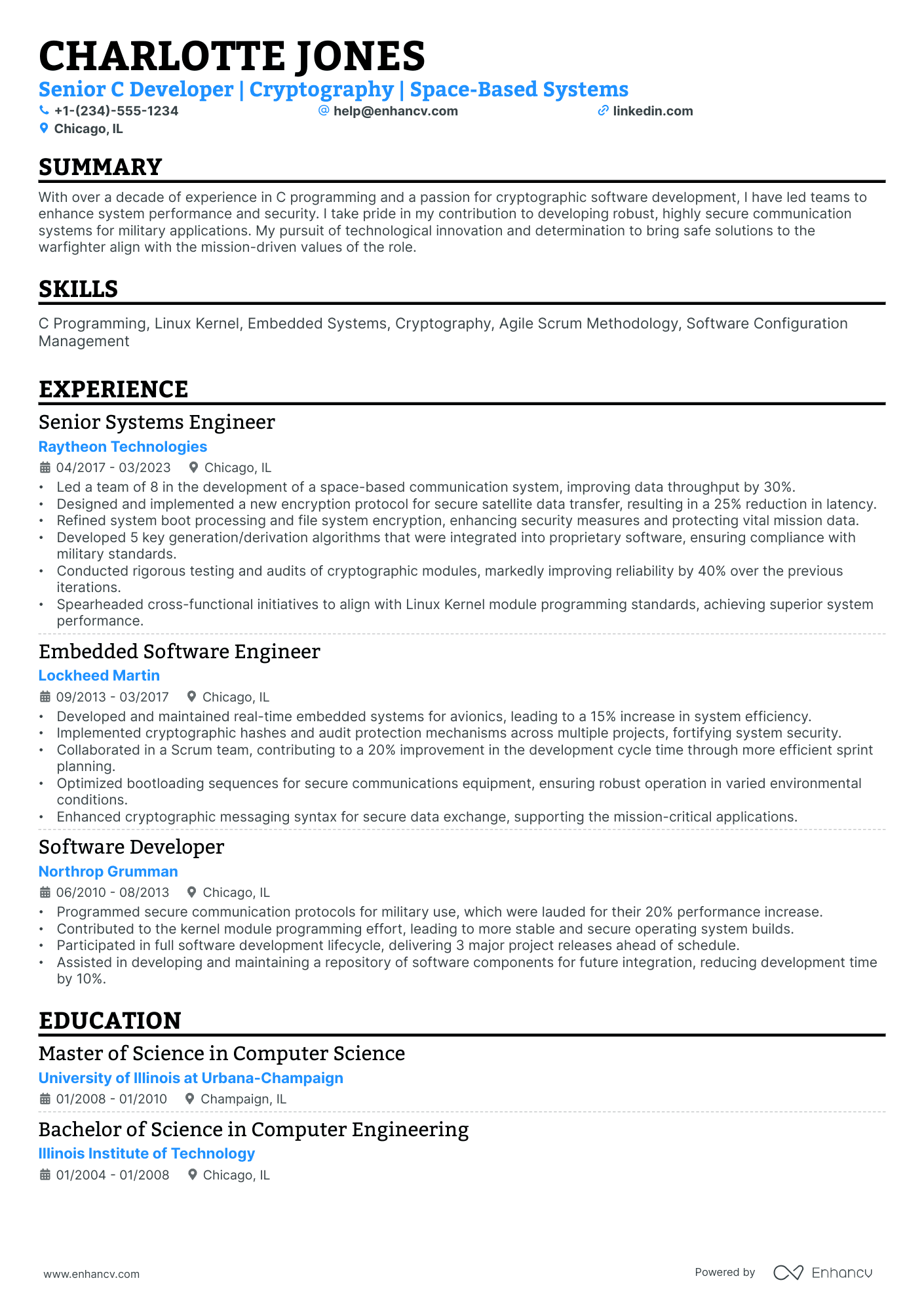
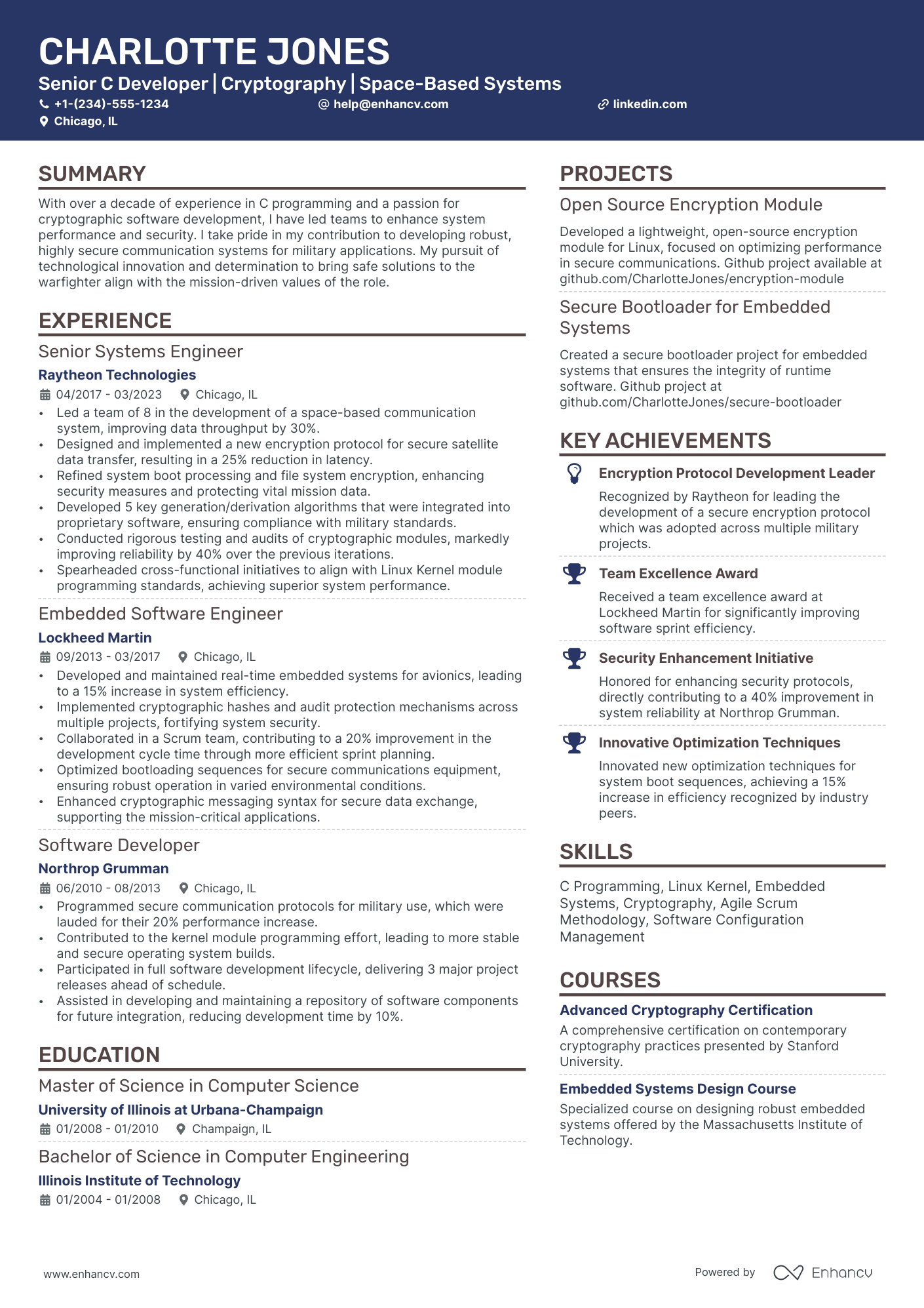
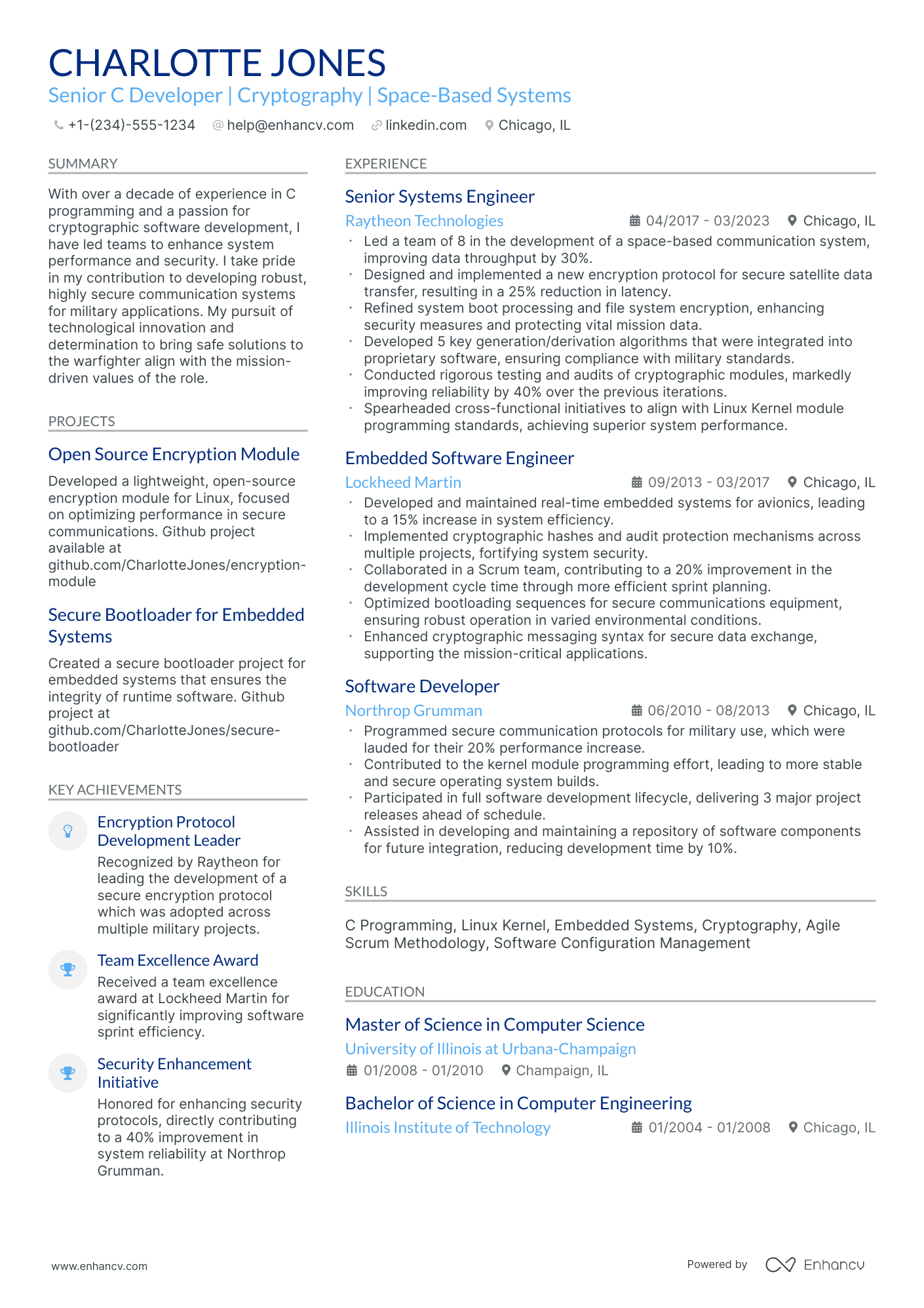
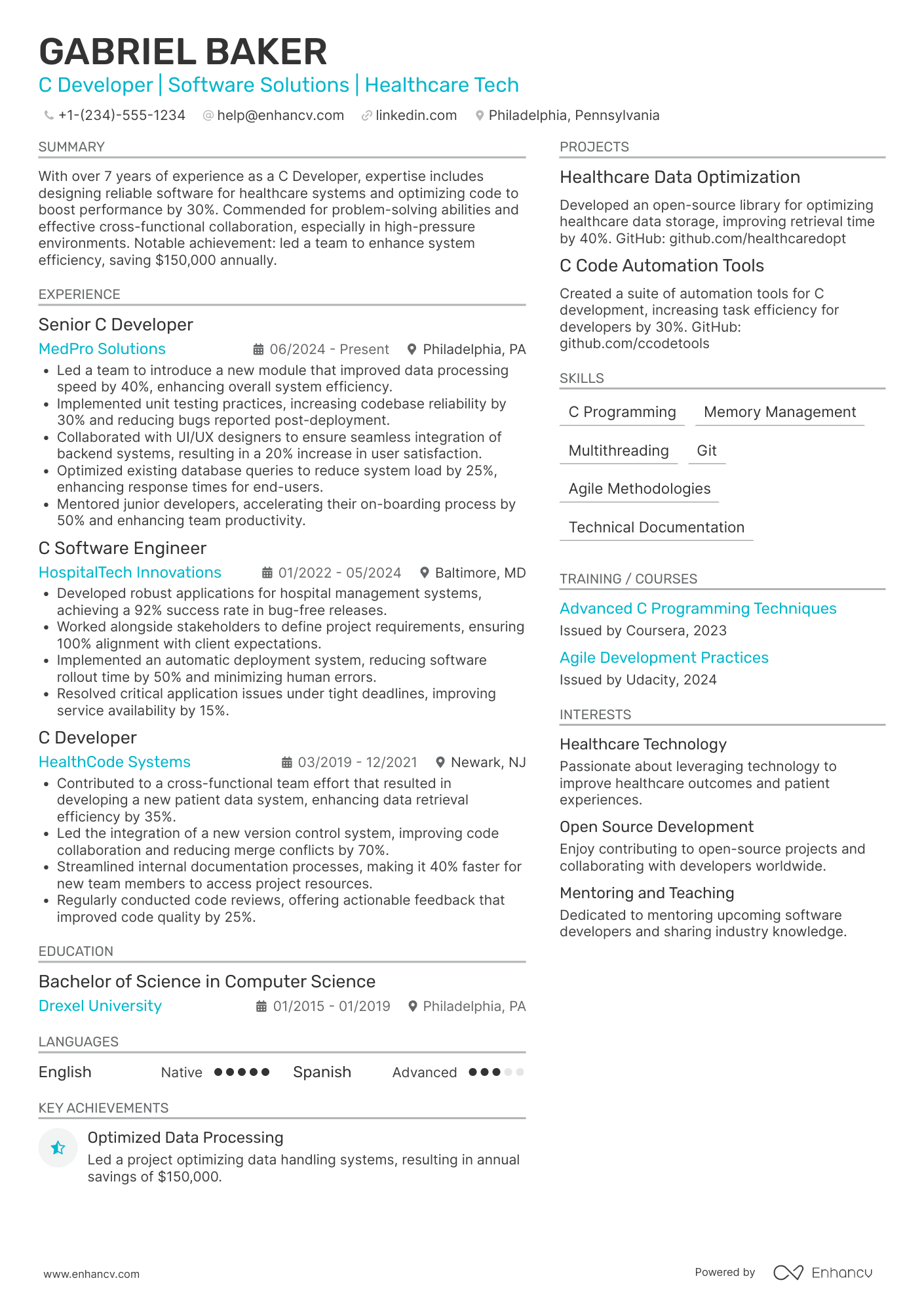
Most C developer resume submissions fail because they read like task logs and bury impact behind dense project notes. That hurts in ATS screening and during fast recruiter scans, where keywords, clarity, and results decide interviews. If you're unsure where to begin, understanding how to write a resume from the ground up can help you avoid these common pitfalls.
A strong resume shows what you delivered and why it mattered, so you get credit for outcomes. You should highlight latency reductions, memory savings, crash-rate drops, shipped releases, test coverage gains, throughput improvements, and bugs eliminated at scale.

Key takeaways
- Quantify every experience bullet with metrics like latency reductions, memory savings, or crash-rate drops.
- Use reverse-chronological format for senior roles and hybrid format for career changers or juniors.
- Tailor each resume to mirror the job posting's exact tools, standards, and domain language.
- Demonstrate skills in context within your summary and experience—not just in a standalone list.
- Lead with C projects, measurable results, and GitHub links when you lack professional experience.
- Use AI prompts to sharpen bullet points and alignment, but stop before it invents claims.
- Build your resume faster with Enhancv to keep formatting clean and sections consistently structured.
Job market snapshot for C developers
We analyzed 54 recent C developer job ads across major US job boards. These numbers help you understand employment type trends, regional hotspots, top companies hiring at a glance.
What level of experience employers are looking for C developers
| Years of Experience | Percentage found in job ads |
|---|---|
| 1–2 years | 3.7% (2) |
| 3–4 years | 5.6% (3) |
| 5–6 years | 14.8% (8) |
| 7–8 years | 3.7% (2) |
| 9–10 years | 1.9% (1) |
| 10+ years | 5.6% (3) |
| Not specified | 66.7% (36) |
C developer ads by area of specialization (industry)
| Industry (Area) | Percentage found in job ads |
|---|---|
| Finance & Banking | 70.4% (38) |
Role overview stats
These tables show the most common responsibilities and employment types for C developer roles. Use them to align your resume with what employers expect and to understand how the role is structured across the market.
Day-to-day activities and top responsibilities for a C developer
| Responsibility | Percentage found in job ads |
|---|---|
| C++ | 53.7% (29) |
| C# | 51.9% (28) |
| Linux | 31.5% (17) |
| Git | 29.6% (16) |
| Sql | 27.8% (15) |
| .net | 22.2% (12) |
| Agile | 22.2% (12) |
| .net core | 16.7% (9) |
| Azure devops | 16.7% (9) |
| Python | 16.7% (9) |
| Javascript | 14.8% (8) |
| Oracle | 14.8% (8) |
Type of employment (remote vs on-site vs hybrid)
| Employment type | Percentage found in job ads |
|---|---|
| On-site | 53.7% (29) |
| Remote | 31.5% (17) |
| Hybrid | 14.8% (8) |
How to format a C developer resume
Recruiters evaluating C developer resumes prioritize systems-level expertise, memory management proficiency, and evidence of working close to hardware or within performance-critical codebases. A clean, well-structured resume format ensures these technical signals—along with project scope and toolchain fluency—surface immediately during both automated parsing and manual review.

I have significant experience in this role—which format should I use?
Use a reverse-chronological format to present your deepest C development experience first, giving recruiters immediate access to your most relevant and recent work. Do:
- Lead each role entry with scope indicators: team size, codebase scale, platform targets (embedded, kernel, networking), and ownership of architectural decisions.
- Highlight role-specific tools and domains—GDB, Valgrind, Make/CMake, RTOS environments, POSIX APIs, static analysis tools, and CI/CD pipelines for compiled languages.
- Quantify outcomes tied to system performance, reliability, or efficiency gains rather than listing duties.
I'm junior or switching into this role—what format works best?
A hybrid format works best, letting you lead with a focused C skills section while supporting it with project-based or professional experience that demonstrates applied competency. Do:
- Place core C competencies—pointer arithmetic, data structures, manual memory management, build systems—in a dedicated skills section near the top of the resume.
- Feature personal projects, open-source contributions, or coursework involving systems programming, embedded development, or low-level optimization as primary experience entries.
- Connect each listed skill or project to a concrete action and a measurable or observable result.
Why not use a functional resume?
A functional format strips away the project context and progression that C developer hiring managers rely on to evaluate how you've applied systems-level skills in real environments.
- Career changers with transferable low-level programming experience: You've worked in C++ or assembly and completed C-based side projects but lack formal C job titles.
- Bootcamp or self-taught developers with limited work history: You have strong portfolio projects in C (drivers, embedded firmware, CLI tools) but no professional roles to list.
- Professionals returning after a resume gap: You've stayed current through open-source contributions or personal embedded projects during time away from employment.
Once your layout and formatting choices are in place, the next step is deciding which sections to include so each one reinforces your qualifications as a C developer.
What sections should go on a C developer resume
Recruiters expect a C developer resume to quickly show low-level programming expertise, systems impact, and production-grade results. Knowing which resume sections to include ensures your qualifications are organized for maximum clarity.
Use this structure for maximum clarity:
- Header
- Summary
- Experience
- Skills
- Projects
- Education
- Certifications
- Optional sections: Open-source work, Publications, Awards
Strong experience bullets should emphasize performance gains, reliability improvements, memory and concurrency outcomes, and measurable results across embedded, systems, or tooling scope.
Is your resume good enough?
Drop your resume here or choose a file. PDF & DOCX only. Max 2MB file size.
Now that you’ve outlined the key resume components, the next step is to write your C developer experience section so those elements are supported with clear, role-relevant proof.
How to write your C developer resume experience
The experience section is where you prove you've shipped working software, not just written code. Hiring managers prioritize demonstrated impact—optimized systems, stable releases, and measurable performance gains—over generic task lists that describe daily routines.
Each entry should include:
- Job title
- Company and location (or remote)
- Dates of employment (month and year)
Three to five concise bullet points showing what you owned, how you executed, and what outcomes you delivered:
- Ownership scope: the embedded systems, kernel modules, firmware, drivers, libraries, or low-level platforms you were directly accountable for building, maintaining, or improving as a C developer.
- Execution approach: the compilers, debuggers, static analysis tools, build systems, memory profilers, or development methodologies you relied on to diagnose issues, optimize code paths, and deliver production-ready C code.
- Value improved: the specific dimensions of system performance, memory efficiency, latency, code reliability, portability, or security posture that changed as a direct result of your C development work.
- Collaboration context: how you coordinated with hardware engineers, QA teams, embedded systems architects, product managers, or open-source contributors to align your C development efforts with broader project goals.
- Impact delivered: the tangible outcomes your work produced—expressed through system stability, deployment scale, resource savings, or business-critical results—rather than a summary of tasks you performed.
Experience bullet formula
A C developer experience example
✅ Right example - modern, quantified, specific.
Senior C Software Engineer
Orion Robotics | Austin, TX
2022–Present
Built safety-critical embedded firmware for autonomous warehouse robots operating across three hundred customer sites.
- Optimized real-time motion-control loops in C on ARM Cortex-M using fixed-point math and CMSIS-DSP, cutting control latency thirty-eight percent and reducing path-tracking error twenty-one percent.
- Refactored a legacy CAN bus stack to ISO-TP with DMA-driven ring buffers and lock-free queues, increasing telemetry throughput two point six times and eliminating ninety-two percent of dropped frames under peak load.
- Implemented a secure over-the-air update pipeline with dual-bank flash, SHA-256 verification, and rollback logic, reducing field-brick incidents from one point three percent to zero point one percent and saving an estimated four hundred technician hours per quarter.
- Built deterministic unit and hardware-in-the-loop test coverage with CMocka, Python, and Jenkins, raising firmware test coverage from forty-five percent to seventy-six percent and cutting regression escapes fifty percent.
- Partnered with hardware engineers and product managers to profile power and thermal behavior using JTAG, GDB, and Segger SystemView, extending battery runtime eighteen percent and meeting a sub-forty-five degrees Celsius thermal target.
Now that you've seen how a strong experience section comes together, let's look at how to adjust those details to match the specific job you're targeting.
How to tailor your C developer resume experience
Recruiters evaluate your C developer resume through both applicant tracking systems and manual review. Tailoring your resume to the job description ensures your qualifications align with what the hiring team actually needs.
Ways to tailor your C developer experience:
- Match the specific compilers toolchains and build systems listed in the posting.
- Use the same terminology for coding standards like MISRA or CERT.
- Mirror performance benchmarks or reliability metrics the role prioritizes.
- Highlight embedded or systems-level domain experience when the job requires it.
- Emphasize memory management or optimization techniques referenced in the description.
- Reflect the development methodologies such as Agile or Waterfall they specify.
- Include relevant platform experience like Linux kernel or RTOS development.
- Align debugging and testing workflows with tools the employer names.
Tailoring means aligning your real accomplishments with the role's stated requirements—not forcing keywords into sentences where they don't belong.
Resume tailoring examples for C developer
| Job description excerpt | Untailored | Tailored |
|---|---|---|
| "Develop and optimize embedded C firmware for ARM Cortex-M microcontrollers in automotive safety-critical systems, following MISRA C guidelines." | Wrote C code for embedded systems and fixed bugs as needed. | Developed MISRA C-compliant firmware for ARM Cortex-M4 microcontrollers in an ASIL-B automotive braking system, reducing interrupt latency by 35% through optimized ISR handling. |
| "Design and maintain Linux kernel modules and device drivers for custom PCIe hardware, with a focus on memory management and DMA operations." | Worked on Linux drivers and helped with hardware integration tasks. | Wrote and maintained three Linux kernel modules for custom PCIe 4.0 endpoints, implementing scatter-gather DMA transfers that increased data throughput by 2.1 GB/s while eliminating memory leak issues in the buffer allocation path. |
| "Build and profile high-performance networking code in C for a low-latency trading platform, using DPDK and lock-free data structures." | Developed networking software and improved application performance. | Engineered a DPDK-based packet processing pipeline in C using lock-free ring buffers, achieving sub-3μs tick-to-trade latency across 40 GbE interfaces and handling 12 million messages per second during peak market hours. |
Once you’ve aligned your experience with the role’s priorities, the next step is to quantify your C developer achievements so employers can see the measurable impact of your work.
How to quantify your C developer achievements
Quantifying your achievements proves business impact beyond code. For C developers, focus on performance, reliability, memory use, defect rates, security risk reduction, and delivery speed across real systems and releases.
Quantifying examples for C developer
| Metric | Example |
|---|---|
| Performance | "Reduced packet parsing latency from 2.4 ms to 0.9 ms by rewriting hot paths in C and adding SIMD with SSE4.2." |
| Memory efficiency | "Cut peak heap usage 38% (1.6 GB to 1.0 GB) by fixing leaks with Valgrind and replacing linked lists with a ring buffer." |
| Reliability | "Lowered crash rate from 1.8% to 0.3% by adding bounds checks, fuzz tests with libFuzzer, and hardened error handling." |
| Security | "Eliminated twelve high-risk buffer overflow findings by enabling AddressSanitizer, adopting safe string APIs, and adding compiler hardening flags." |
| Delivery speed | "Shortened release cycle from biweekly to weekly by automating builds in CMake and CI tests in GitHub Actions across three targets." |
Turn vague job duties into measurable, recruiter-ready resume bullets in seconds with Enhancv's Bullet Point Generator.
Once your bullet points clearly convey your impact, the next step is ensuring your skills section reinforces that expertise with the right mix of hard and soft skills.
How to list your hard and soft skills on a C developer resume
Your skills section shows you can build reliable, high-performance systems in C, and recruiters and an ATS (applicant tracking system) scan them to confirm keyword match and seniority; aim for a balanced mix of hard skills and job-relevant soft skills.
C developer roles require a blend of:
- Product strategy and discovery skills.
- Data, analytics, and experimentation skills.
- Delivery, execution, and go-to-market discipline.
- Soft skills.
Your skills section should be:
- Scannable (bullet-style grouping).
- Relevant to the job post.
- Backed by proof in experience bullets.
- Updated with current tools.
Place your skills section:
- Above experience if you're junior or switching careers.
- Below experience if you're mid/senior with strong achievements.

Hard skills
- C11/C17, GCC, Clang
- Linux systems programming
- POSIX threads, concurrency
- GDB, Valgrind
- CMake, Make
- Git, GitHub, GitLab
- Static analysis: clang-tidy, cppcheck
- Unit testing: CMocka, Unity
- Networking: TCP/IP, sockets
- Embedded: ARM Cortex-M, FreeRTOS
- Performance profiling: perf, gprof
- CI/CD: GitHub Actions, Jenkins
Soft skills
- Write clear design docs
- Review code with rigor
- Debug systematically under pressure
- Communicate trade-offs early
- Collaborate with hardware teams
- Align on requirements with product
- Break work into milestones
- Own defects through resolution
- Prioritize reliability and safety
- Mentor junior developers
- Escalate risks with context
- Document decisions and changes
How to show your C developer skills in context
Your skills shouldn't live only in a bulleted list on your resume. Explore resume skills examples to see how other developers present their technical abilities effectively.
They should be demonstrated in:
- Your summary (high-level professional identity)
- Your experience (proof through outcomes)
Here's what strong, contextualized examples look like in practice.
Summary example
Senior C developer with 10 years in embedded automotive systems. Skilled in RTOS, MISRA C, and cross-platform debugging. Led a firmware redesign that cut boot times by 35%, coordinating across hardware and QA teams.
- Specifies senior-level experience clearly
- Names role-relevant tools and standards
- Includes a measurable performance outcome
- Highlights cross-team collaboration skills
Experience example
Senior Embedded C Developer
Meridian Systems | Austin, TX
March 2019–February 2024
- Refactored legacy C codebase using static analysis tools, reducing field-reported bugs by 42% over two release cycles.
- Developed low-level device drivers with RTOS integration, collaborating with hardware engineers to cut power consumption by 18%.
- Designed automated unit testing pipelines with CUnit and Jenkins, improving team deployment confidence and shortening QA cycles by 25%.
- Every bullet includes measurable proof
- Skills appear naturally within real outcomes
Once you’ve demonstrated your C skills through concrete examples and outcomes, the next step is to apply that approach to building a C developer resume when you don’t have professional experience.
How do I write a C developer resume with no experience
Even without full-time experience, you can demonstrate readiness through projects and self-directed learning. If you're wondering how to build a resume without work experience, focus on showcasing applied skills instead:
- Personal C projects on GitHub
- University systems programming assignments
- Open-source C bug fixes
- Embedded C hobby microcontroller builds
- Coding challenges with C solutions
- C libraries built and documented
- Internships using C or C++
Focus on:
- C projects with measurable results
- Debugging, profiling, and testing evidence
- Git workflow and code reviews
- Low-level concepts: memory, pointers
Resume format tip for entry-level C developer
Use a skills-based resume format because it highlights C projects, tools, and results when your work history is limited. Do:
- Lead with a Projects section.
- Write bullets with metrics and scope.
- List tools: Git, GCC, GDB.
- Link to GitHub repos you own.
- Include testing: unit tests, sanitizers.
- Built a C command-line log parser with GCC, GDB, and Valgrind, cutting runtime 35% and reaching 92% unit test coverage.
Even without professional experience, your educational background can serve as one of the strongest sections on your resume—here's how to present it effectively.
How to list your education on a C developer resume
Your education section helps hiring teams confirm you have the foundational knowledge a C developer needs. It validates core skills in programming, systems design, and computer science theory.
Include:
- Degree name
- Institution
- Location
- Graduation year
- Relevant coursework (for juniors or entry-level candidates)
- Honors & GPA (if 3.5 or higher)
Skip month and day details—list the graduation year only.
Here's a strong education entry tailored for a C developer resume:
Example education entry
Bachelor of Science in Computer Science
Georgia Institute of Technology, Atlanta, GA
Graduated 2021
GPA: 3.7/4.0
- Relevant coursework: Operating Systems, Data Structures, Computer Architecture, Embedded Systems Programming, Algorithm Design
- Honors: Dean's List (six semesters), Magna Cum Laude
How to list your certifications on a C developer resume
Certifications on your resume show your commitment to learning, confirm tool proficiency, and signal industry relevance as a C developer. They also help hiring teams gauge your readiness for production code and modern workflows.
Include:
- Certificate name
- Issuing organization
- Year
- Optional: credential ID or URL
- List certifications below education when your degree is recent and more relevant than older credentials.
- List certifications above education when the certifications are recent and directly match the C developer role requirements.
Best certifications for your C developer resume
- Linux Foundation Certified System Administrator (LFCS)
- Red Hat Certified System Administrator (RHCSA)
- Cisco Certified Network Associate (CCNA)
- AWS Certified Developer – Associate
- Certified Kubernetes Application Developer (CKAD)
- ISTQB Certified Tester Foundation Level (CTFL)
- GIAC Secure Software Programmer – C/C++ (GSSP-C)
Once you’ve placed your credentials where they support your technical qualifications, shift to your C developer resume summary to highlight those strengths upfront.
How to write your C developer resume summary
Your resume summary is the first thing a recruiter reads. A strong one instantly signals you have the right skills and experience for a C developer role.
Keep it to three to four lines, with:
- Your title and years of hands-on C development experience.
- The domain you've worked in, such as embedded systems, firmware, or operating systems.
- Core tools and skills like GCC, GDB, POSIX, RTOS, or memory management.
- One or two measurable achievements, such as reduced latency or improved code efficiency.
- Soft skills tied to real outcomes, like debugging under pressure or collaborating across hardware teams.

PRO TIP
At a junior level, lead with your strongest technical skills and any real project contributions. Highlight specific tools, languages, and measurable results from internships or coursework. Avoid vague phrases like "passionate learner" or "hardworking team player." Recruiters want proof of what you can do, not motivation statements.
Example summary for a C developer
C developer with two years of experience building embedded firmware for IoT devices. Reduced system boot time by 30% through memory optimization using GCC and FreeRTOS. Collaborated with hardware engineers to resolve critical integration defects ahead of schedule.
Optimize your resume summary and objective for ATS
Drop your resume here or choose a file.
PDF & DOCX only. Max 2MB file size.
Now that your summary is ready to hook recruiters with your strongest qualifications, make sure your header presents the essential contact and professional details they'll need to reach you.
What to include in a C developer resume header
A resume header lists your key identifiers and contact details, helping C developer candidates stay visible, credible, and easy to screen fast.
Essential resume header elements
- Full name
- Tailored job title and headline
- Location
- Phone number
- Professional email
- GitHub link
- Portfolio link
A LinkedIn link helps recruiters confirm your work history quickly and supports faster screening decisions.
Do not include a photo on a C developer resume unless the role is explicitly front-facing or appearance-dependent.
Keep your header to one or two lines per item, and mirror the exact job title from the posting to improve matching.
C developer resume header
Jordan Lee
C developer | Embedded systems and Linux C
Austin, TX
(512) 555-01XX
your.name@enhancv.com
github.com/yourname
yourwebsite.com
linkedin.com/in/yourname
Once your contact details and role information are clear and easy to scan, you can strengthen your application with additional sections for C developer resumes that add relevant context and credibility.
Additional sections for C developer resumes
Adding extra sections strengthens your resume when they highlight specialized skills or experiences directly relevant to C development roles. For example, listing language skills can set you apart when applying to globally distributed teams or companies with international codebases.
- Languages
- Open source contributions
- Publications and technical papers
- Certifications
- Hobbies and interests
- Professional memberships
- Conference talks and presentations
Once you've strengthened your resume with relevant additional sections, it's worth pairing it with a cover letter to give hiring managers even more context about your qualifications.
Do C developer resumes need a cover letter
A cover letter isn't required for a C developer, but it helps in competitive roles or teams that expect one. It can make a difference when your resume needs context, or when you want to show targeted fit. If you're unsure where to start, learn what a cover letter is and how it complements your resume.
Use a cover letter to add details your resume can't:
- Explain role and team fit by matching your C developer strengths to the stack, constraints, and collaboration style.
- Highlight one or two relevant projects or outcomes, including measurable impact like latency cuts, memory savings, or defect reduction.
- Show understanding of the product, users, or business context, and connect it to your C developer work on performance, reliability, or safety.
- Address career transitions or non-obvious experience by mapping prior work to C developer skills, such as embedded systems, tooling, or debugging.
Drop your resume here or choose a file.
PDF & DOCX only. Max 2MB file size.
Even if you decide a cover letter won’t add value for your C developer application, the next step is using AI to improve your C developer resume so it carries the full weight of your candidacy.
Using AI to improve your C developer resume
AI can sharpen your resume's clarity, structure, and overall impact. It helps tighten language and highlight measurable results. But overuse strips away authenticity. Once your content feels clear and role-aligned, step away from AI. If you're exploring options, this guide on which AI is best for writing resumes can help you choose the right tool.
Here are 10 practical prompts to strengthen specific sections of your C developer resume:
- Strengthen your summary. "Rewrite my C developer resume summary to highlight my core technical strengths and years of experience in under four sentences."
- Quantify experience bullets. "Add measurable outcomes to these C developer experience bullets, focusing on performance gains, bug reduction, or code efficiency."
- Tighten skills formatting. "Organize my C developer skills section into clear categories—languages, tools, platforms, and libraries—removing anything outdated or redundant."
- Improve project descriptions. "Rewrite this C developer project description to emphasize the technical challenge, my specific contribution, and the measurable result."
- Align with job postings. "Compare my C developer resume experience section against this job description and suggest targeted keyword additions."
- Clarify education details. "Refine my C developer education section to highlight coursework, thesis topics, or labs directly relevant to systems programming."
- Refine certification entries. "Rewrite my C developer certifications section to clearly state each credential's relevance to embedded systems or low-level programming roles."
- Eliminate weak phrasing. "Identify and replace vague or passive phrases in my C developer experience bullets with direct, action-driven language."
- Trim unnecessary content. "Remove any bullet points on my C developer resume that don't directly support a systems programming or embedded development role."
- Sharpen action verbs. "Replace generic verbs like 'worked on' or 'helped with' in my C developer resume with precise technical action verbs."
Stop using AI once your resume sounds accurate, specific, and aligned with real experience. AI should never invent experience or inflate claims—if it didn't happen, it doesn't belong here.
Conclusion
A strong C developer resume shows measurable outcomes, role-specific skills, and a clear structure that’s easy to scan. It connects your work to performance gains, reliability, and maintainability. It highlights C, debugging, memory management, and systems knowledge without burying key details.
Keep your sections consistent and focused, so hiring teams can confirm fit fast. When your impact is quantified and your skills match the role, you look ready for today’s interviews. This approach also keeps your resume relevant as C developer roles evolve.