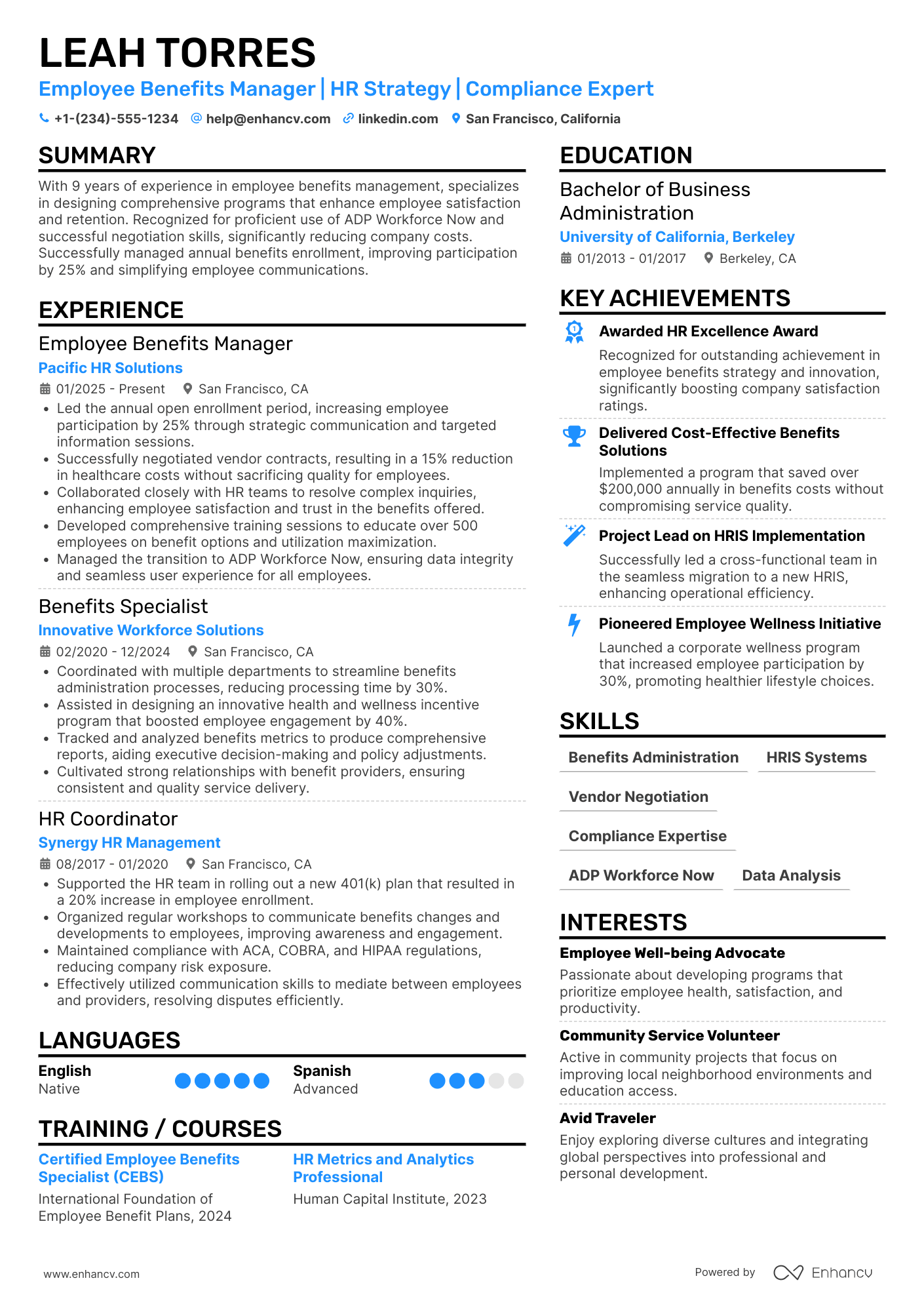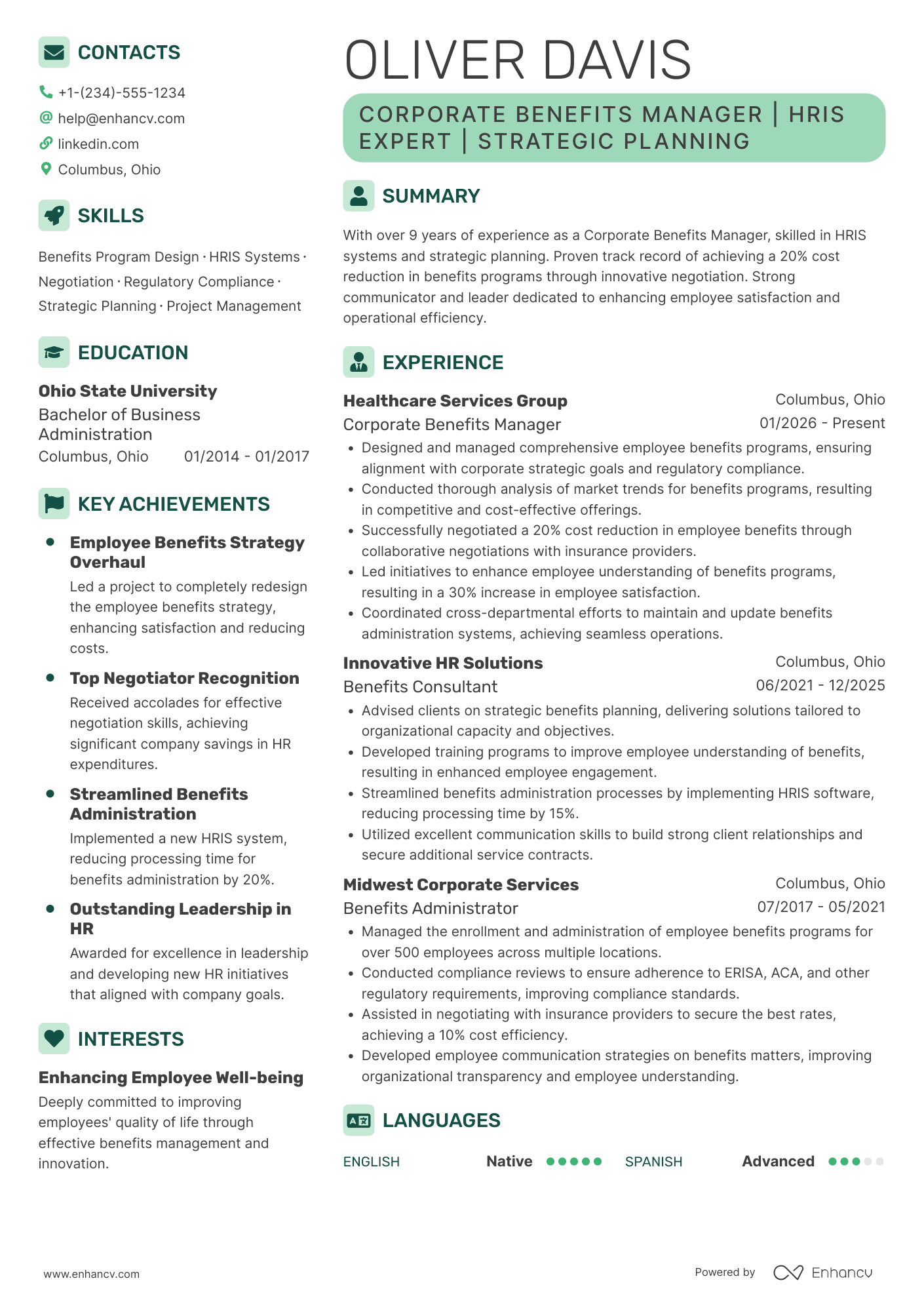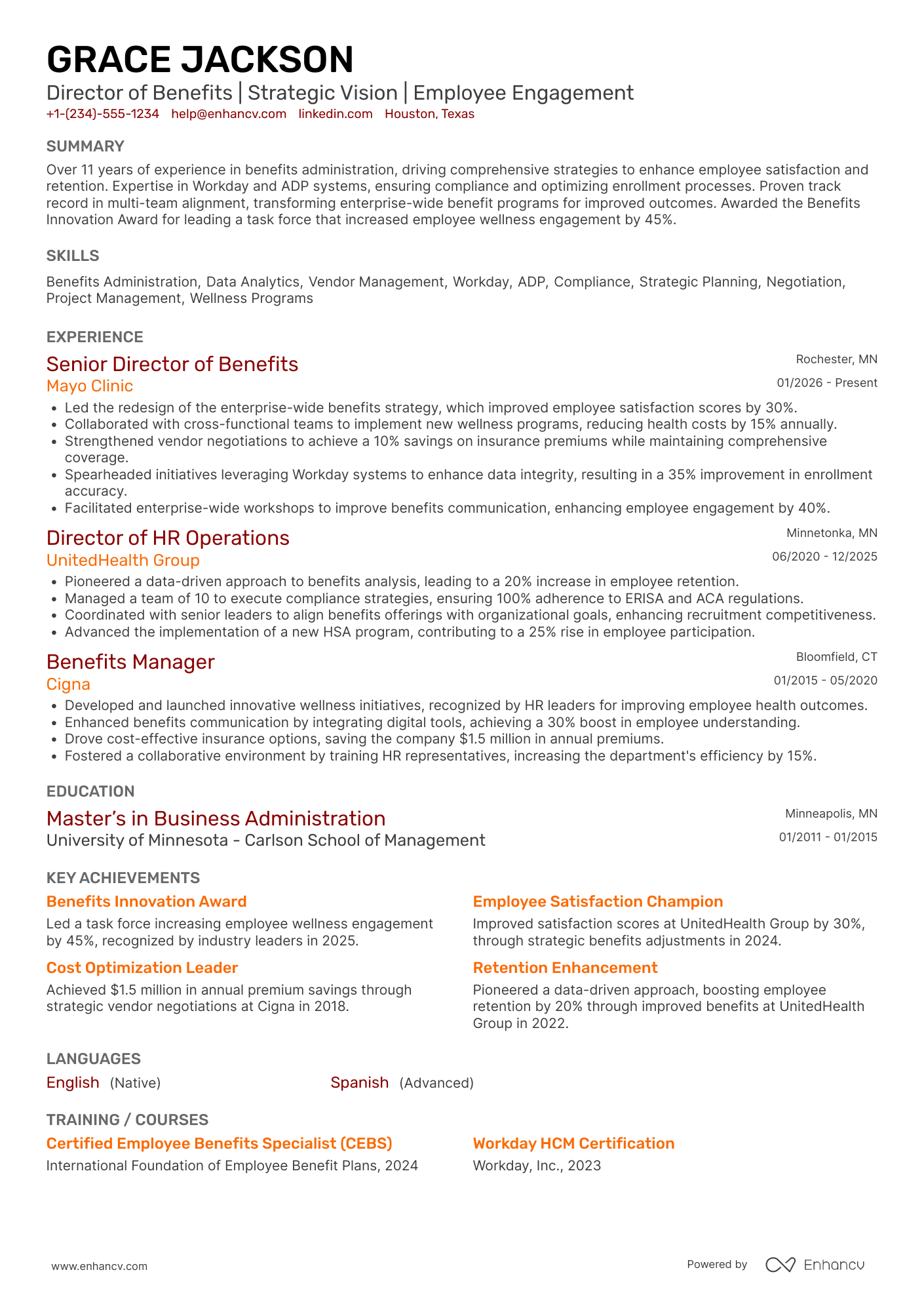
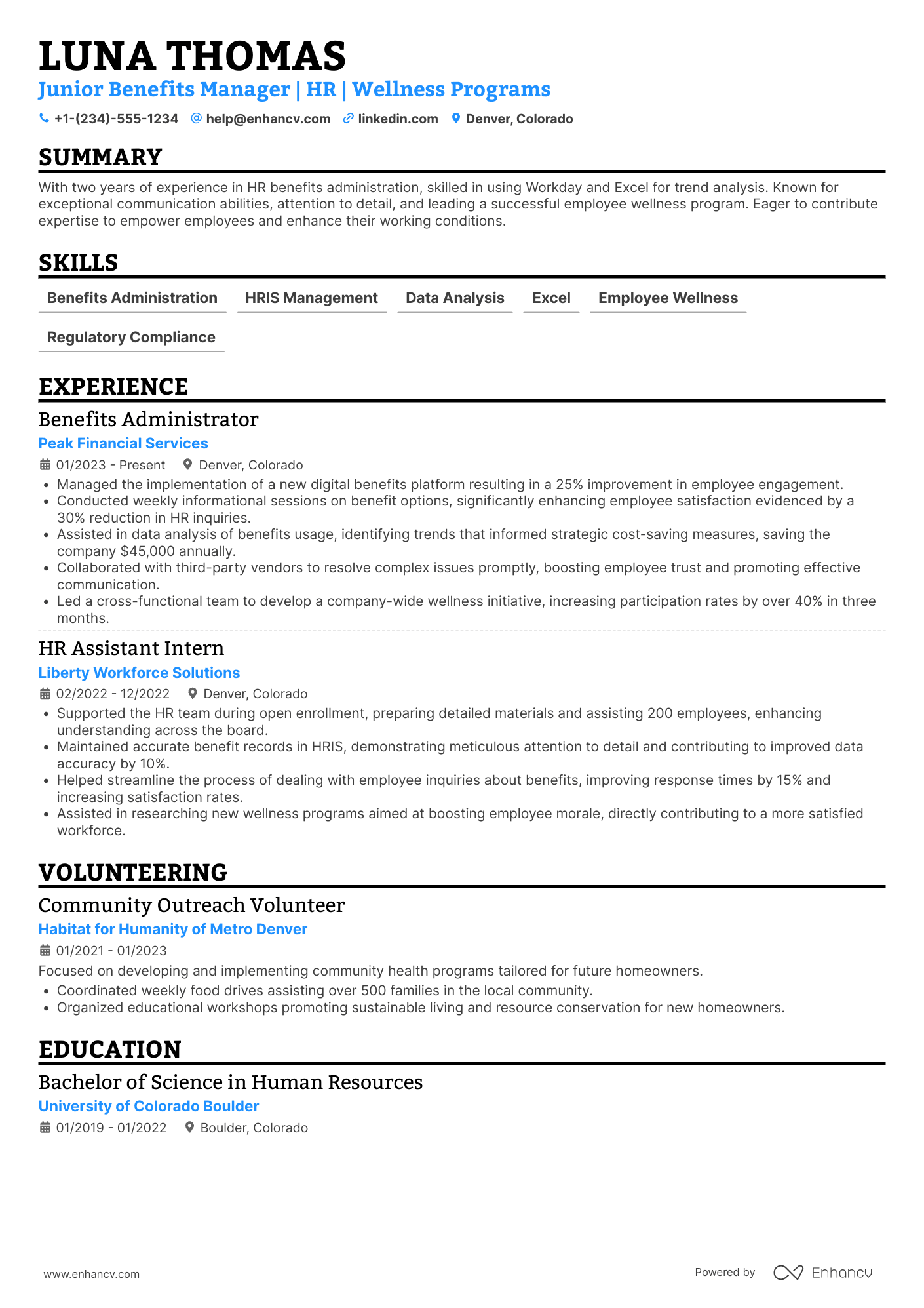
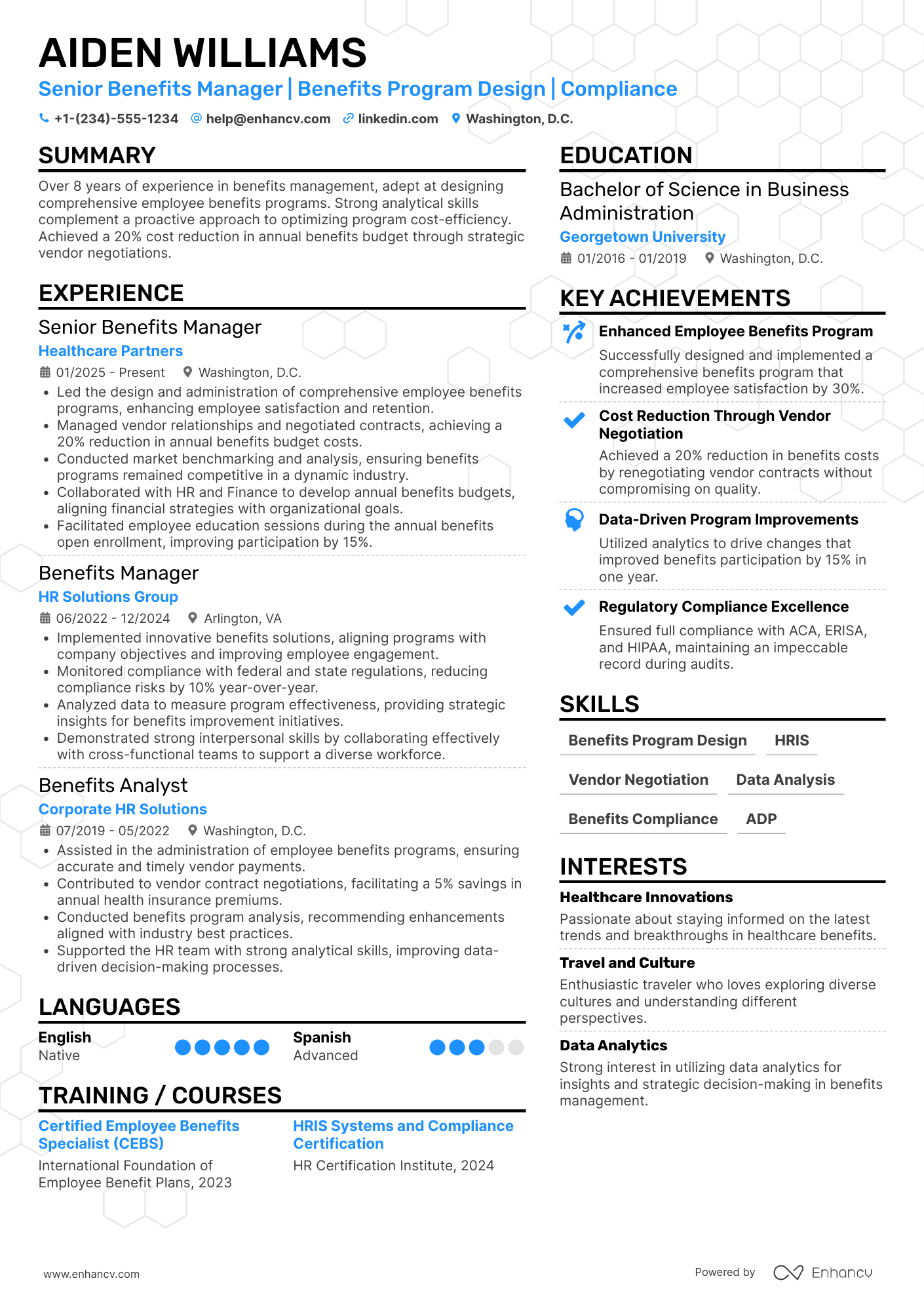
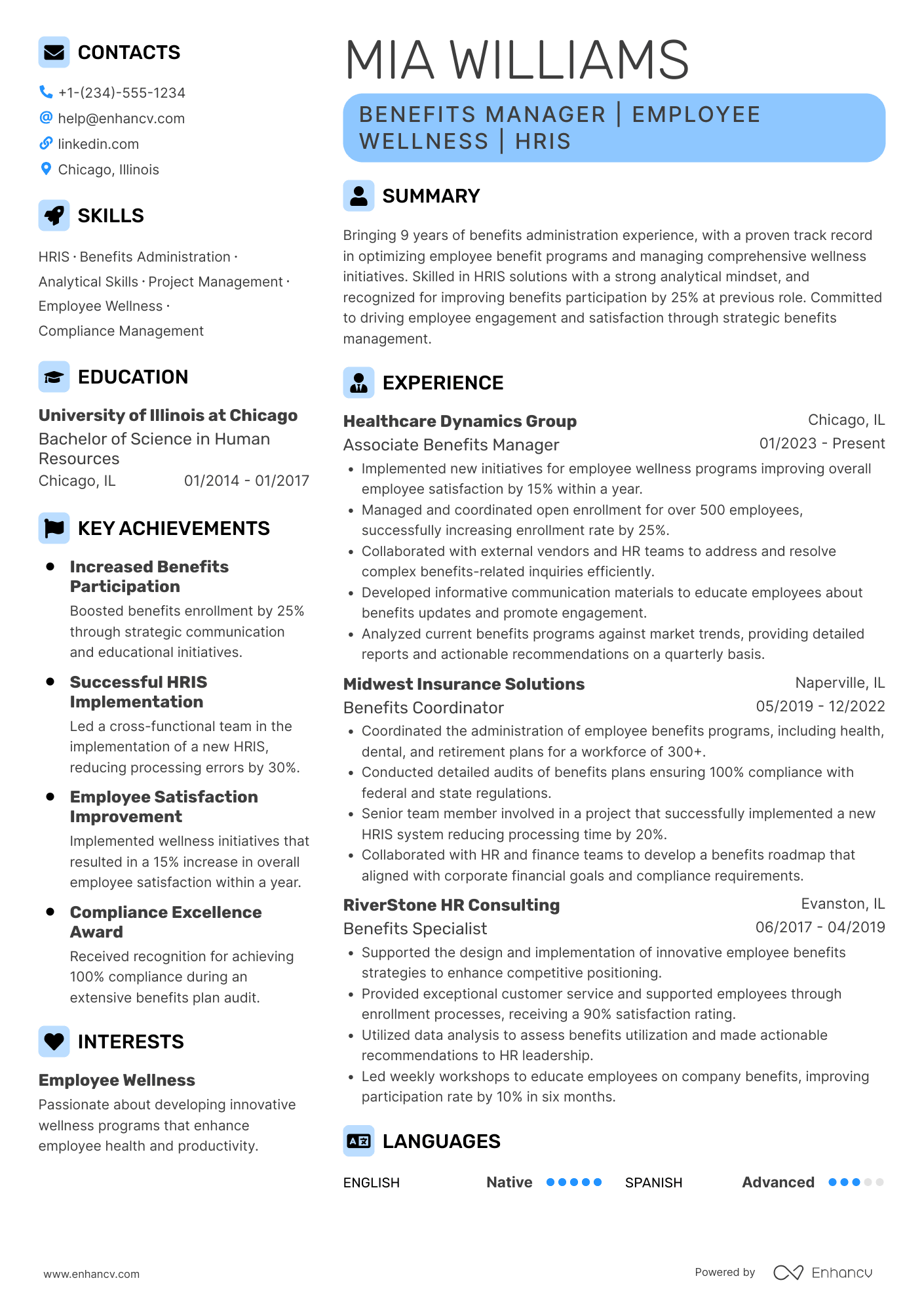
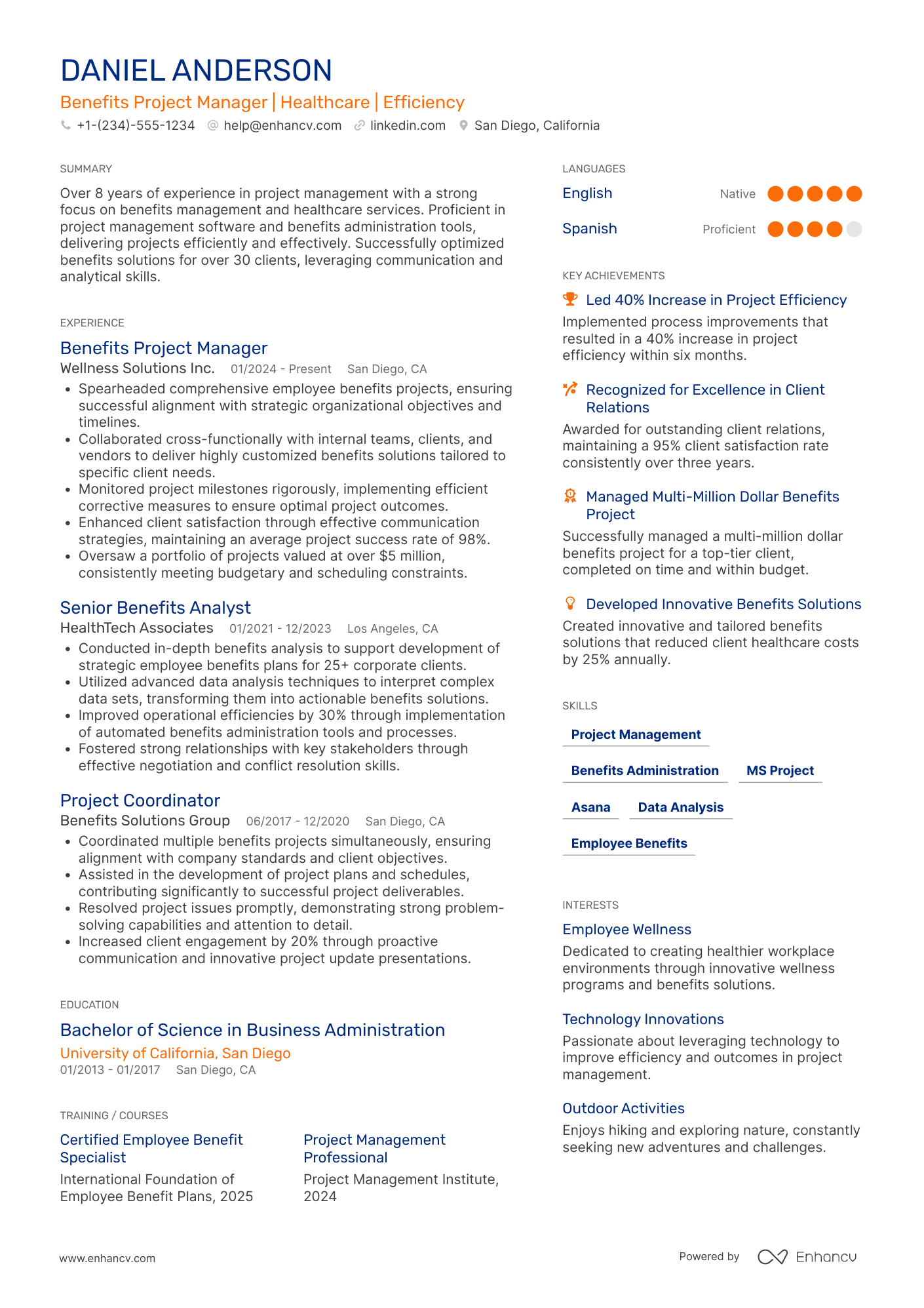
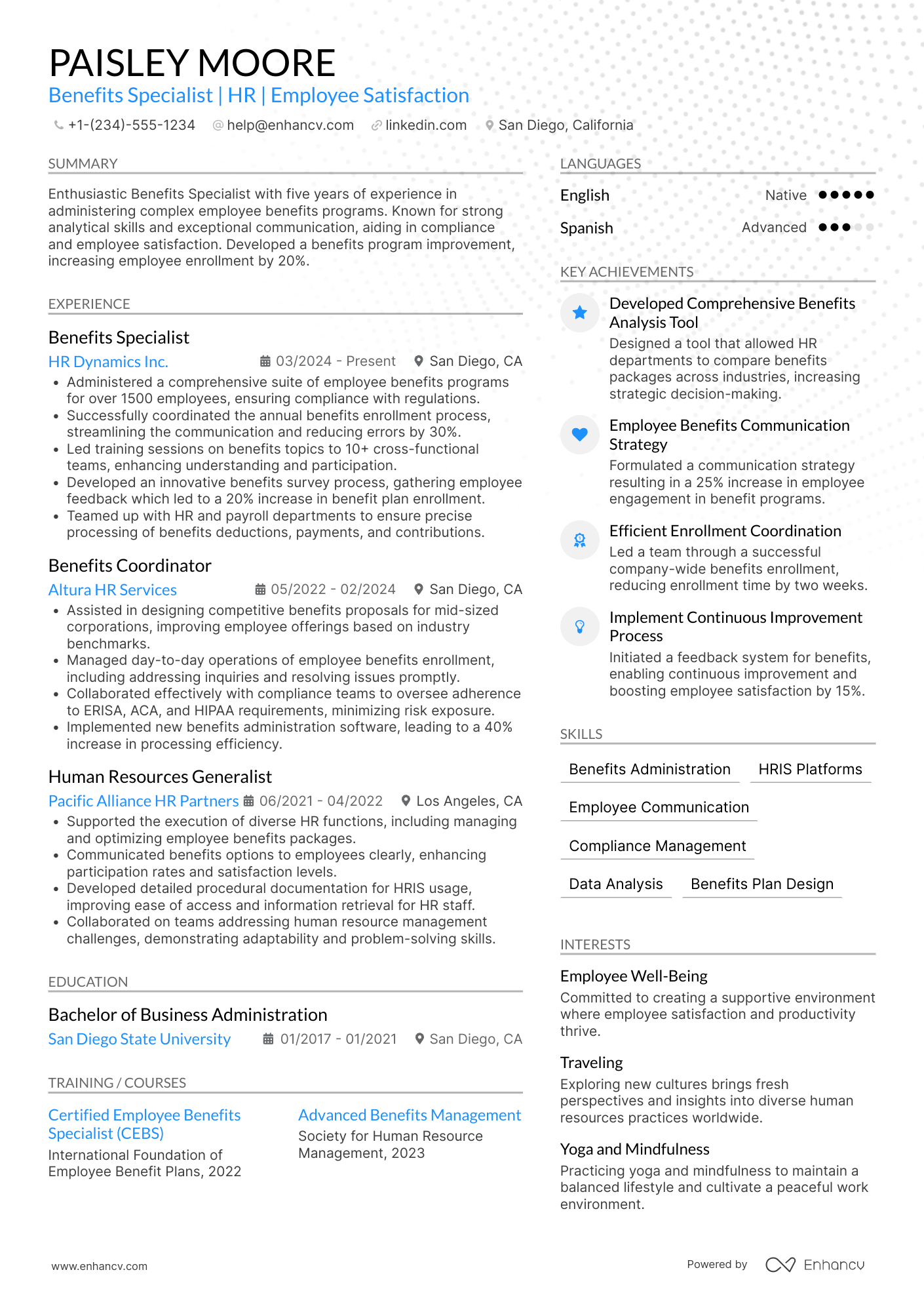
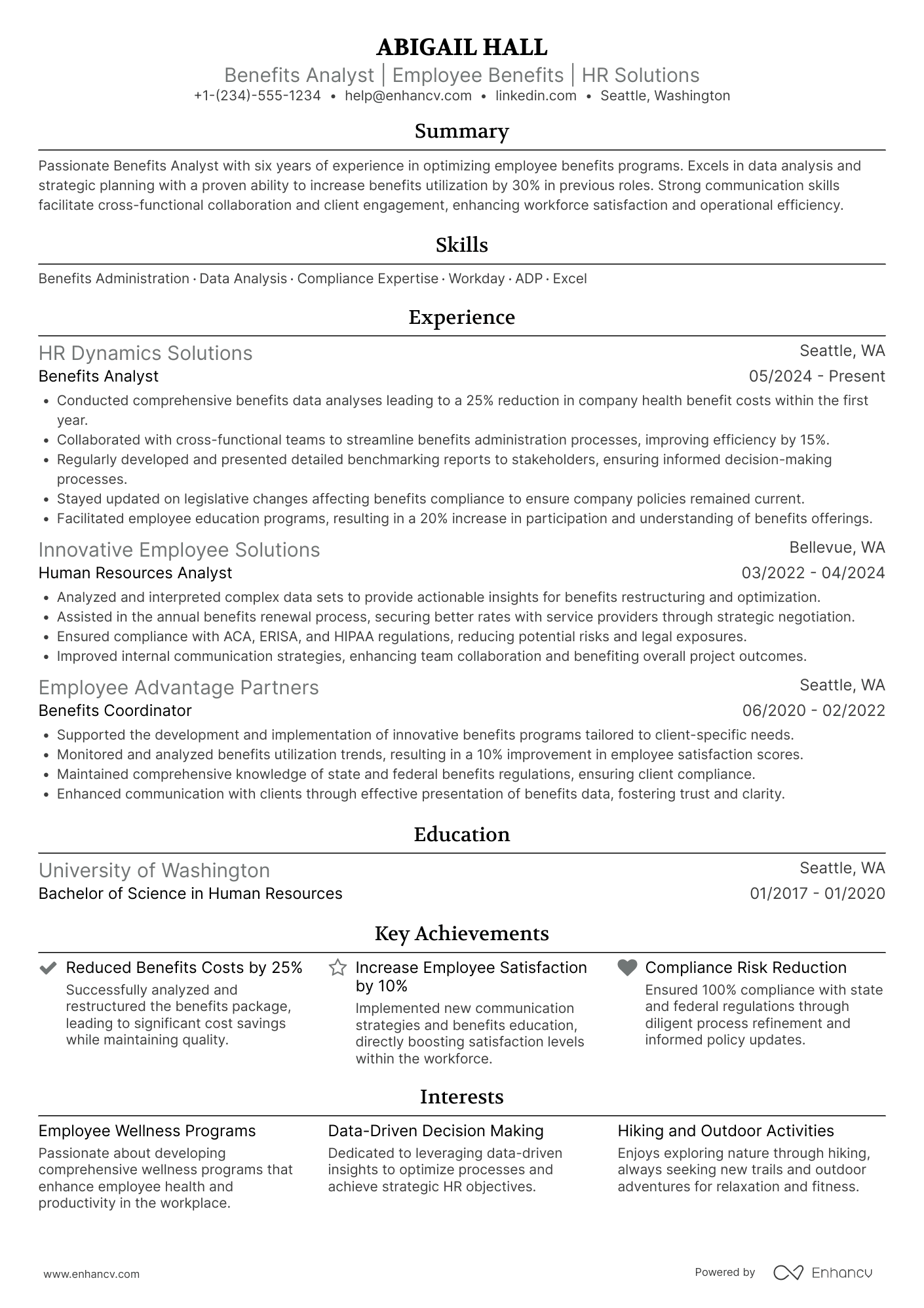
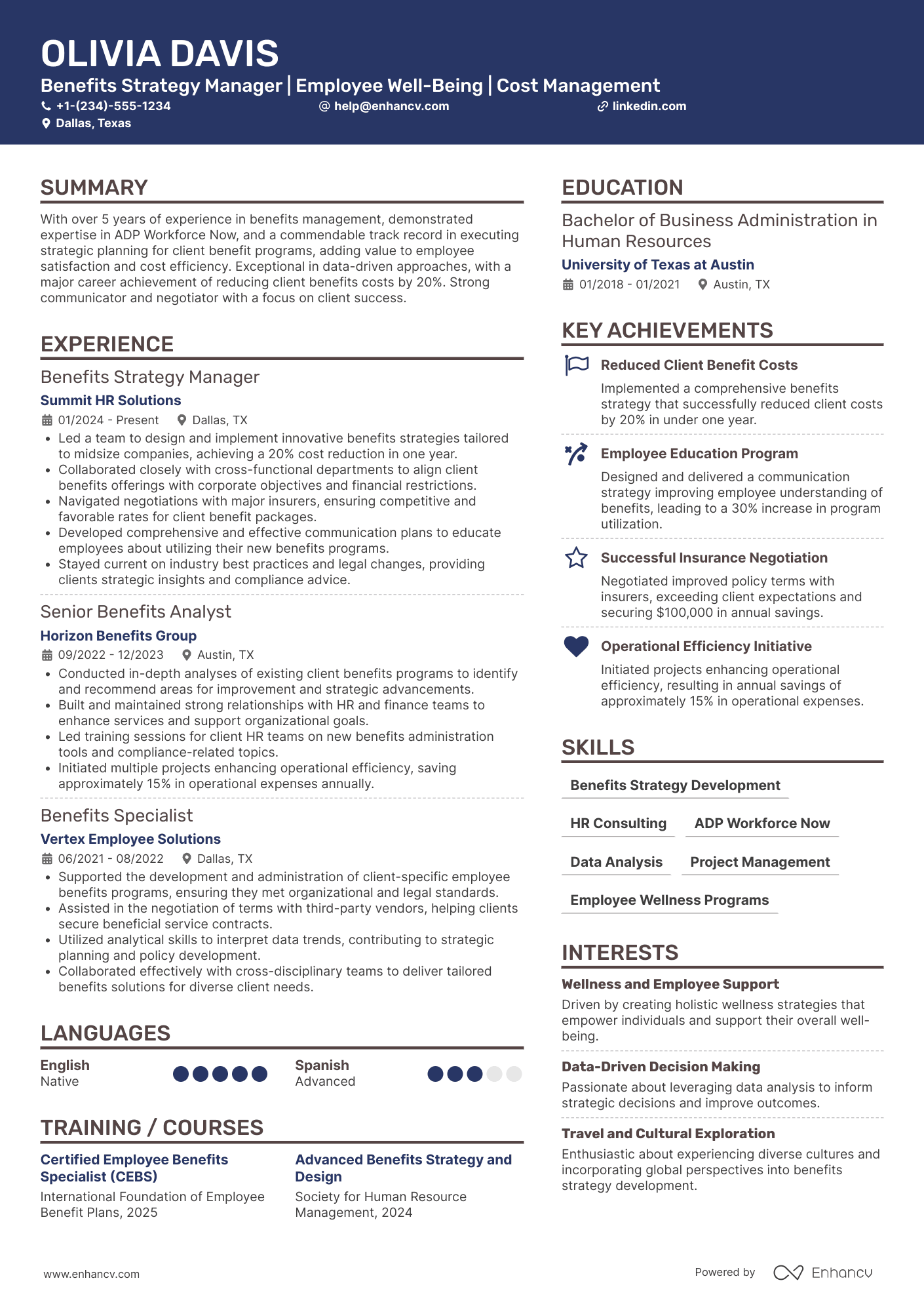
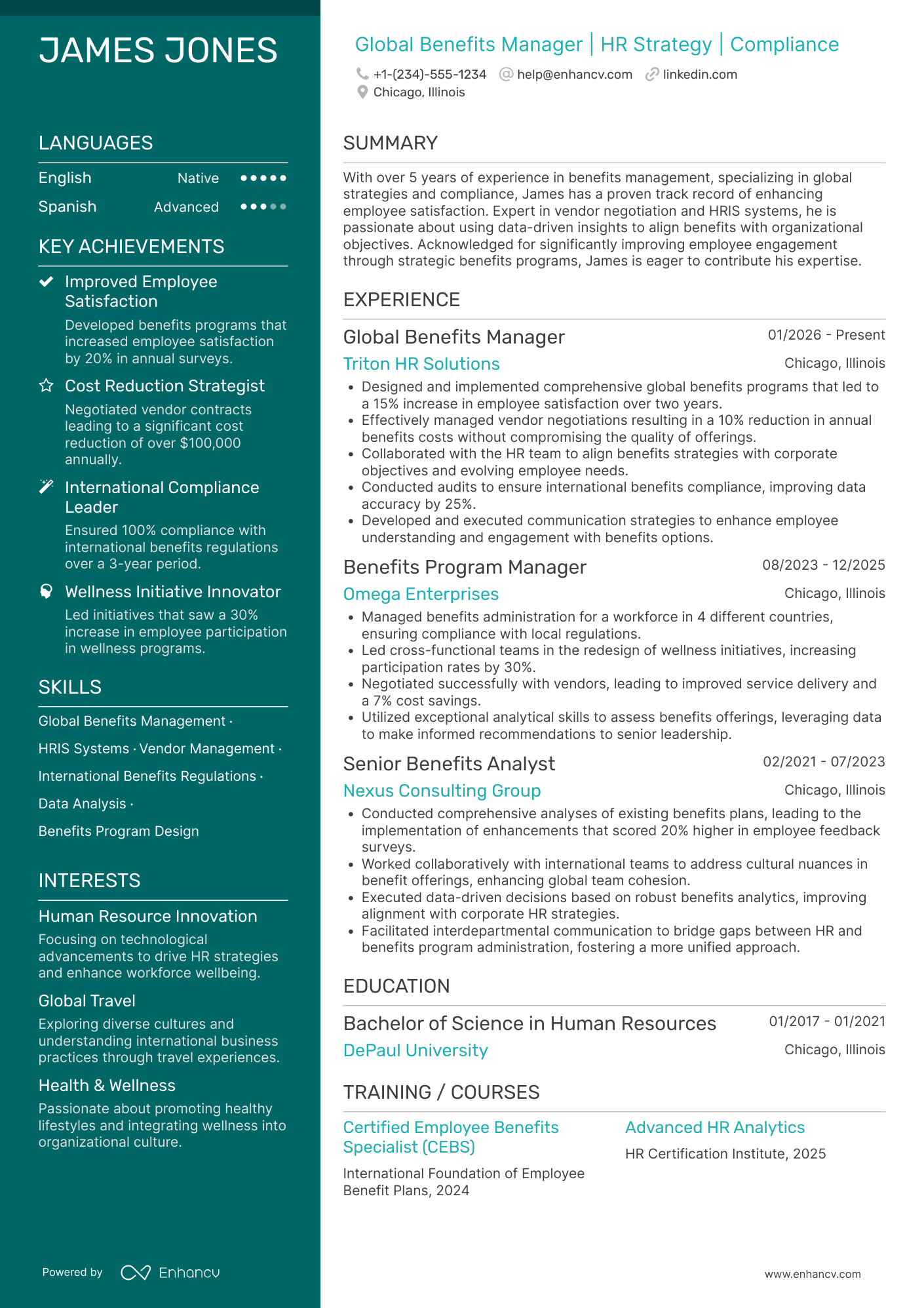
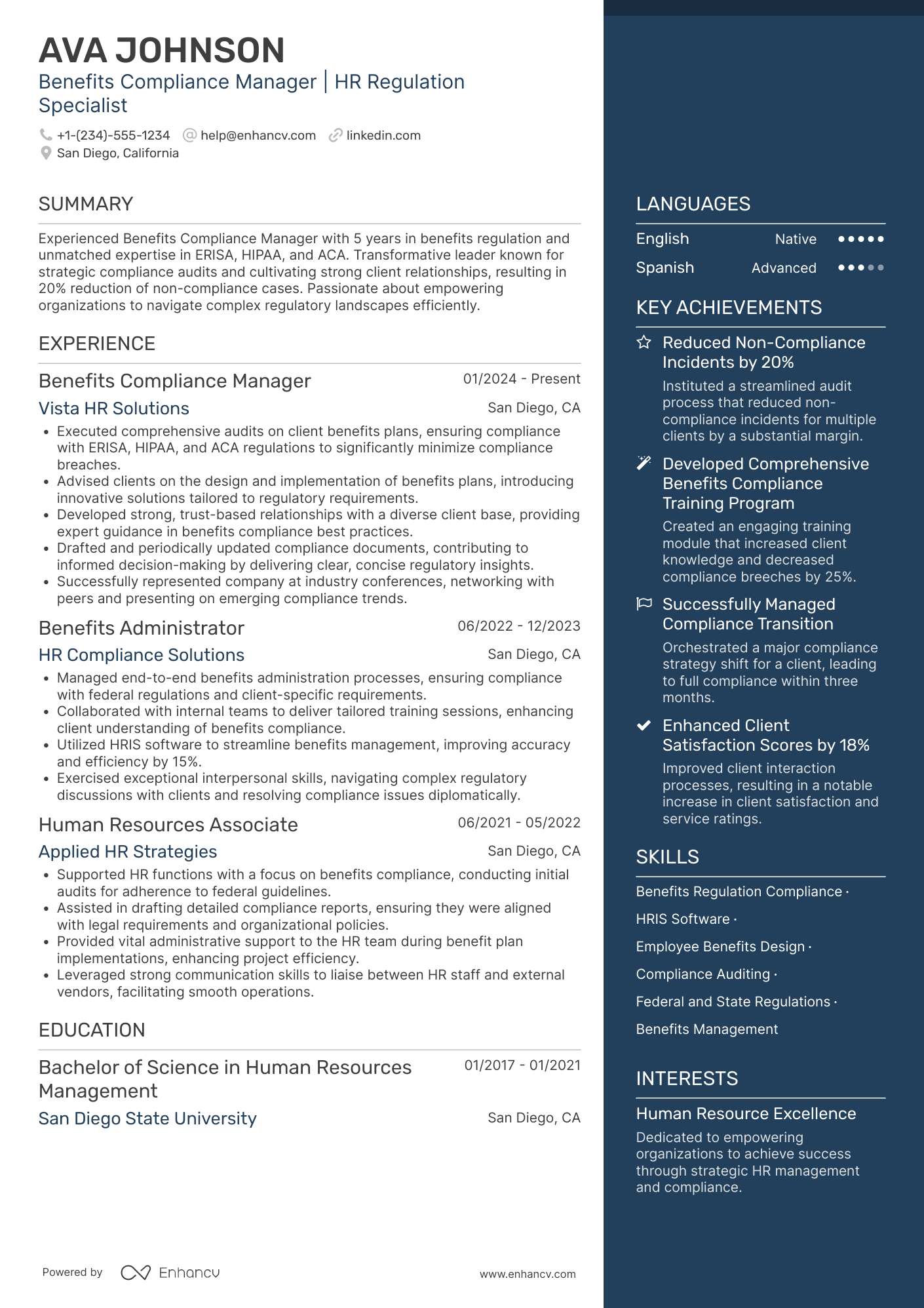
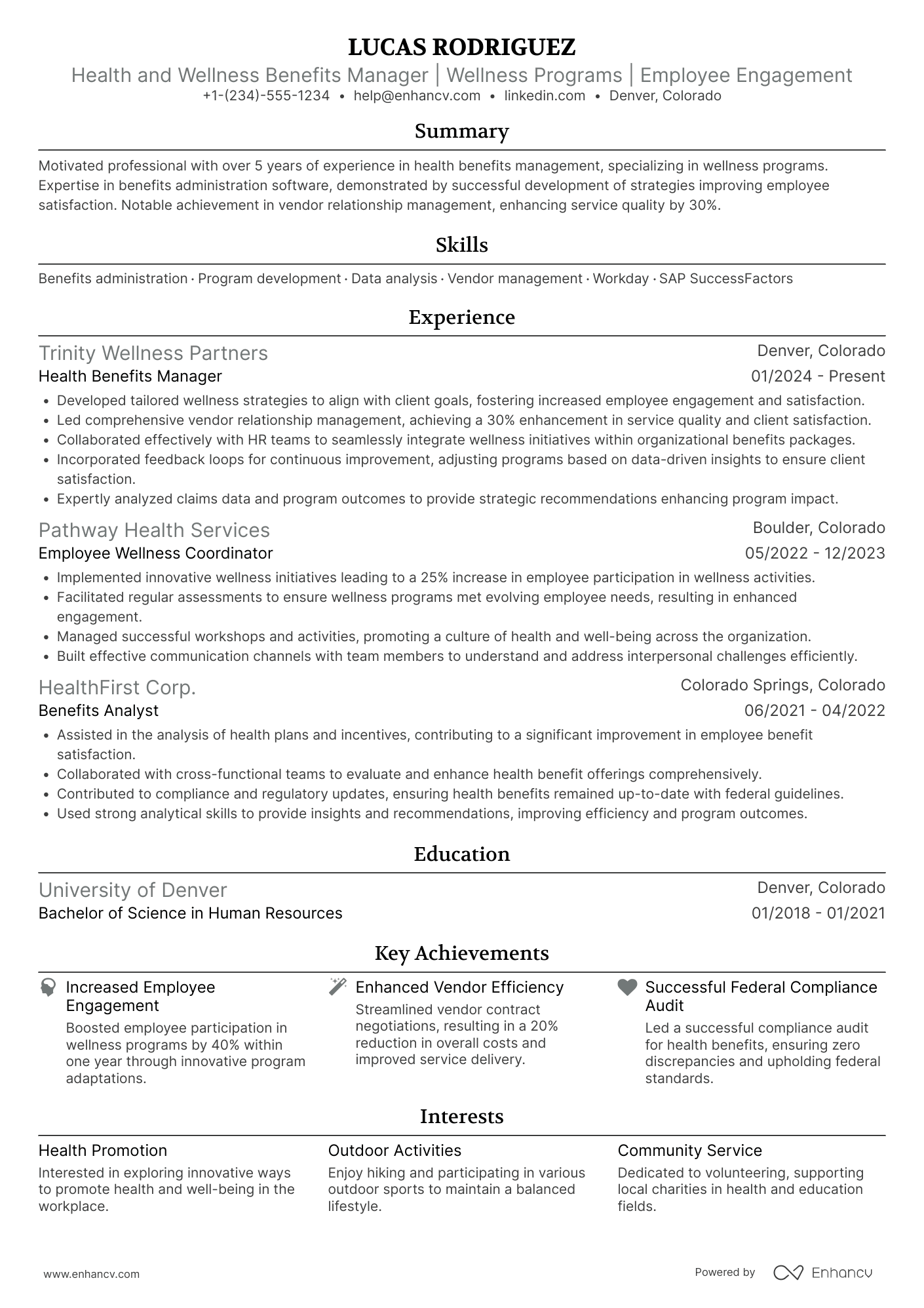
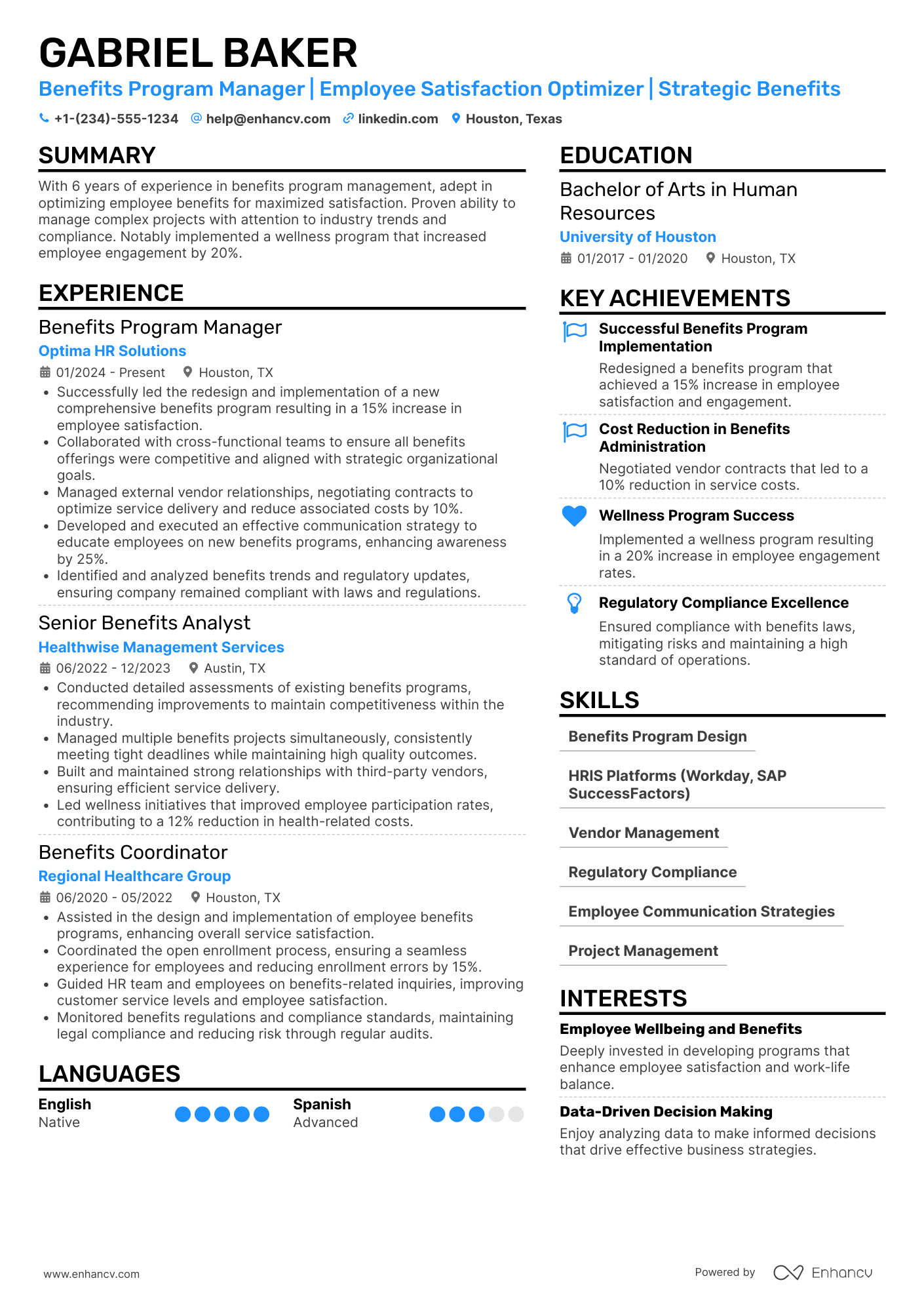
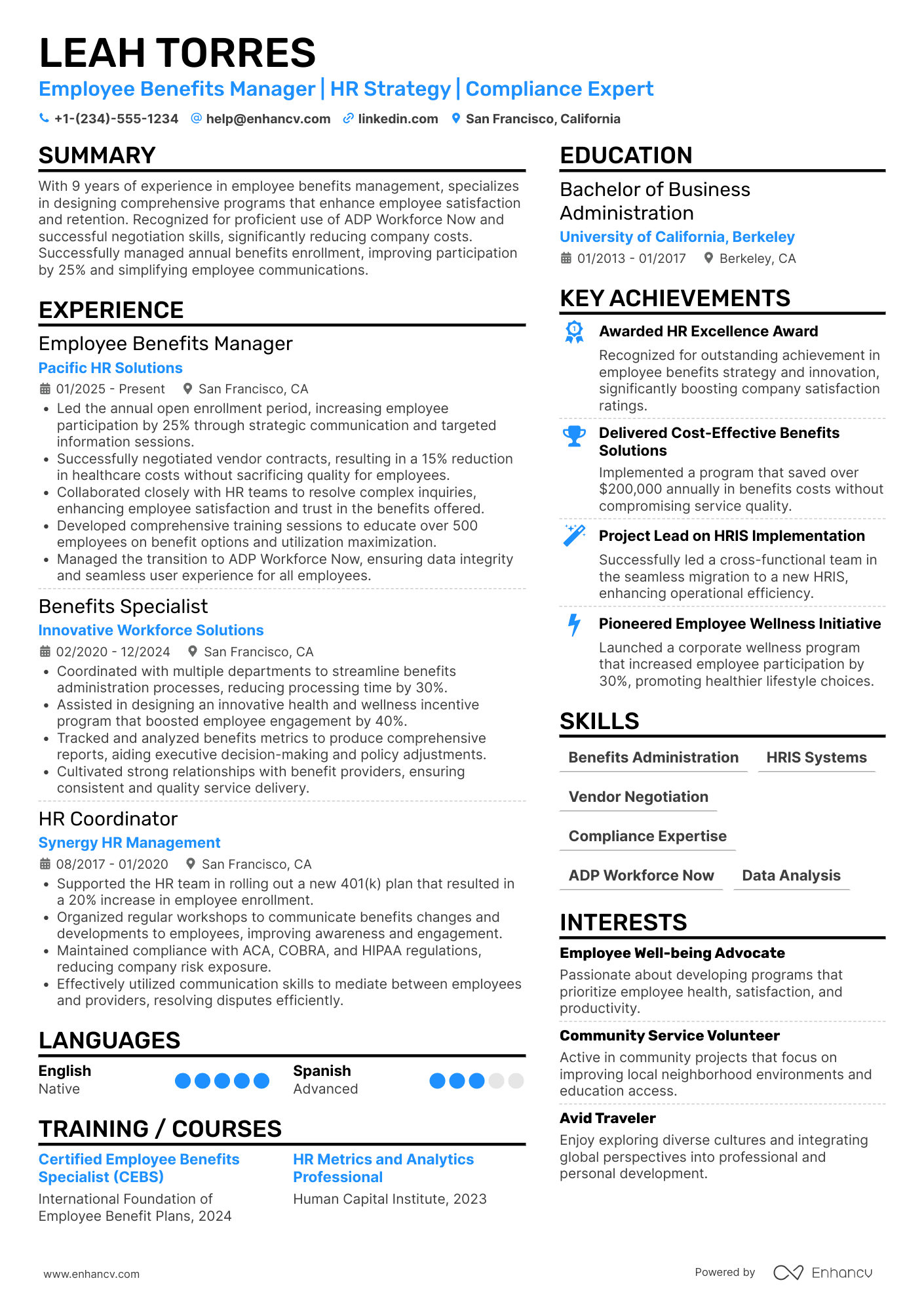
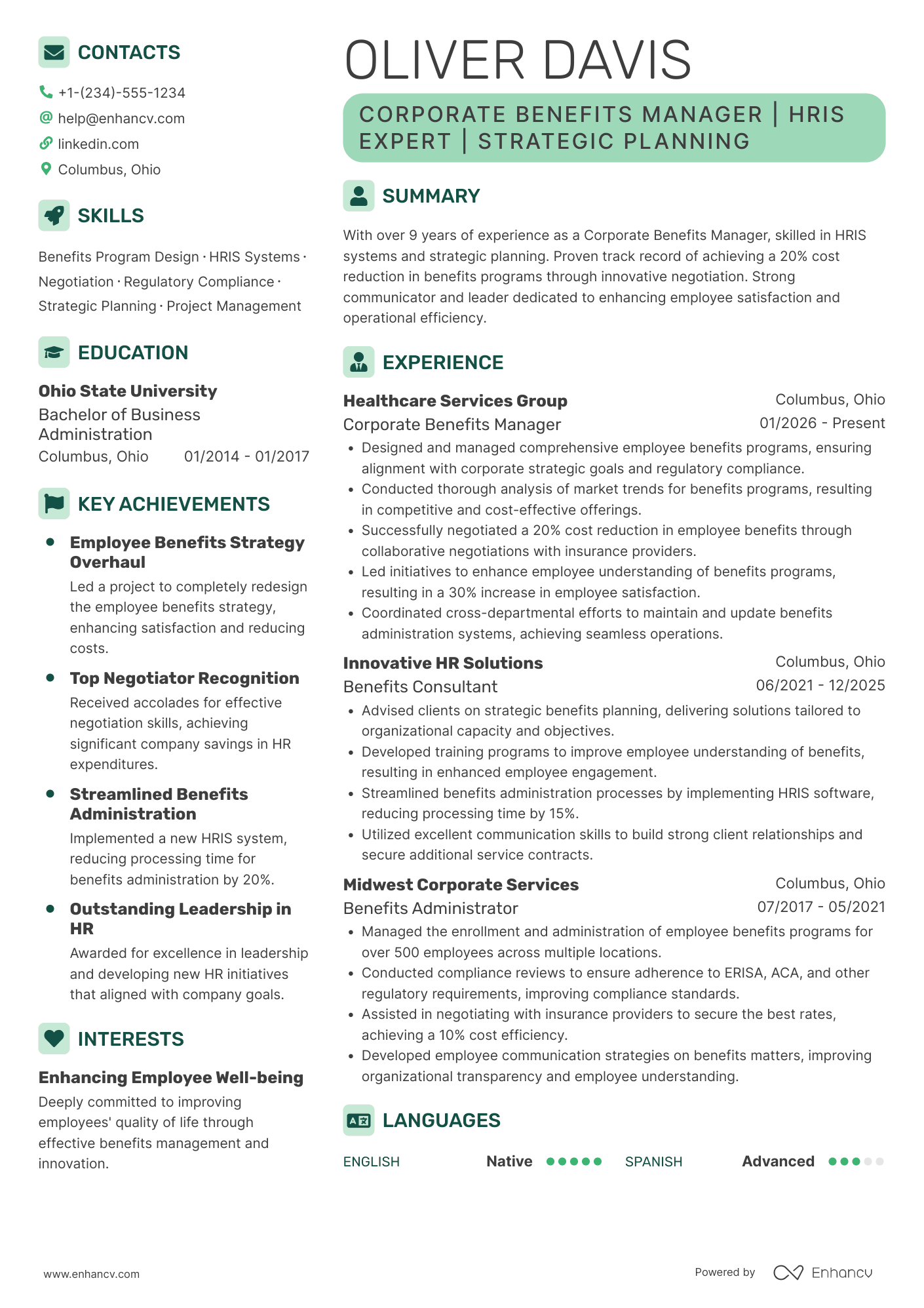
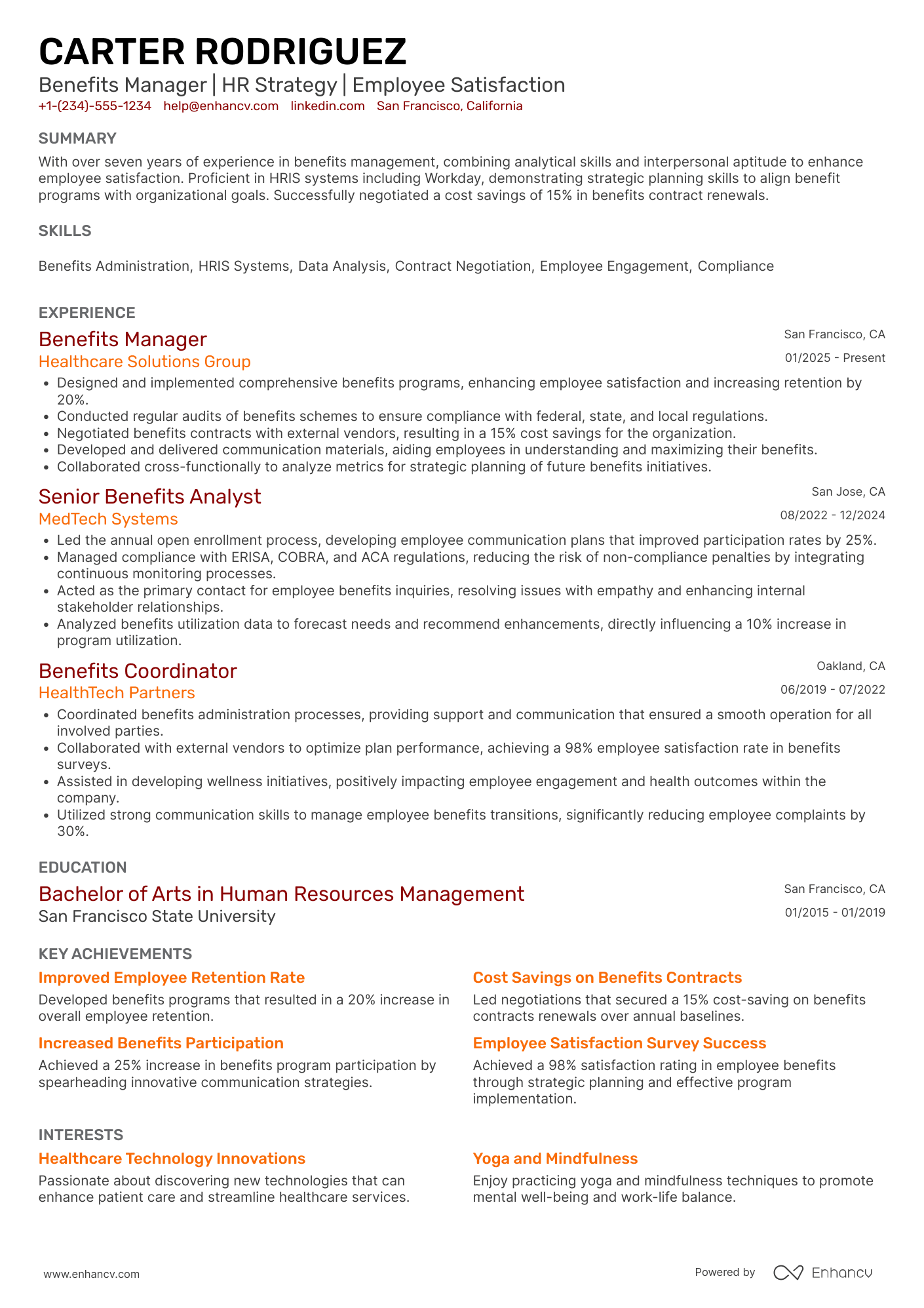
Many benefits manager resume drafts fail because they list plan administration tasks without showing scale, cost impact, or compliance outcomes. That gap gets you filtered by applicant tracking systems and missed in fast recruiter scans in a crowded market.
A strong resume shows what you delivered and why it mattered. If you're unsure where to begin, learning how to write a resume that highlights impact is a critical first step. You should quantify savings from renewals, claims trend reductions, enrollment lift, audit outcomes, vendor performance gains, and employee satisfaction improvements across eligible populations and locations.

Key takeaways
- Quantify benefits achievements with cost savings, enrollment rates, and compliance audit results.
- Use reverse-chronological format if you have direct benefits management experience showing progression.
- Mirror the job posting's exact tools, compliance terms, and KPIs in your experience bullets.
- Pair every listed skill with a measurable outcome in your summary or experience section.
- Add certifications like CEBS, PHR, or SHRM-CP to signal specialized, current benefits expertise.
- Use AI to refine language and add metrics, but stop before it overrides your real experience.
- Build a results-driven resume faster with Enhancv to align each section with recruiter expectations.
Job market snapshot for benefits managers
We analyzed 122 recent benefits manager job ads across major US job boards. These numbers help you understand employer expectations, salary landscape, industry demand at a glance.
What level of experience employers are looking for benefits managers
| Years of Experience | Percentage found in job ads |
|---|---|
| 1–2 years | 1.6% (2) |
| 3–4 years | 27.9% (34) |
| 5–6 years | 13.1% (16) |
| 7–8 years | 11.5% (14) |
| 9–10 years | 6.6% (8) |
| 10+ years | 6.6% (8) |
| Not specified | 39.3% (48) |
Benefits manager ads by area of specialization (industry)
| Industry (Area) | Percentage found in job ads |
|---|---|
| Finance & Banking | 49.2% (60) |
| Healthcare | 43.4% (53) |
Top companies hiring benefits managers
| Company | Percentage found in job ads |
|---|---|
| Elevance Health | 20.5% (25) |
| CVS Health | 10.7% (13) |
Role overview stats
These tables show the most common responsibilities and employment types for benefits manager roles. Use them to align your resume with what employers expect and to understand how the role is structured across the market.
Day-to-day activities and top responsibilities for a benefits manager
| Responsibility | Percentage found in job ads |
|---|---|
| Hris | 26.2% (32) |
| Erisa | 17.2% (21) |
| Aca | 15.6% (19) |
| Microsoft excel | 15.6% (19) |
| Benefits administration | 13.9% (17) |
| Project management | 13.9% (17) |
| Data analysis | 13.1% (16) |
| Hipaa | 13.1% (16) |
| Agile | 12.3% (15) |
| Microsoft office | 9.8% (12) |
| Excel | 9.0% (11) |
| Workday | 9.0% (11) |
Type of employment (remote vs on-site vs hybrid)
| Employment type | Percentage found in job ads |
|---|---|
| On-site | 45.9% (56) |
| Hybrid | 36.9% (45) |
| Remote | 17.2% (21) |
How to format a benefits manager resume
Recruiters evaluating benefits manager resumes prioritize demonstrated expertise in plan design, compliance management, vendor negotiations, and cost-containment strategies—alongside clear evidence of cross-functional collaboration with HR leadership and finance teams. A well-chosen resume format ensures these signals surface quickly, both for human reviewers scanning in seconds and for applicant tracking systems parsing your content.

I have significant experience in this role—which format should I use?
Use a reverse-chronological format to present your benefits management career in a clear, progression-driven timeline. Do:
- Lead each role entry with your scope of ownership—number of employees covered, plan types managed, and budget authority.
- Highlight domain-specific expertise such as ERISA compliance, self-funded plan administration, benefits benchmarking tools, and HRIS platforms like Workday or ADP.
- Quantify outcomes tied to cost savings, enrollment improvements, employee satisfaction scores, or regulatory audit results.
I'm junior or switching into this role—what format works best?
A hybrid format works best, letting you lead with a targeted skills section while still showing relevant work history in chronological order. Do:
- Place core competencies—benefits administration, open enrollment coordination, compliance monitoring—near the top of your resume so recruiters and ATS systems register them immediately.
- Include project-based experience such as benefits onboarding initiatives, vendor evaluation support, or HRIS data migration work, even if it came from adjacent HR roles.
- Connect every action to a measurable result, no matter how small the scope.
Why not use a functional resume?
A functional format strips away the timeline context that recruiters need to evaluate how your benefits knowledge was built and applied in real workplace settings.
- Career change with transferable skills: You're moving from a generalist HR, payroll, or insurance role and need to reframe compliance, vendor management, or data analysis skills toward benefits-specific responsibilities.
- Limited direct benefits experience: You've completed a CEBS certification or benefits-focused coursework and supported open enrollment or plan administration as part of a broader HR role, but haven't held a dedicated benefits title.
Once your layout and formatting choices are in place, the next step is deciding which sections to include so each one reinforces your qualifications.
What sections should go on a benefits manager resume
Recruiters expect a benefits manager resume to clearly show your benefits administration expertise, compliance knowledge, and measurable program results. Understanding what to put on a resume for this role helps you prioritize the right content. Use this structure for maximum clarity:
- Header
- Summary
- Experience
- Skills
- Projects
- Education
- Certifications
- Optional sections: Awards, Leadership, Languages
Strong experience bullets should emphasize cost savings, compliance outcomes, enrollment or participation improvements, vendor performance, and the scale of programs you managed.
Is your resume good enough?
Drop your resume here or choose a file. PDF & DOCX only. Max 2MB file size.
Once you’ve organized the key resume components, the next step is to write your benefits manager resume experience section to show how you’ve delivered results in those areas.
How to write your benefits manager resume experience
Your experience section should showcase the benefits programs you've designed, implemented, and optimized—along with the tools, compliance frameworks, and enrollment platforms you used to deliver measurable results. Hiring managers prioritize demonstrated impact on cost savings, employee satisfaction, and regulatory compliance over descriptive task lists. Building a targeted resume that aligns each bullet with the employer's priorities is essential for standing out.
Each entry should include:
- Job title
- Company and location (or remote)
- Dates of employment (month and year)
Three to five concise bullet points showing what you owned, how you executed, and what outcomes you delivered:
- Ownership scope: the benefits programs, vendor relationships, open enrollment cycles, wellness initiatives, or employee populations you were directly accountable for as a benefits manager.
- Execution approach: the HRIS platforms, benefits administration systems, data analytics tools, benchmarking methods, or compliance frameworks you used to evaluate plan performance and inform decision-making.
- Value improved: changes to plan cost-effectiveness, enrollment accuracy, claims processing efficiency, regulatory compliance, employee access to benefits, or reduction in administrative risk tied to your benefits management work.
- Collaboration context: how you partnered with brokers, insurance carriers, legal counsel, payroll teams, HR leadership, or finance stakeholders to align benefits strategy with organizational goals.
- Impact delivered: outcomes expressed through improvements in retention, cost containment, benefits utilization, audit readiness, or employee engagement rather than routine administrative activity.
Experience bullet formula
A benefits manager experience example
✅ Right example - modern, quantified, specific.
Benefits Manager
BrightWave Logistics | Chicago, IL
2021–Present
National third-party logistics company supporting five thousand employees across thirty-two sites in a high-volume, hourly workforce environment.
- Led annual open enrollment in Workday and bswift for five thousand employees; increased enrollment completion from eighty-six percent to ninety-six percent and cut HR ticket volume by thirty-two percent through targeted campaigns and redesigned decision-support content.
- Negotiated medical, dental, vision, and life renewals with three carriers using claims experience and benchmarking; held total benefits cost trend to four-point-one percent versus seven-point-zero percent prior year, saving one-point-two million dollars while maintaining plan richness.
- Implemented dependent eligibility verification with a third-party vendor and audit rules in Workday; removed eight percent in ineligible dependents and reduced annual premium leakage by six hundred fifty thousand dollars.
- Built a monthly benefits analytics dashboard in Power BI using Workday and carrier eligibility feeds; improved eligibility file accuracy from ninety-seven-point-two percent to ninety-nine-point-six percent and reduced carrier reconciliation cycle time from ten days to four days.
- Partnered with Finance, Legal, and the benefits broker to update plan documents, Summary Plan Descriptions, and ERISA (Employee Retirement Income Security Act) disclosures; closed a Department of Labor audit with zero findings and reduced compliance review time by twenty-five percent via standardized checklists and version control.
Now that you've seen what a strong experience section looks like in practice, let's break down how to adapt yours to match the specific role you're targeting.
How to tailor your benefits manager resume experience
Recruiters evaluate your benefits manager resume through both applicant tracking systems and human review, so tailoring your resume to the job description is essential. Tailoring ensures the skills, tools, and accomplishments you highlight directly reflect what the employer is looking for.
Ways to tailor your benefits manager experience:
- Mirror the benefits administration platforms and HRIS tools listed in the posting.
- Match terminology for compliance standards like ERISA ACA or HIPAA.
- Reflect specific KPIs such as enrollment rates or cost containment targets.
- Highlight vendor management experience when the role requires carrier negotiations.
- Emphasize open enrollment strategy if the posting prioritizes annual benefits cycles.
- Include leave administration or wellness program oversight when explicitly requested.
- Align your experience with the collaboration models referenced like cross-functional HR teams.
- Showcase data analysis skills if the role calls for benchmarking or reporting.
Tailoring means connecting your real accomplishments to what the employer values rather than forcing keywords into your experience section.
Resume tailoring examples for benefits manager
| Job description excerpt | Untailored | Tailored |
|---|---|---|
| Administer employee benefits programs including medical, dental, vision, and 401(k) plans using Workday; ensure compliance with ERISA, ACA, and COBRA regulations. | Managed employee benefits and handled compliance tasks. | Administered medical, dental, vision, and 401(k) plans for 2,500+ employees in Workday, maintaining full compliance with ERISA, ACA, and COBRA through quarterly audits and updated SOPs. |
| Lead annual open enrollment strategy, coordinate with brokers and carriers, and analyze plan utilization data to recommend cost-effective plan designs. | Helped with open enrollment and worked with vendors. | Led annual open enrollment for three consecutive cycles, negotiating with brokers and carriers to restructure plan designs—reducing employer premium costs by 12% while improving employee participation by 9%. |
| Manage leave of absence programs (FMLA, ADA, state leave laws) and serve as the primary point of contact for benefits-related employee inquiries, resolving escalations within 48 hours. | Answered employee questions about benefits and time off. | Managed FMLA, ADA, and state leave programs for a multi-state workforce of 1,800 employees, serving as the primary benefits contact and resolving 95% of escalated inquiries within the 48-hour SLA. |
Once your experience aligns with the role’s priorities, the next step is to quantify your benefits manager achievements so hiring teams can see the results you delivered.
How to quantify your benefits manager achievements
Quantifying your achievements proves you improved cost, compliance, and employee experience. Focus on spend per employee, enrollment accuracy, issue resolution time, audit findings, and participation rates across medical, dental, vision, life, and retirement plans.
Quantifying examples for benefits manager
| Metric | Example |
|---|---|
| Cost savings | "Reduced annual benefits spend by $420K by renegotiating medical renewals with broker and carriers, holding plan design changes to a 3% premium increase for 1,200 employees." |
| Enrollment accuracy | "Cut open enrollment errors from 2.3% to 0.6% by auditing eligibility rules in Workday and validating EDI files with carriers before go-live." |
| Cycle time | "Reduced benefits ticket resolution time from five days to two days by implementing ServiceNow routing, templates, and weekly carrier escalation reviews." |
| Compliance risk | "Passed a Department of Labor audit with zero findings by tightening ERISA documentation, updating summary plan descriptions, and tracking required notices in a compliance calendar." |
| Participation rate | "Increased health savings account enrollment from 38% to 52% by redesigning decision-support content and running three webinars with 600 attendees." |
Turn vague job duties into measurable, recruiter-ready resume bullets in seconds with Enhancv's Bullet Point Generator.
Once you've crafted strong bullet points that highlight your accomplishments, the next step is ensuring your resume also showcases the right mix of hard and soft skills that benefits manager roles demand.
How to list your hard and soft skills on a benefits manager resume
Your skills section matters because benefits managers drive plan design, compliance, and employee experience, and recruiters and an ATS (applicant tracking system) scan this section to confirm fit—aim for a mix of hard skills and role-specific soft skills. benefits manager roles require a blend of:
- Product strategy and discovery skills.
- Data, analytics, and experimentation skills.
- Delivery, execution, and go-to-market discipline.
- Soft skills.
Your skills section should be:
- Scannable (bullet-style grouping).
- Relevant to the job post.
- Backed by proof in experience bullets.
- Updated with current tools.
Place your skills section:
- Above experience if you're junior or switching careers.
- Below experience if you're mid/senior with strong achievements.

Hard skills
- Benefits plan design
- Open enrollment management
- Vendor and broker management
- Request for proposal process
- Total rewards strategy
- Health and welfare benefits
- Retirement plans, 401(k) administration
- Compliance: ERISA, ACA, COBRA, HIPAA
- Leave administration: FMLA, state leaves
- Human resources information system (Workday, ADP, UKG)
- Benefits administration platforms: bswift, Benefitfocus
- Data reporting, Excel, dashboards
Soft skills
- Stakeholder alignment across HR and Finance
- Clear employee-facing communication
- Vendor negotiations and escalation handling
- Policy writing and documentation
- Prioritization under enrollment deadlines
- Risk-based decision-making
- Cross-functional project leadership
- Confidentiality and sound judgment
- Process improvement ownership
- Change management for plan updates
- Coaching HR partners and managers
- Issue triage and root-cause analysis
How to show your benefits manager skills in context
Skills shouldn't live only in a bulleted list on your resume. Explore resume skills examples to see how top candidates integrate competencies throughout their documents.
They should be demonstrated in:
- Your summary (high-level professional identity)
- Your experience (proof through outcomes)
Here's what both look like in practice.
Summary example
Senior benefits manager with 10+ years designing scalable health, retirement, and wellness programs using Workday and ADP. Led a multistate open enrollment overhaul that boosted participation by 22% while reducing administrative costs through streamlined vendor negotiations.
- Reflects senior-level experience clearly
- Names industry-standard tools immediately
- Quantifies enrollment and cost outcomes
- Signals vendor negotiation soft skills
Experience example
Senior Benefits Manager
Covington Health Partners | Remote
March 2019–Present
- Redesigned the company's benefits enrollment workflow in Workday, cutting processing time by 35% across 12 regional offices.
- Partnered with HR leadership and finance to renegotiate carrier contracts, saving $480K annually while maintaining plan quality.
- Launched a voluntary wellness initiative tracked through ADP, driving a 28% increase in employee participation within one year.
- Every bullet includes measurable proof
- Skills surface naturally through real outcomes
Once you’ve tied your benefits manager skills to real outcomes, the next step is applying that approach to a benefits manager resume when you don’t have direct experience.
How do I write a benefits manager resume with no experience
Even without full-time experience, you can demonstrate readiness through:
- HR benefits administration internship
- Open enrollment volunteer coordination
- Benefits data audits in spreadsheets
- Human resources information system coursework labs
- Employee benefits compliance research project
- Insurance carrier liaison shadowing
- Benefits communication writing samples
- Payroll and deductions reconciliation project
If you're entering the field without a traditional background, our guide on writing a resume without work experience offers strategies to showcase transferable skills and projects effectively.
Focus on:
- Benefits compliance and documentation accuracy
- Data analysis and reconciliation results
- Human resources information system exposure
- Enrollment support and issue resolution
Resume format tip for entry-level benefits manager
Use a hybrid resume format because it highlights benefits-relevant skills and projects first, while still showing a clean timeline for internships and coursework. Do:
- Add a "Projects" section near the top.
- List tools: Excel, human resources information system.
- Quantify results: error rate, time saved.
- Mirror benefits manager keywords from postings.
- Include compliance topics: ERISA, HIPAA.
- Reconciled payroll deductions against enrollment files in Excel, flagged twenty-three discrepancies, and reduced billing errors by 12% in one month.
Even without direct experience, your educational background can serve as a strong foundation for your benefits manager resume—here's how to present it effectively.
How to list your education on a benefits manager resume
Your education section helps hiring teams confirm you have the foundational knowledge needed for a benefits manager role. It validates your expertise in HR, business, or related fields.
Include:
- Degree name
- Institution
- Location
- Graduation year
- Relevant coursework (for juniors or entry-level candidates)
- Honors & GPA (if 3.5 or higher)
Skip month and day details—list the graduation year only.
Here's a strong education entry tailored to the benefits manager role.
Example education entry
Bachelor of Science in Human Resource Management
University of Illinois at Urbana-Champaign, Urbana, IL
Graduated 2019
GPA: 3.7/4.0
- Relevant coursework: Compensation and Benefits Design, Employment Law, Organizational Behavior, Business Analytics
- Honors: Magna Cum Laude, Dean's List (six consecutive semesters)
How to list your certifications on a benefits manager resume
Certifications on your resume show a benefits manager's commitment to ongoing learning, proficiency with benefits tools and compliance topics, and alignment with current industry standards.
Include:
- Certificate name
- Issuing organization
- Year
- Optional: credential ID or URL
- Place certifications below education when your degrees are recent and certifications add support, not a stronger signal than your academic background.
- Place certifications above education when they are recent, highly relevant to benefits manager work, or required for the roles you target.
Best certifications for your benefits manager resume
- Certified Employee Benefit Specialist (CEBS)
- Professional in Human Resources (PHR)
- Senior Professional in Human Resources (SPHR)
- Society for Human Resource Management Certified Professional (SHRM-CP)
- Society for Human Resource Management Senior Certified Professional (SHRM-SCP)
- Certified Benefits Professional (CBP)
Once you’ve positioned your credentials where hiring teams can spot them, use your benefits manager resume summary to reinforce those qualifications upfront and frame the value you bring.
How to write your benefits manager resume summary
Your resume summary is the first thing a recruiter reads. A strong one instantly signals you're qualified for the benefits manager role.
Keep it to three to four lines, with:
- Your title and total years of experience in benefits administration or management.
- Domain expertise such as employee benefits, group health plans, or retirement programs.
- Core skills and tools like HRIS platforms, ADP, Workday, or benefits benchmarking software.
- One or two measurable achievements, such as cost savings or enrollment improvements.
- Soft skills tied to outcomes, like vendor negotiation that reduced premiums or communication that boosted participation.

PRO TIP
As a mid-level professional, emphasize program ownership, cost optimization results, and cross-functional collaboration. Highlight how your decisions affected the bottom line or employee satisfaction. Avoid vague descriptors like "passionate" or "team player" without tying them to specific outcomes.
Example summary for a benefits manager
Benefits manager with seven years of experience administering health, retirement, and wellness programs. Renegotiated vendor contracts to cut annual benefits costs by 18%. Skilled in Workday, compliance reporting, and open enrollment strategy.
Optimize your resume summary and objective for ATS
Drop your resume here or choose a file.
PDF & DOCX only. Max 2MB file size.
Now that your summary effectively communicates your value, make sure the header framing it presents your professional details accurately and consistently.
What to include in a benefits manager resume header
A resume header lists your key contact details and role focus, helping benefits manager candidates improve visibility, build credibility, and pass recruiter screening faster.
Essential resume header elements
- Full name
- Tailored job title and headline
- Location
- Phone number
- Professional email
- GitHub link
- Portfolio link
A LinkedIn link helps recruiters verify experience quickly and supports screening with consistent dates, titles, and employer details.
Don't include a photo on a benefits manager resume unless the role is explicitly front-facing or appearance-dependent.
Match your header job title and headline to the posting's wording, and keep every link current, professional, and easy to scan.
Benefits manager resume header
Jordan Taylor
Benefits Manager | Total Rewards and Benefits Administration
Chicago, IL
(312) 555-01XX
jordan.taylor@enhancv.com
github.com/jordantaylor
jordantaylor.com
linkedin.com/in/jordantaylor
Once your contact details and role identifiers are clear at the top, you can strengthen the rest of the document by adding additional sections that support your benefits manager qualifications.
Additional sections for benefits manager resumes
Adding extra sections helps you stand out when your core qualifications match other candidates, giving hiring managers more reasons to choose you. For example, listing language skills can be especially valuable if you support multilingual employee populations or work across international offices.
- Languages
- Professional affiliations (e.g., IFEBP, WorldatWork)
- Certifications and continuing education
- Volunteer experience in employee wellness or advocacy
- Publications or speaking engagements
- Awards and recognitions
- Industry conferences attended
Once you've strengthened your resume with well-chosen additional sections, the next step is pairing it with a cover letter that adds even more context to your candidacy.
Do benefits manager resumes need a cover letter
A cover letter isn't required for a benefits manager, but it often helps in competitive searches or when hiring teams expect one. If you're wondering what a cover letter is and how it complements your resume, it's a targeted document that adds narrative context beyond your bullet points. It can make a difference when your resume needs context, or when you want to show clear fit fast.
Use a cover letter to add value in these situations:
- Explain role or team fit: Connect your experience to the company's benefits strategy, workforce mix, and HR structure.
- Highlight one or two relevant projects or outcomes: Quantify results like cost savings, enrollment gains, vendor performance, or improved compliance.
- Show understanding of the product, users, or business context: Reference the benefits programs, employee needs, and constraints like budgets, unions, or multi-state rules.
- Address career transitions or non-obvious experience: Clarify moves across industries, shifts from generalist roles, or gaps with a direct, job-related explanation.
Drop your resume here or choose a file.
PDF & DOCX only. Max 2MB file size.
Even if you decide to submit a cover letter to add context beyond your resume, the next section shows how using AI can help you strengthen that resume efficiently and consistently.
Using AI to improve your benefits manager resume
AI can sharpen your resume's clarity, structure, and overall impact. It helps refine language and highlight measurable results. However, overusing it risks sounding robotic. Once your content feels clear and role-aligned, step away from AI. For a deeper look at available options, explore which AI is best for writing resumes to find the right tool for your needs.
Here are 10 practical prompts you can copy and paste to strengthen specific sections of your benefits manager resume:
Strengthen your summary
Quantify experience bullets
Align skills with job posts
Tighten action verbs
Improve certification descriptions
Refine education entries
Clarify compliance experience
Showcase project outcomes
Remove filler language
Tailor for ATS readability
Conclusion
A strong benefits manager resume proves impact with measurable outcomes, like cost savings, enrollment gains, and compliance accuracy. It highlights role-specific skills, including plan administration, vendor management, and employee communication. It uses a clear structure with targeted summaries, clean sections, and scannable bullets.
Hiring teams want benefits managers who deliver results and manage change with confidence. A focused, metrics-driven resume shows you can support today’s needs and adapt to near-future priorities. Keep it clear, specific, and results-based.
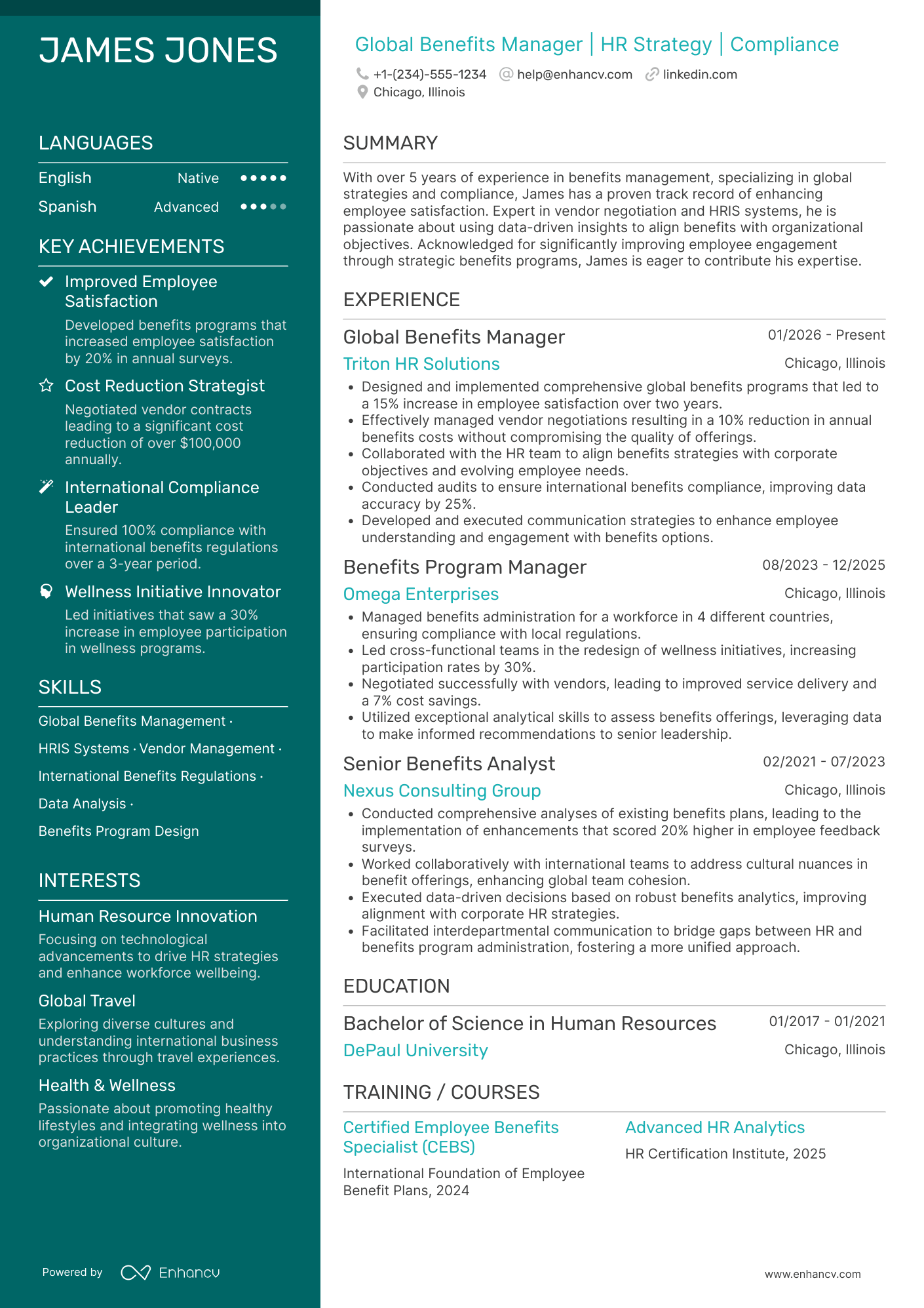
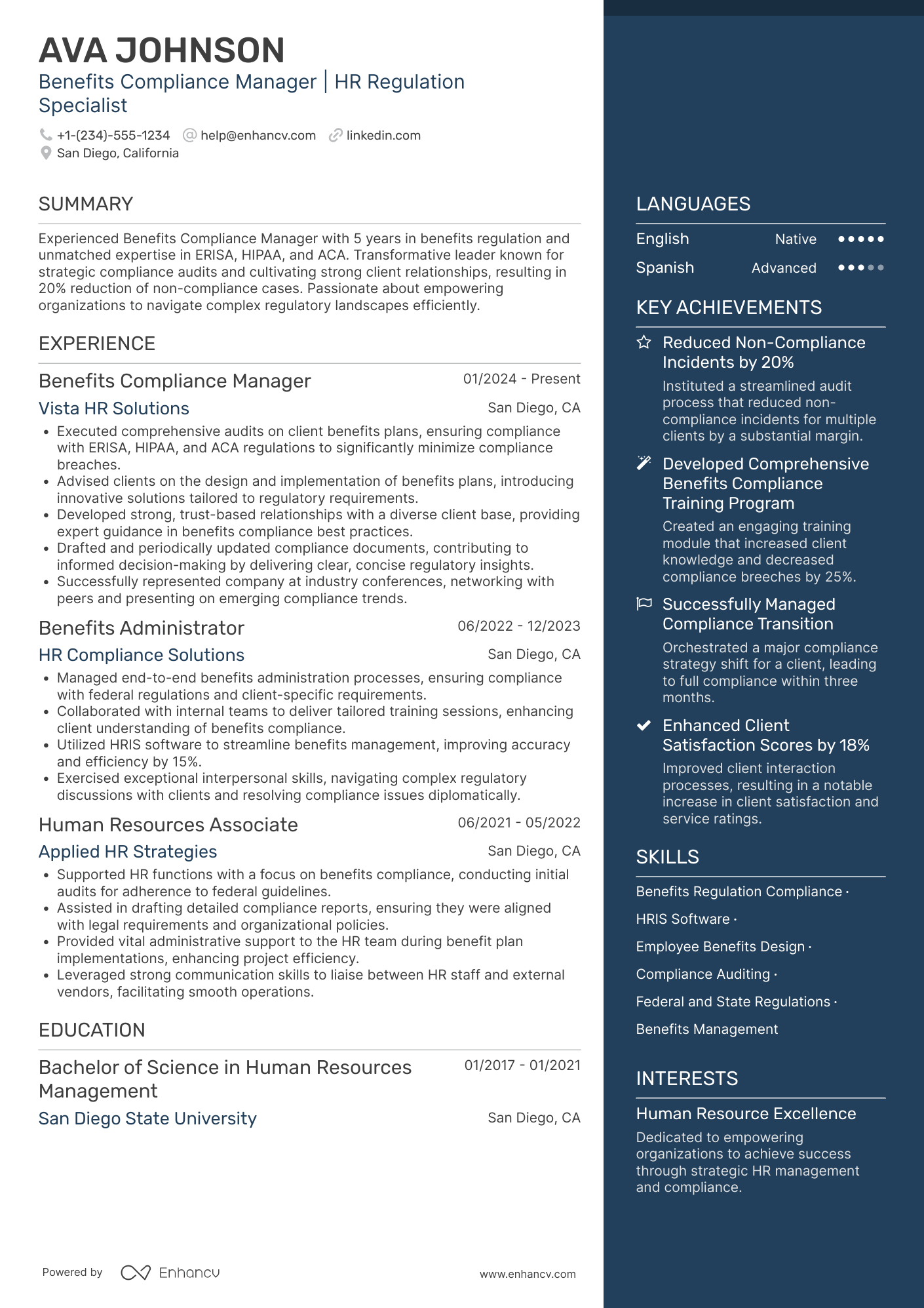
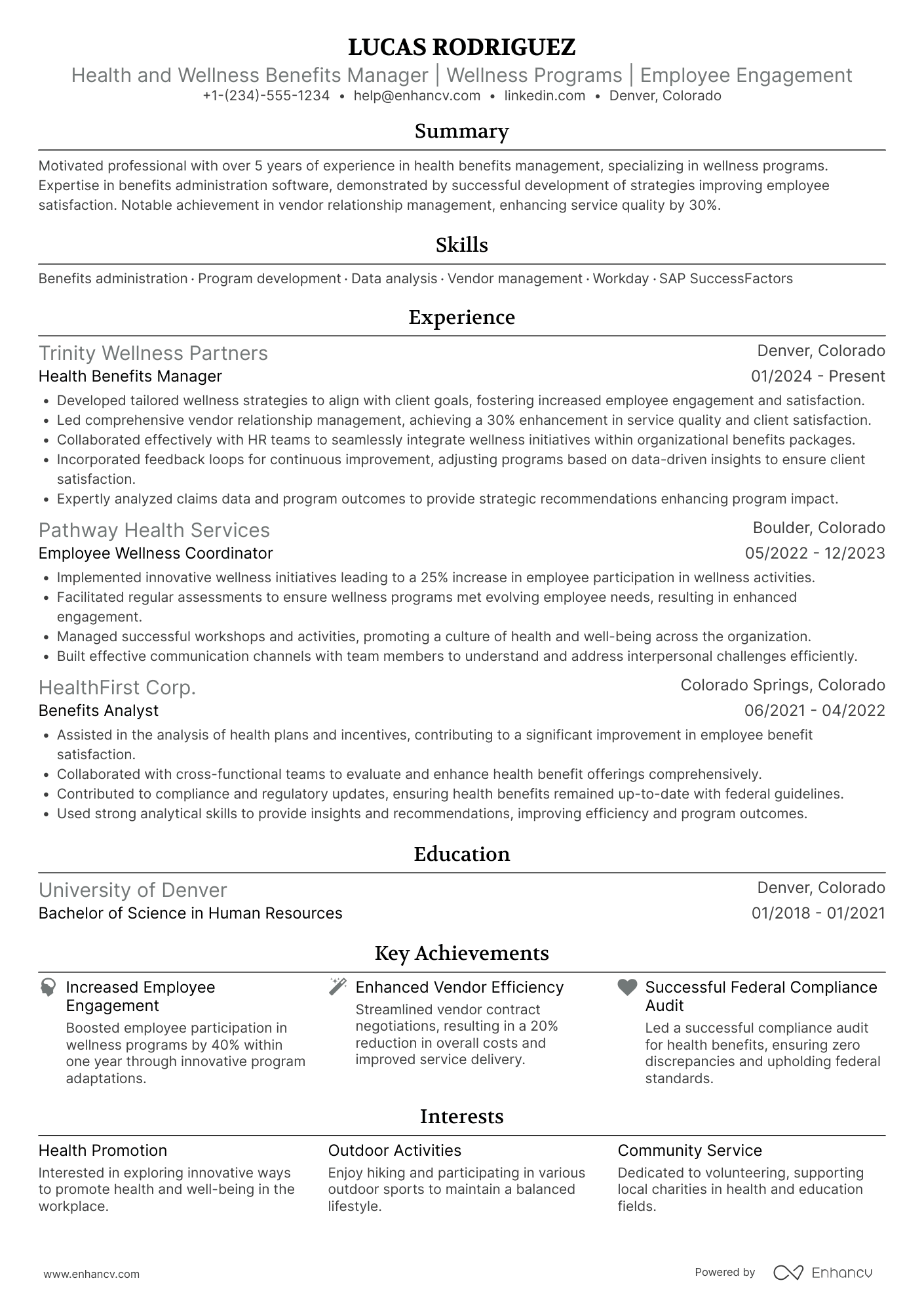
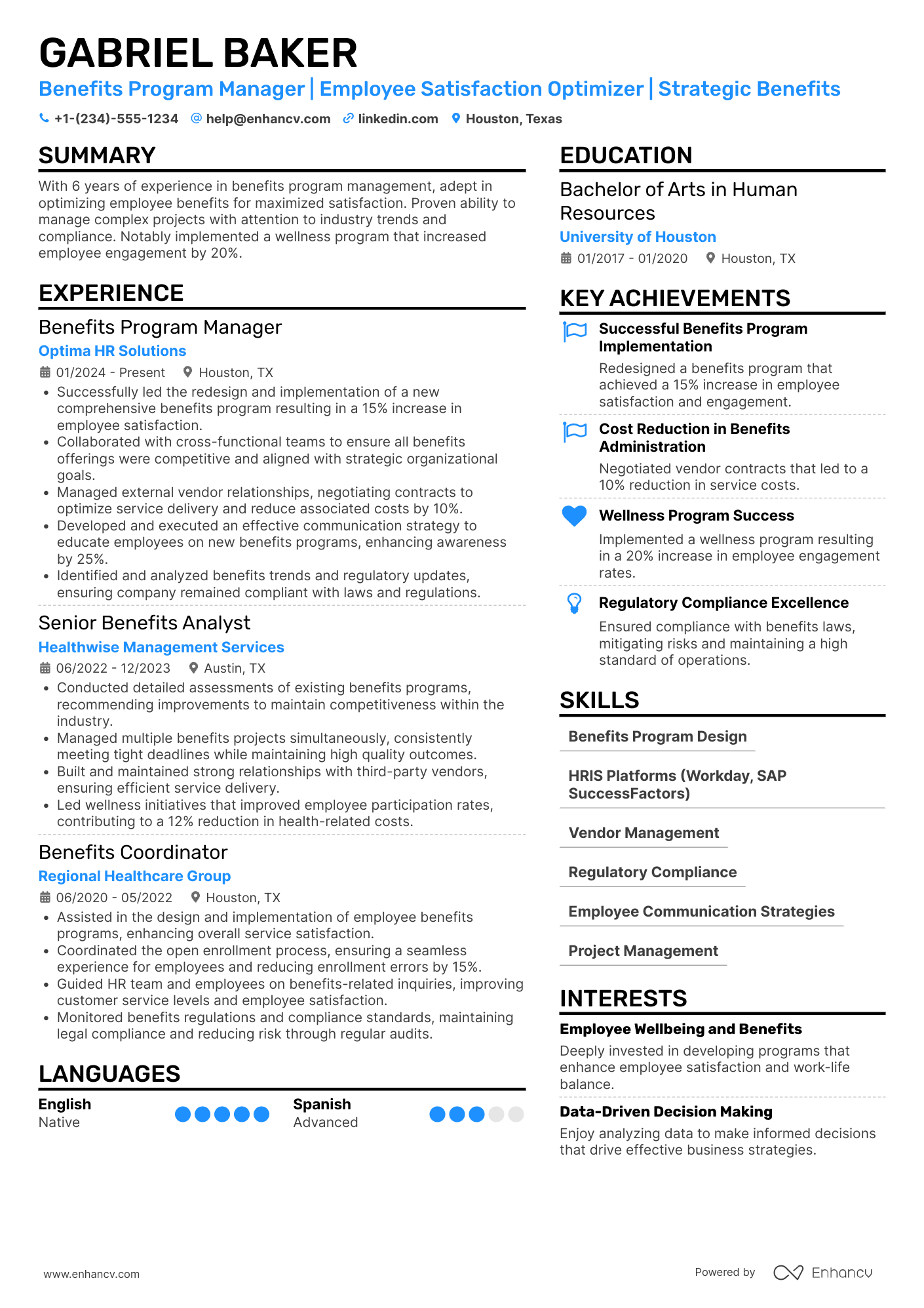
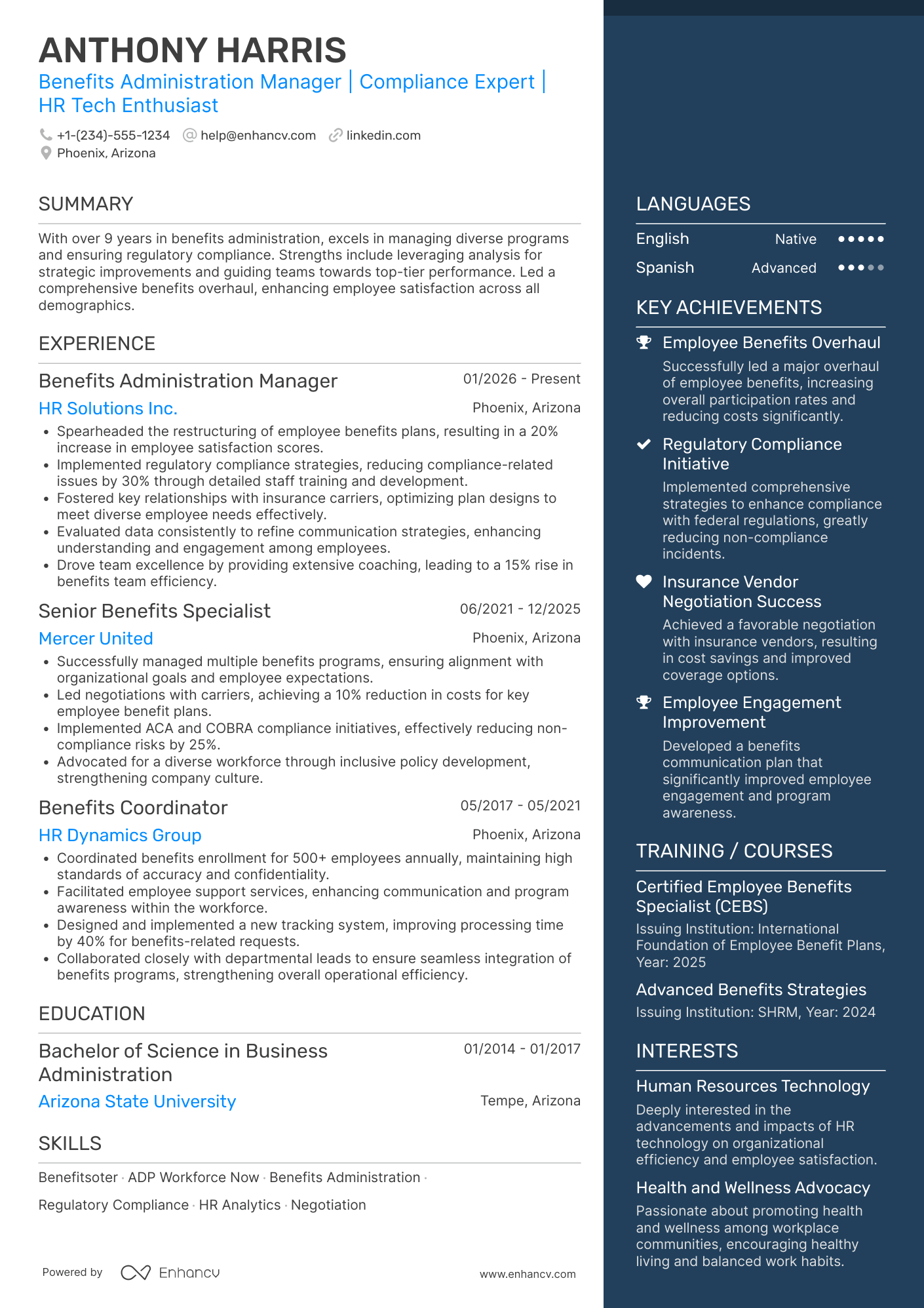
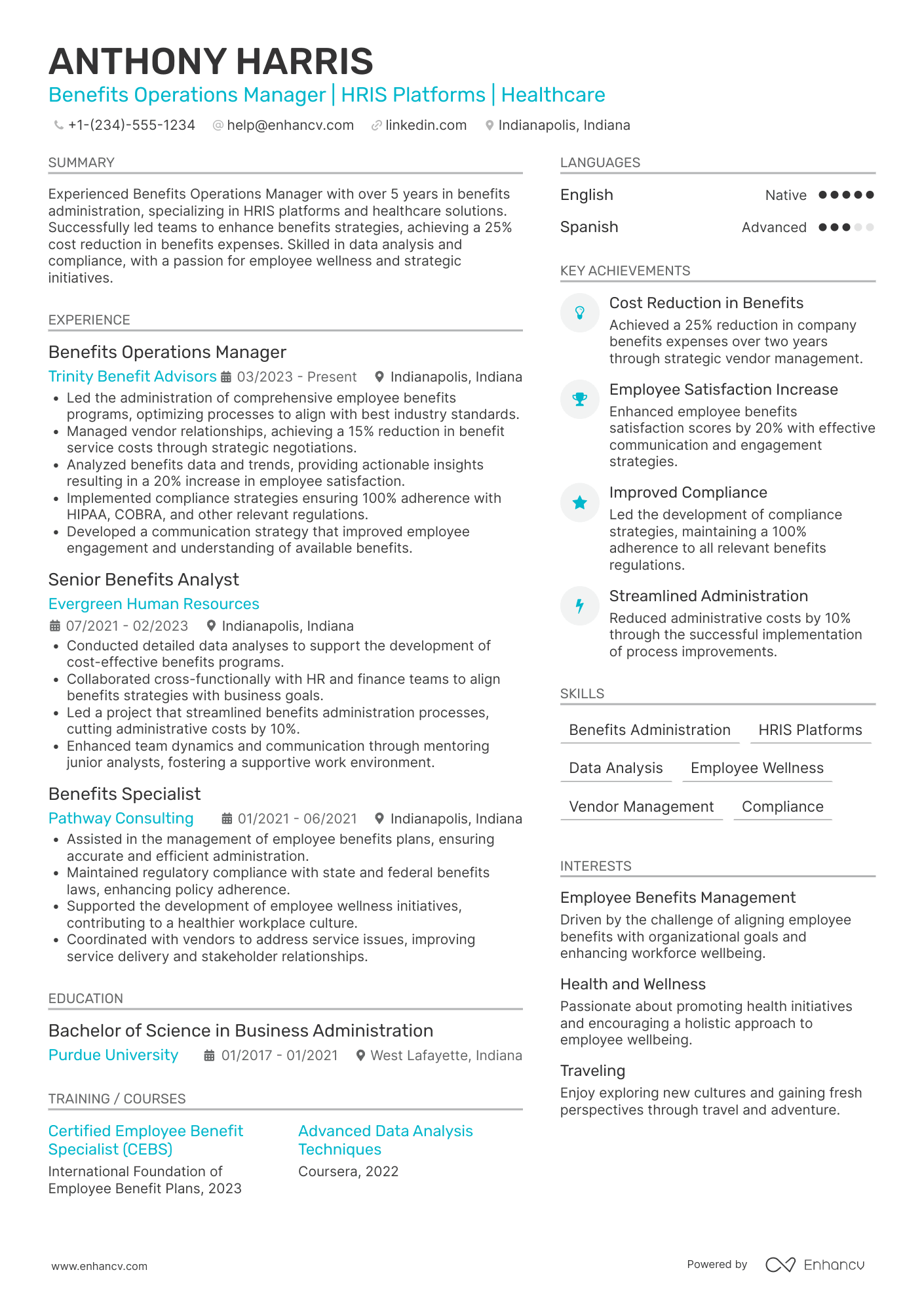
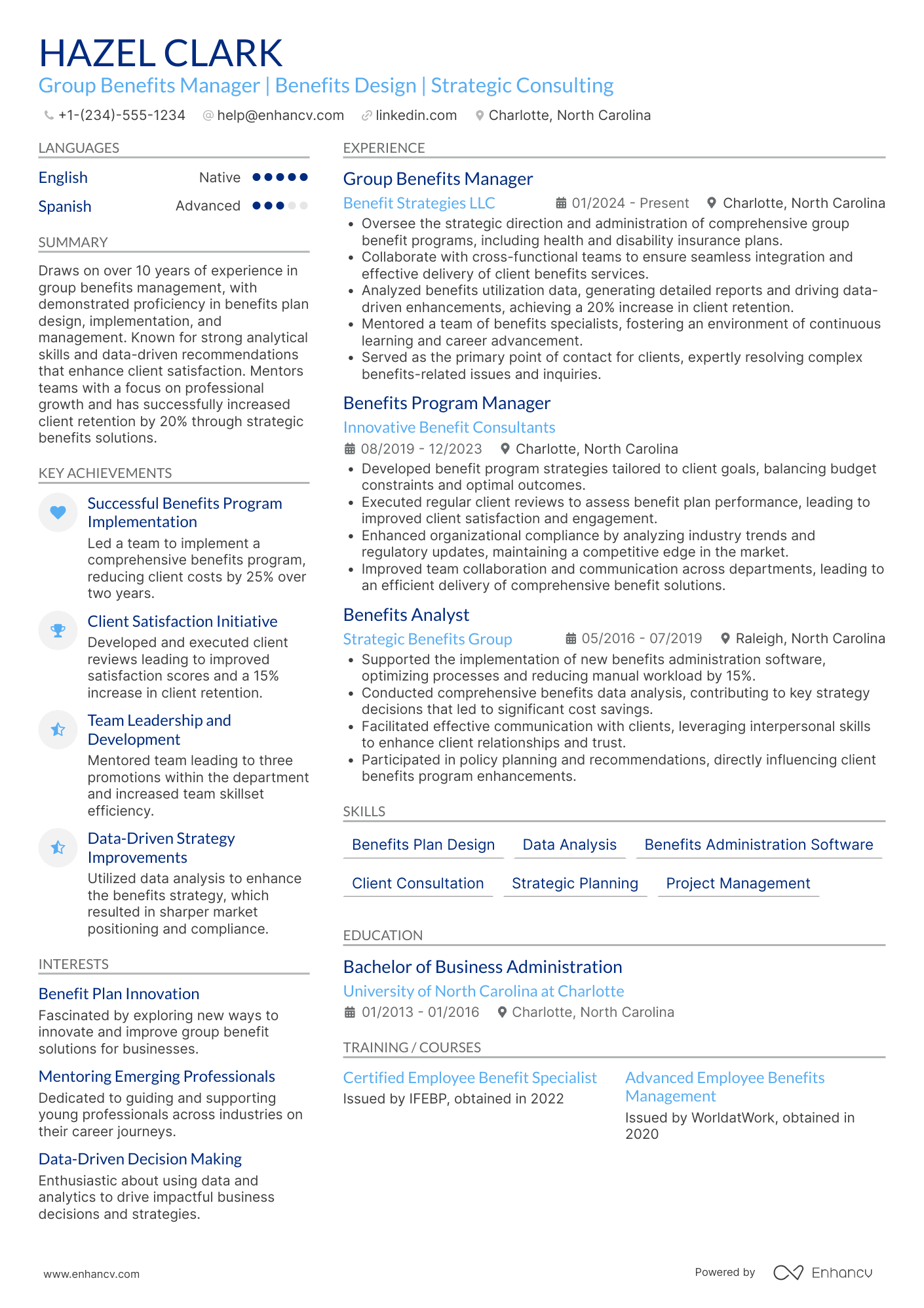
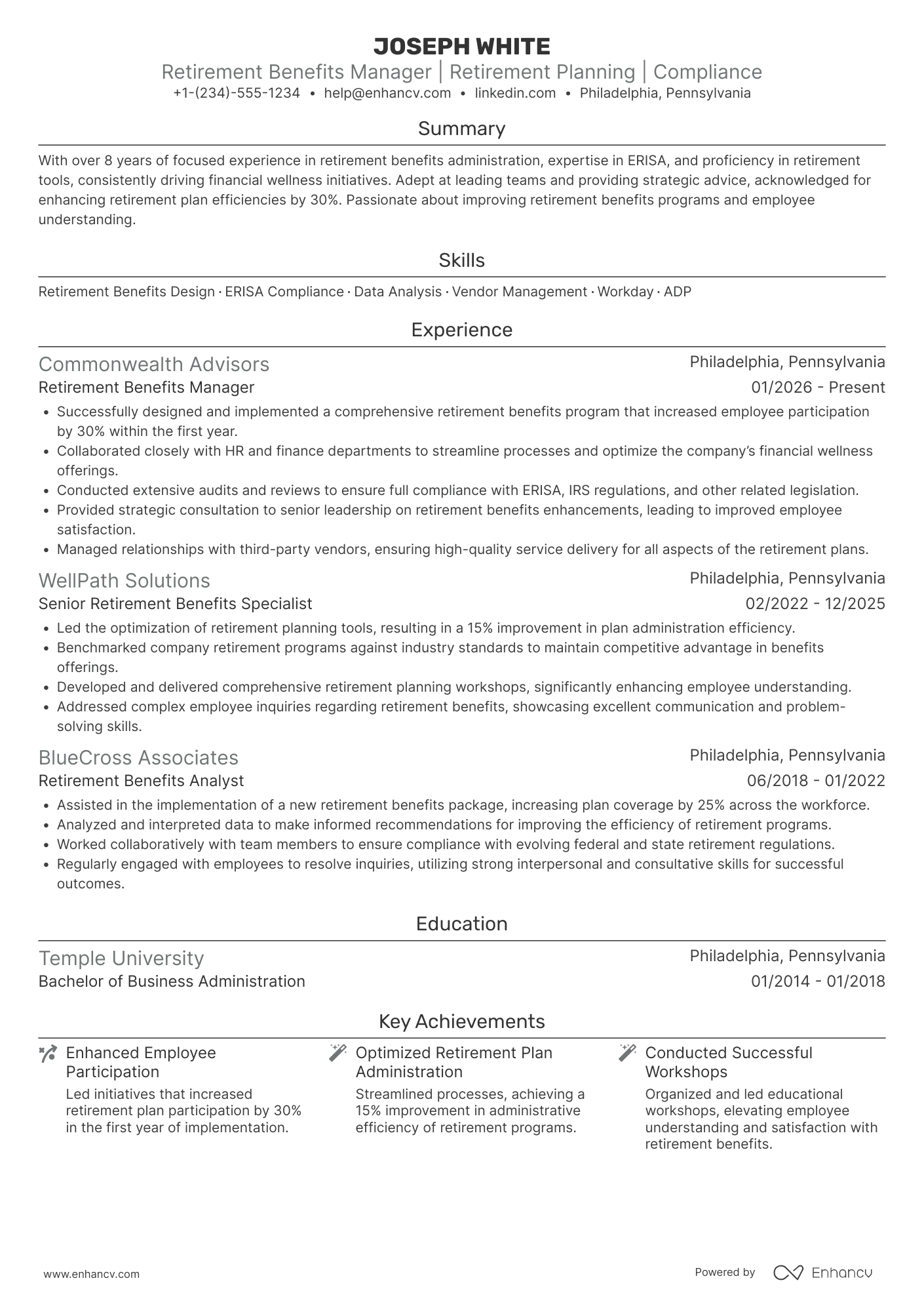
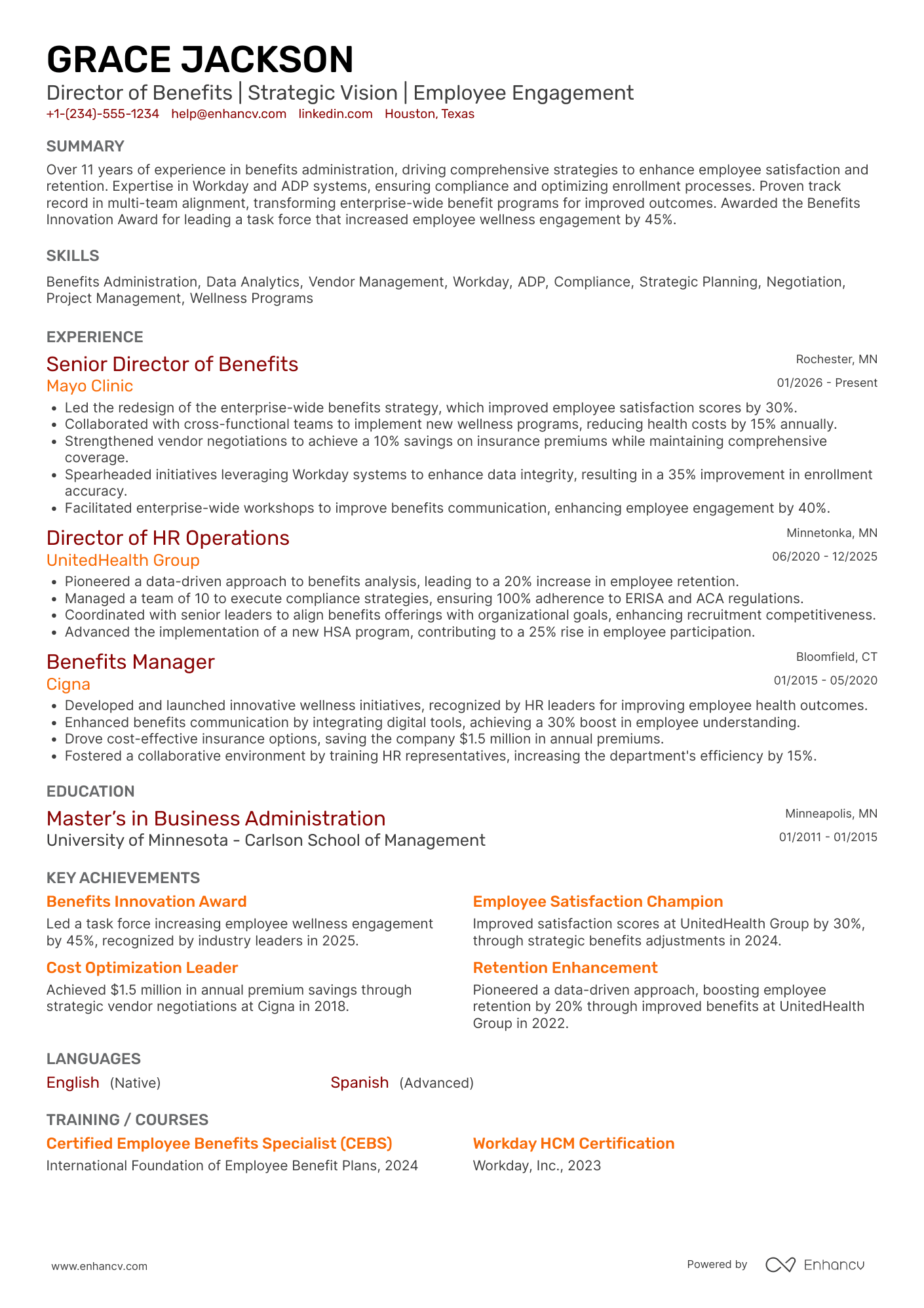
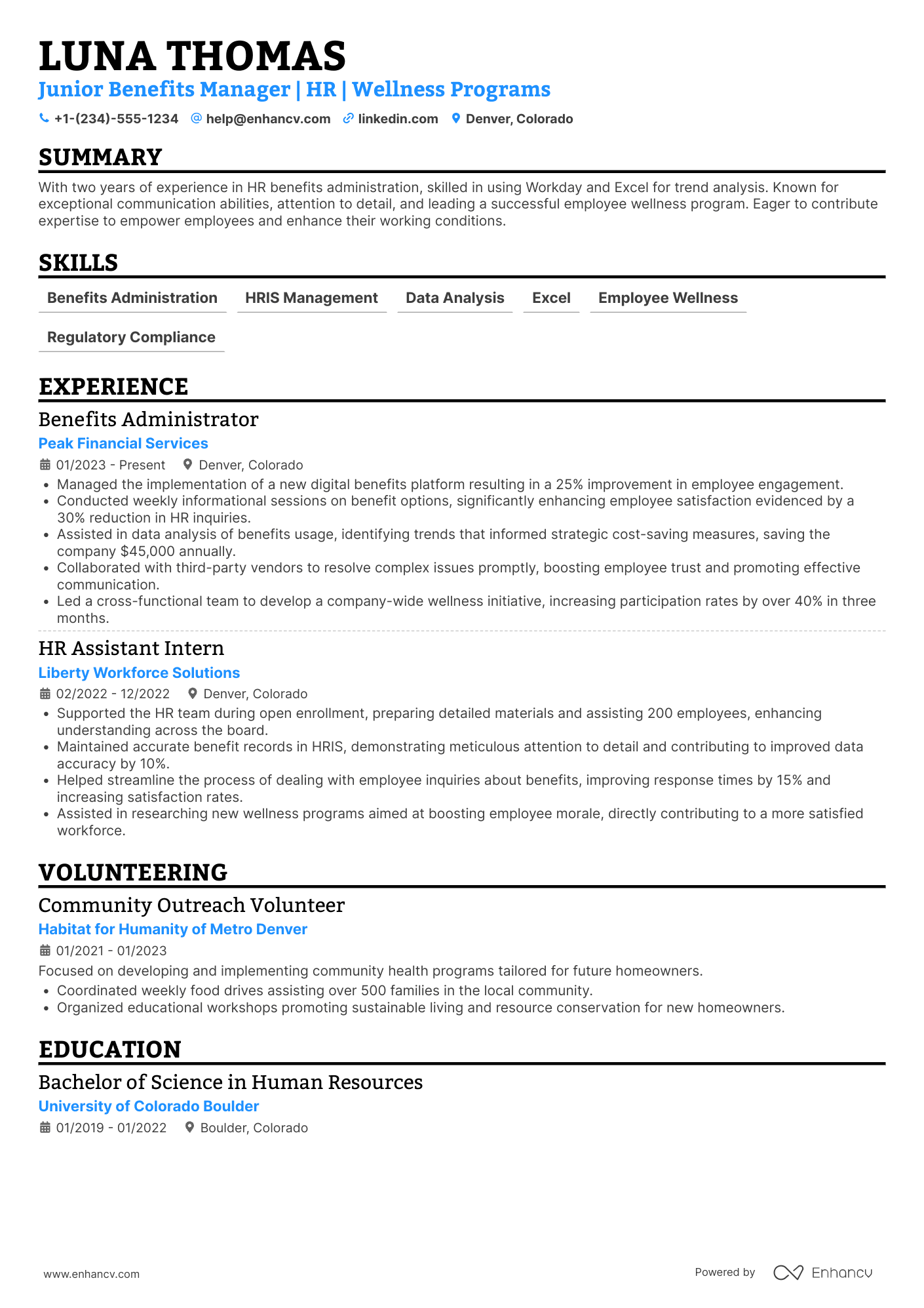
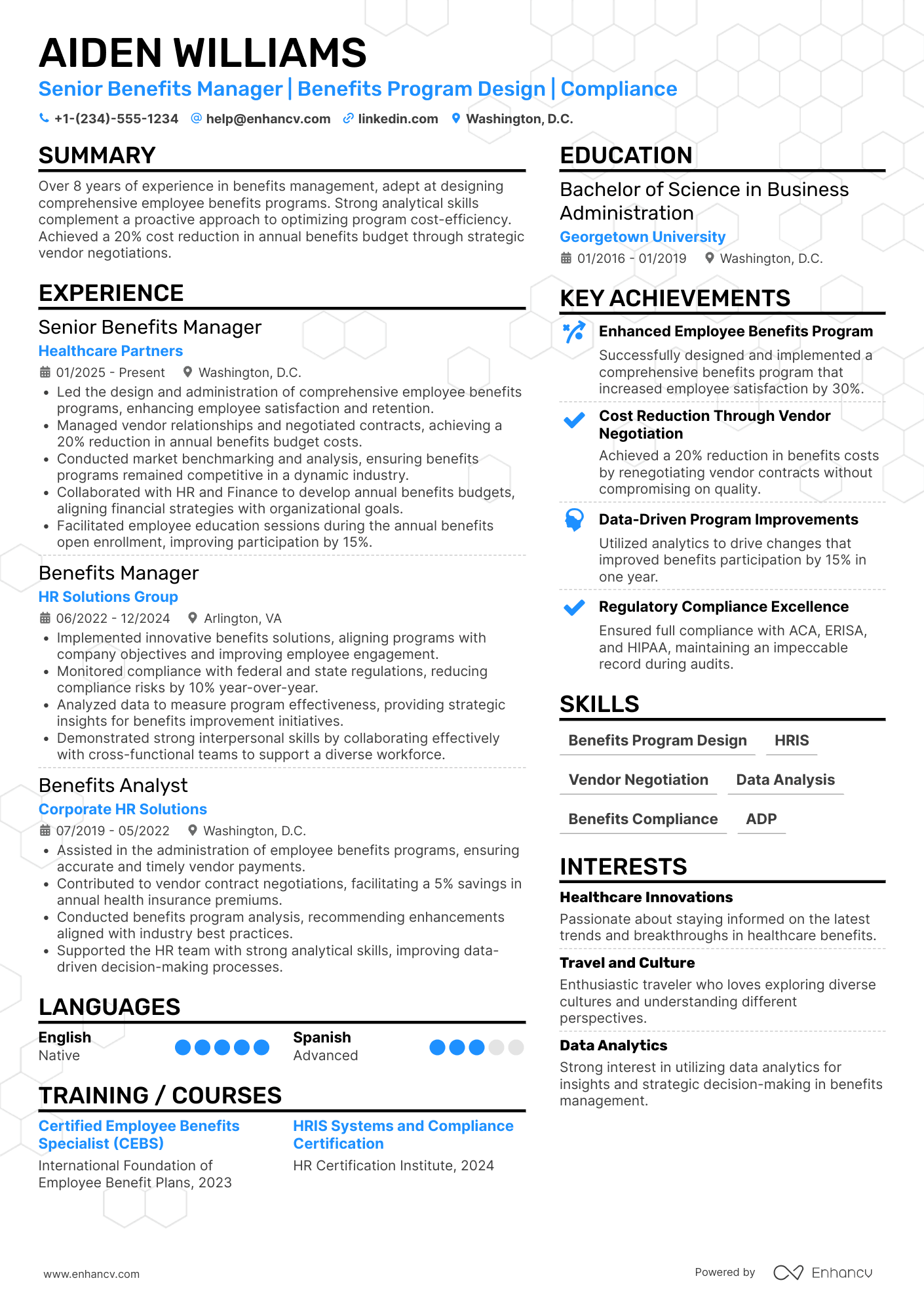
Benefits Manager resume examples
By Experience
By Role