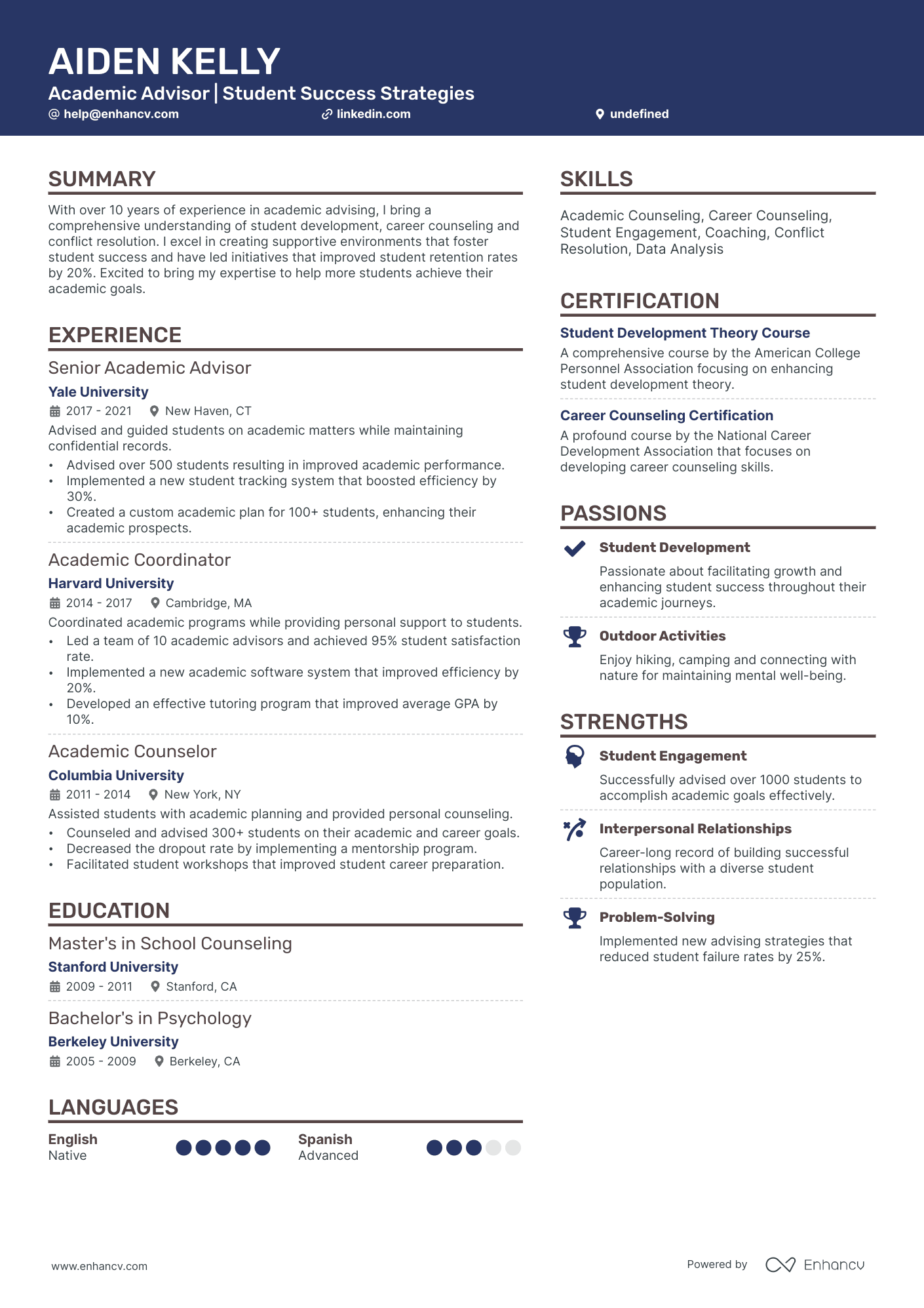
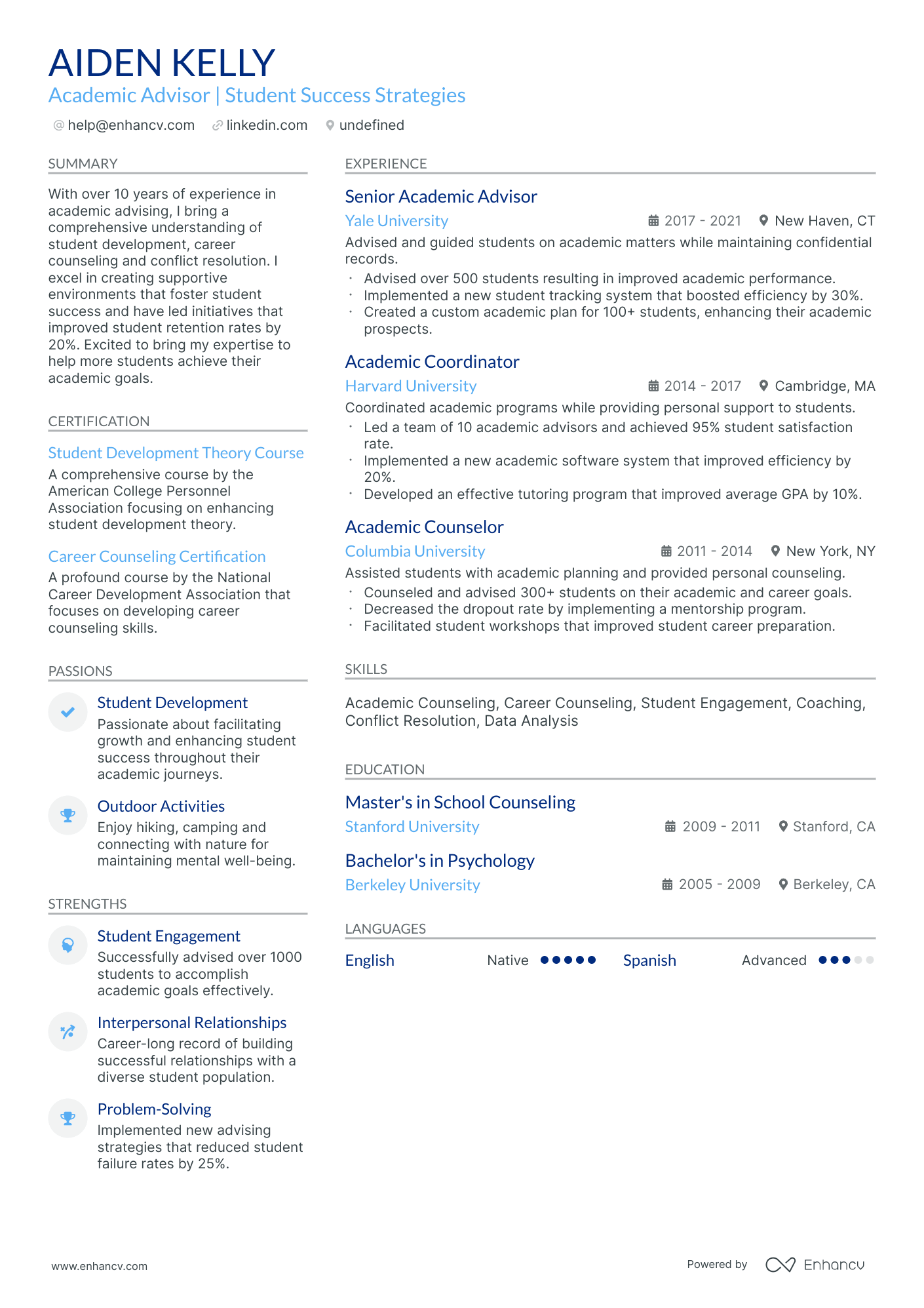
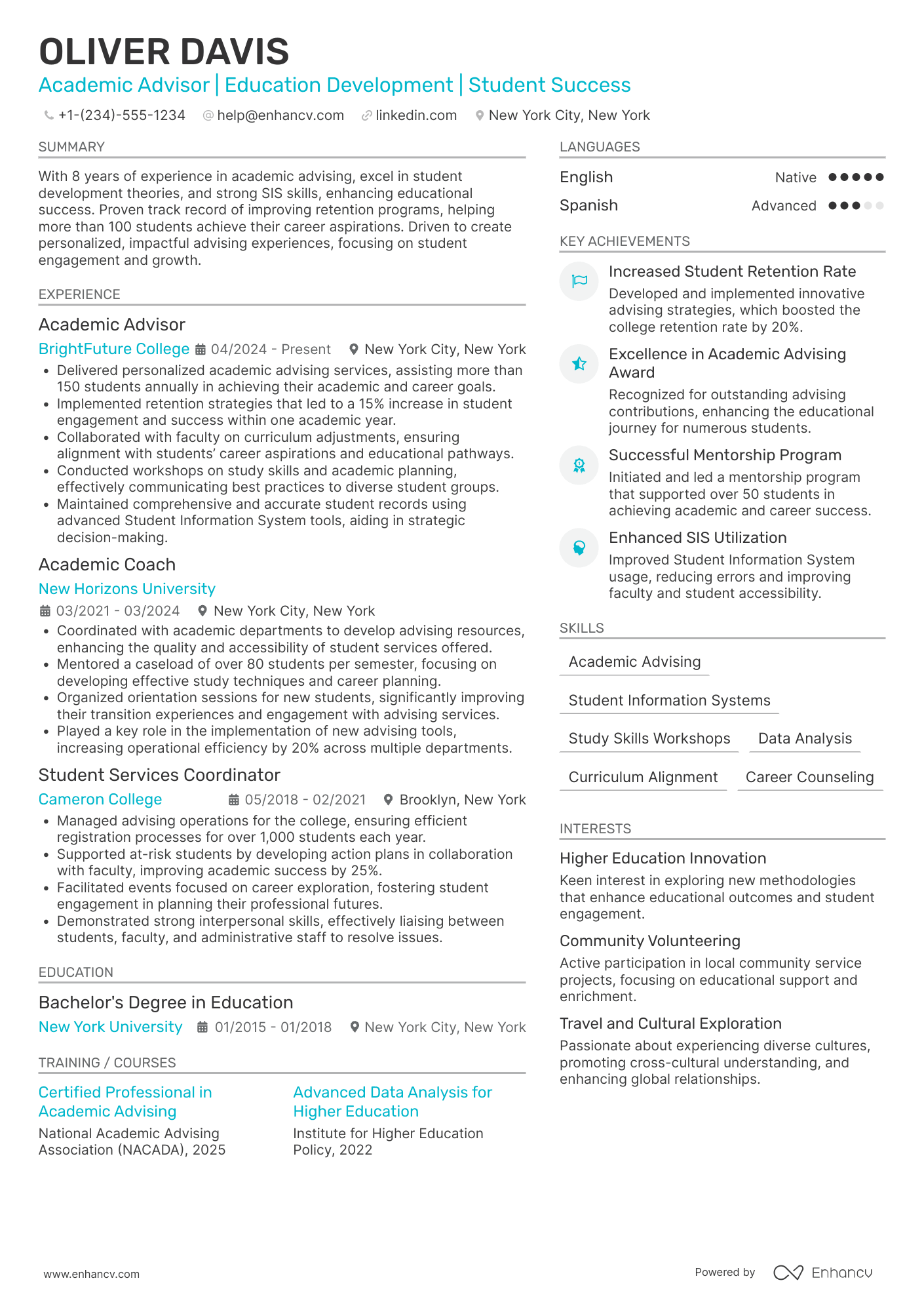
Many academic advisor resume submissions fail because they list duties and campus systems without showing student impact. That makes them easy to reject during ATS screening and quick recruiter scans, especially when applicant volume is high.
A strong resume shows outcomes and scope so you stand out fast. Knowing how to make your resume stand out means highlighting retention gains, increased credit completion, caseload size, reduced time to degree, improved early alert follow-up rates, and higher student satisfaction scores.

Key takeaways
- Quantify advising outcomes like retention lifts, caseload size, and graduation rate improvements in every bullet.
- Use reverse-chronological format if you have progressive advising experience and growing responsibilities.
- Mirror the exact tools, frameworks, and student populations named in the job posting.
- Lead each experience bullet with an action verb, task scope, and measurable result.
- Place your skills section above experience when entering advising without full-time role history.
- Add certifications like NACADA or GCDF directly after education to strengthen your candidacy.
- Use Enhancv's Bullet Point Generator to turn vague duties into recruiter-ready, quantified accomplishments.
Job market snapshot for academic advisors
We analyzed 300 recent academic advisor job ads across major US job boards. These numbers help you understand employment type trends, regional hotspots, top companies hiring at a glance.
What level of experience employers are looking for academic advisors
| Years of Experience | Percentage found in job ads |
|---|---|
| 1–2 years | 9.3% (28) |
| 3–4 years | 3.7% (11) |
| 5–6 years | 2.3% (7) |
| Not specified | 84.3% (253) |
Academic advisor ads by area of specialization (industry)
| Industry (Area) | Percentage found in job ads |
|---|---|
| Education | 88.3% (265) |
| Government | 9.0% (27) |
Top companies hiring academic advisors
| Company | Percentage found in job ads |
|---|---|
| State of Virginia | 6.0% (18) |
| University of Houston | 5.0% (15) |
| University of Missouri System | 4.0% (12) |
Role overview stats
These tables show the most common responsibilities and employment types for academic advisor roles. Use them to align your resume with what employers expect and to understand how the role is structured across the market.
Day-to-day activities and top responsibilities for a academic advisor
| Responsibility | Percentage found in job ads |
|---|---|
| Microsoft office | 17.0% (51) |
| Banner | 16.3% (49) |
| Student information systems | 7.3% (22) |
| Word processing | 6.7% (20) |
| Degreeworks | 6.3% (19) |
| Academic advising | 6.0% (18) |
| Excel | 6.0% (18) |
| Peoplesoft | 5.7% (17) |
| Powerpoint | 5.7% (17) |
| Word | 5.7% (17) |
| Degree works | 5.3% (16) |
| Microsoft office suite | 5.0% (15) |
Type of employment (remote vs on-site vs hybrid)
| Employment type | Percentage found in job ads |
|---|---|
| On-site | 86.7% (260) |
| Hybrid | 13.0% (39) |
How to format a academic advisor resume
Recruiters evaluating academic advisor candidates prioritize student-facing experience, knowledge of academic policies and retention strategies, and the ability to manage diverse caseloads effectively. A clean, well-structured resume format ensures these signals surface quickly during both human review and applicant tracking system (ATS) screening.

I have significant experience in this role—which format should I use?
Use a reverse-chronological format to present your advising career in a clear, progressive timeline that highlights growing caseload responsibility and institutional impact. Do:
- Lead with your most recent role and emphasize scope: caseload size, student populations served, and departmental or program-level responsibilities.
- Feature role-specific tools and domains prominently—degree audit systems (DegreeWorks, Banner), student information systems, FERPA compliance, retention frameworks, and curriculum mapping.
- Quantify outcomes tied to student success metrics, retention rates, graduation timelines, or program enrollment growth.
I'm junior or switching into this role—what format works best?
A hybrid format works best because it lets you lead with relevant advising competencies while still providing a chronological work history that demonstrates professional consistency. Do:
- Place a dedicated skills section near the top highlighting academic advising competencies such as student development theory, degree planning, crisis referral protocols, and SIS platforms.
- Include practicum placements, graduate assistantships, peer mentoring, or volunteer advising roles as transitional experience that demonstrates direct student engagement.
- Connect every action to a clear outcome so reviewers can assess your impact even without extensive professional advising history.
When does a functional resume make sense?
A functional format is rarely ideal for academic advisor roles, but it can serve candidates in specific transitional situations:
- You're shifting from a related field—such as teaching, counseling, or student affairs—and need to reframe transferable skills around advising competencies.
- You have a gap in employment but maintained relevant engagement through volunteer advising, professional development, or committee work.
- You hold limited formal advising experience but completed a graduate program in higher education, counseling, or a related discipline with a practicum component.
Now that you've established a clean, readable layout, it's time to fill it with the right sections that showcase your qualifications as an academic advisor.
What sections should go on a academic advisor resume
Recruiters expect to see clear evidence that you can advise students effectively, improve retention and outcomes, and manage a high caseload with accuracy. Understanding what to put on a resume for this role is critical to passing both ATS filters and human review.
Use this structure for maximum clarity:
- Header
- Summary
- Experience
- Skills
- Projects
- Education
- Certifications
- Optional sections: Awards, Leadership, Languages
Strong experience bullets should emphasize measurable student outcomes, caseload scope, program impact, and cross-functional results.
Is your resume good enough?
Drop your resume here or choose a file. PDF & DOCX only. Max 2MB file size.
Once you’ve organized your resume with the right components, the next step is to write your academic advisor resume experience in a way that fits that structure and highlights your impact.
How to write your academic advisor resume experience
Your experience section should demonstrate the advising outcomes you've delivered, the student development frameworks you've applied, and the measurable impact you've had on retention, graduation rates, or program enrollment. Hiring managers prioritize demonstrated impact over descriptive task lists—so lead with what you achieved, not just what you were assigned. Building a targeted resume that aligns each bullet with the role's priorities will significantly improve your chances.
Each entry should include:
- Job title
- Company and location (or remote)
- Dates of employment (month and year)
Three to five concise bullet points showing what you owned, how you executed, and what outcomes you delivered:
- Ownership scope: the student populations, academic programs, caseloads, or institutional initiatives you were directly accountable for as an academic advisor.
- Execution approach: the advising models, student information systems, degree audit tools, or intervention frameworks you used to guide students toward degree completion and academic success.
- Value improved: changes to student retention, graduation timelines, course completion rates, academic standing recovery, or equitable access to academic resources resulting from your advising work.
- Collaboration context: how you partnered with faculty, registrar offices, financial aid teams, career services, or community organizations to coordinate holistic student support.
- Impact delivered: outcomes expressed through improvements in student persistence, program growth, policy adoption, or institutional performance rather than a list of daily advising activities.
Experience bullet formula
A academic advisor experience example
✅ Right example - modern, quantified, specific.
Academic Advisor
Riverview State University | Columbus, OH
2022–Present
Public university serving 18,000 students with a focus on improving retention and on-time graduation outcomes.
- Advised a 320-student caseload using Ellucian Banner and EAB Navigate; increased fall-to-spring retention by 4.8% and reduced average time-to-degree by 0.2 years through proactive degree-map reviews.
- Built and maintained program audit workflows in Degree Works; cut graduation clearance review time by 35% and reduced audit-related exceptions by 22% by standardizing course substitution documentation.
- Launched an early-alert outreach cadence using Navigate campaigns and Microsoft Excel tracking; improved appointment show rate from 71% to 84% and reduced probation-to-good-standing turnaround by 18% within two terms.
- Partnered with faculty, financial aid, and the registrar to resolve complex SAP (Satisfactory Academic Progress) and registration holds; decreased hold resolution cycle time from five days to two days and improved student satisfaction scores by 0.6 points (out of five).
- Delivered monthly advising analytics in Tableau for department leadership; identified bottlenecks in gateway courses and helped drive supplemental instruction adoption that lifted pass rates by 6% across three high-enrollment sections.
Now that you've seen how to structure your experience entries, let's focus on customizing them to match the specific academic advisor role you're targeting.
How to tailor your academic advisor resume experience
Recruiters evaluate your academic advisor resume through both human review and applicant tracking systems, so tailoring your resume to the job description is essential. Tailoring ensures the skills and accomplishments you highlight directly reflect what the institution needs.
Ways to tailor your academic advisor experience:
- Mirror the student information systems named in the job description.
- Use the exact advising frameworks or models the posting references.
- Highlight retention and graduation rate outcomes the role prioritizes.
- Include experience with specific student populations the position serves.
- Emphasize FERPA compliance knowledge when the listing requires it.
- Reference collaboration with faculty or departmental teams if mentioned.
- Align your language with the institution's stated advising philosophy.
- Showcase familiarity with degree audit tools the employer currently uses.
Tailoring means connecting your real achievements to the role's stated requirements, not inserting keywords where they don't belong.
Resume tailoring examples for academic advisor
| Job description excerpt | Untailored | Tailored |
|---|---|---|
| Advise a caseload of 350+ undergraduate students on degree requirements, course selection, and academic progress using Banner and DegreeWorks | Helped students with course planning and academic questions | Managed a caseload of 350+ undergraduates, leveraging Banner and DegreeWorks to track degree audits, resolve registration holds, and guide semester-by-semester course selection aligned with program requirements |
| Develop and deliver early-alert interventions for at-risk students, collaborating with financial aid, counseling, and faculty to improve first-year retention | Worked with different departments to support students who were struggling academically | Partnered with financial aid, counseling services, and faculty through the early-alert system to design targeted interventions for at-risk first-year students, contributing to a 12% increase in fall-to-spring retention |
| Facilitate new-student orientation sessions and create individualized four-year graduation plans for incoming freshmen in the College of Arts & Sciences | Participated in orientation events and assisted new students during onboarding | Led six orientation sessions per cycle for incoming College of Arts & Sciences freshmen, building individualized four-year graduation plans that accounted for general education requirements, major prerequisites, and experiential learning milestones |
Once you’ve aligned your experience with the role’s priorities, quantify your academic advisor achievements to show the measurable impact of that work.
How to quantify your academic advisor achievements
Quantifying your achievements proves you improved student outcomes and operational efficiency. Focus on retention, graduation progress, advising volume, turnaround time, compliance accuracy, and satisfaction scores tied to advising tools and caseload scope.
Quantifying examples for academic advisor
| Metric | Example |
|---|---|
| Retention lift | "Improved first-year retention from 82% to 88% for a 260-student caseload by implementing proactive outreach in EAB Navigate." |
| Advising throughput | "Completed 520 advising appointments per semester while maintaining same-week availability for 90% of student requests using Microsoft Bookings." |
| Turnaround time | "Cut degree audit review time from five business days to two by standardizing checklists and using Degree Works notes templates." |
| Compliance accuracy | "Reduced FERPA documentation errors from 12 per term to two by retraining staff and adding a Salesforce case-required fields workflow." |
| Student satisfaction | "Raised advising satisfaction from 4.1 to 4.6 out of five across 180 survey responses by introducing end-of-visit action plans and follow-ups." |
Turn vague job duties into measurable, recruiter-ready resume bullets in seconds with Enhancv's Bullet Point Generator.
With your bullet points clearly articulating your accomplishments, it's equally important to ensure your resume highlights the right mix of hard and soft skills that define an effective academic advisor.
How to list your hard and soft skills on a academic advisor resume
Your skills section shows you can guide students with accurate academic planning and timely interventions, and recruiters and applicant tracking system (ATS) filters scan this section for role keywords—aim for a mix of hard skills (systems and policies) and soft skills (advising behaviors). academic advisor roles require a blend of:
- Product strategy and discovery skills.
- Data, analytics, and experimentation skills.
- Delivery, execution, and go-to-market discipline.
- Soft skills.
Your skills section should be:
- Scannable (bullet-style grouping).
- Relevant to the job post.
- Backed by proof in experience bullets.
- Updated with current tools.
Place your skills section:
- Above experience if you're junior or switching careers.
- Below experience if you're mid/senior with strong achievements.

Hard skills
- Degree audit systems, Degree Works
- Student information systems, Banner, PeopleSoft
- Customer relationship management (CRM) advising platforms
- Academic policy interpretation
- Program and major requirement mapping
- Course planning and registration support
- Transfer credit evaluation
- Early alert and retention workflows
- Financial aid and SAP policy basics
- FERPA compliance
- Case notes and documentation standards
- Reporting dashboards, Excel, Power BI
Soft skills
- Conduct structured advising intakes
- Translate policies into clear next steps
- Set boundaries and manage caseloads
- De-escalate student concerns
- Coordinate with faculty and student services
- Write concise, actionable case notes
- Prioritize high-risk student outreach
- Facilitate goal-setting and accountability
- Deliver difficult feedback with empathy
- Navigate sensitive conversations professionally
- Follow through on referrals and outcomes
- Communicate timelines and expectations clearly
How to show your academic advisor skills in context
Skills shouldn't live only in a bulleted list on your resume. Browse examples of effective resume skills presentations to see how top candidates integrate competencies throughout their documents.
They should be demonstrated in:
- Your summary (high-level professional identity)
- Your experience (proof through outcomes)
Here's what strong, skills-rich entries look like in practice.
Summary example
Senior academic advisor with 10+ years in higher education, specializing in retention strategy and degree auditing through Banner and DegreeWorks. Skilled in motivational interviewing and cross-departmental collaboration, helping boost four-year graduation rates by 18%.
- Reflects senior-level expertise immediately
- Names industry-standard advising tools
- Quantifies a meaningful student outcome
- Highlights interpersonal and collaboration strengths
Experience example
Senior Academic Advisor
Ridgemont State University | Columbus, OH
June 2018–Present
- Managed a caseload of 425+ students using DegreeWorks, improving on-time degree completion by 22% over three years.
- Collaborated with financial aid and faculty committees to redesign the early-alert intervention process, reducing academic probation cases by 15%.
- Facilitated motivational interviewing workshops for junior advisors, increasing team student-satisfaction scores by 12% within two semesters.
- Every bullet includes a measurable outcome.
- Skills surface naturally through real achievements.
Once you’ve tied your advising strengths to real examples and outcomes, the next step is to apply that approach to building an academic advisor resume with no experience.
How do I write a academic advisor resume with no experience
Even without full-time experience, you can demonstrate readiness through advising-adjacent roles and projects. Our guide on writing a resume without work experience covers strategies that apply directly to aspiring academic advisors.
Consider highlighting:
- Peer tutoring and success coaching
- Orientation leader advising sessions
- Resident assistant student support
- Student organization officer mentoring
- Career center workshop facilitation
- Academic planning capstone project
- Volunteer advising at nonprofits
- Registrar or advising office internship
Focus on:
- Advising caseload or appointment volume
- Degree audit and planning tools
- Documented outcomes and metrics
- Compliance, privacy, and documentation
Resume format tip for entry-level academic advisor
Use a hybrid resume format because it highlights advising-relevant skills while proving impact through projects, campus roles, and internships. Do:
- Start with a targeted summary naming academic advisor focus areas.
- Add a "Relevant Experience" section for campus roles.
- Include tools like Navigate, Banner, and Excel.
- Quantify advising outputs, like sessions and plans.
- Mirror job posting keywords in bullets.
- Built four-year plans for 25 first-year students using Navigate and Excel degree maps, reducing schedule conflicts by 30% across two registration cycles.
Even without direct experience, your educational background can serve as one of the strongest sections on your resume—here's how to present it effectively.
How to list your education on a academic advisor resume
Your education section helps hiring teams confirm you have the foundational knowledge needed. It validates your qualifications for guiding students through complex academic processes and institutional policies.
Include:
- Degree name
- Institution
- Location
- Graduation year
- Relevant coursework (for juniors or entry-level candidates)
- Honors & GPA (if 3.5 or higher)
Skip month and day details—list the graduation year only.
Here's a strong education entry tailored for an academic advisor resume.
Example education entry
Master of Education in Counseling and Student Development
University of Georgia, Athens, GA
Graduated 2021
GPA: 3.8/4.0
- Relevant Coursework: Academic Advising Strategies, Higher Education Administration, Multicultural Counseling, Student Retention Theory
- Honors: Graduate Dean's List, Phi Kappa Phi Honor Society
How to list your certifications on a academic advisor resume
Listing certifications on your resume shows an academic advisor's commitment to learning, proficiency with advising tools, and alignment with current education standards and student support practices.
Include:
- Certificate name
- Issuing organization
- Year
- Optional: credential ID or URL
- Place certifications below education when your degree is recent or directly matches academic advisor requirements.
- Place certifications above education when they are recent, highly relevant, or required for your academic advisor focus area.
Best certifications for your academic advisor resume
- Global Career Development Facilitator (GCDF)
- National Certified Counselor (NCC)
- Certified Career Services Provider (CCSP)
- Certified Academic Advisor (NACADA)
- Mental Health First Aid Certification
- Title IX Coordinator Certification
- Certified Enrollment Management Professional (CEMP)
Once you’ve positioned your credentials where hiring teams can verify them quickly, shift to your academic advisor resume summary to tie those qualifications to the value you deliver.
How to write your academic advisor resume summary
Your resume summary is the first thing a recruiter reads. A strong one immediately signals you're qualified to guide students through academic planning and success.
Keep it to three to four lines, with:
- Your title and total years of experience in academic advising or student services.
- The type of institution, student population, or program area you specialize in.
- Core tools and skills such as degree audit software, Banner, or PeopleSoft.
- One or two measurable achievements like improved retention rates or caseload size.
- Interpersonal strengths tied to outcomes, such as mentoring that reduced drop rates.

PRO TIP
At this level, focus on relevant advising skills, tools you've used, and early wins with students. Avoid vague phrases like "passionate about helping others" or "strong communicator." Instead, show impact through specific numbers or outcomes from your advising work.
Example summary for a academic advisor
Academic advisor with three years of experience supporting 300+ undergraduate students at a public university. Skilled in DegreeWorks and Banner, improving first-year retention by 12% through proactive outreach and individualized academic planning.
Optimize your resume summary and objective for ATS
Drop your resume here or choose a file.
PDF & DOCX only. Max 2MB file size.
Now that your summary captures the value you bring, make sure the header above it presents your contact details clearly so recruiters can reach you without hesitation.
What to include in a academic advisor resume header
A well-crafted resume header lists your key identifiers and contacts, helping a academic advisor stand out in searches, build credibility, and pass recruiter screening fast.
Essential resume header elements
- Full name
- Tailored job title and headline
- Location
- Phone number
- Professional email
- GitHub link
- Portfolio link
A LinkedIn link lets recruiters confirm your roles and dates fast, which supports quick screening.
Do not include photos on a academic advisor resume unless the role is explicitly front-facing or appearance-dependent.
Keep your header consistent with your application profiles, and match your job title to the posting to improve search visibility.
Academic advisor resume header
Jordan Lee
Academic advisor | Student success, degree planning, and retention support
Austin, TX
(512) 555-01XX
your.name@enhancv.com
github.com/yourname
yourwebsite.com
linkedin.com/in/yourname
Once your contact details and key identifiers are in place at the top of your resume, add targeted additional sections to strengthen your academic advisor application with relevant context.
Additional sections for academic advisor resumes
When your core qualifications match other candidates, additional sections help you stand out by showcasing unique strengths relevant to advising. For example, listing language skills on your resume can demonstrate your ability to support diverse student populations.
- Languages
- Publications
- Professional affiliations
- Conference presentations
- Volunteer work and community engagement
- Certifications and continuing education
- Awards and honors
Once you've rounded out your resume with the right supplementary sections, it's worth turning your attention to the cover letter—a separate document that can reinforce and expand on everything your resume presents.
Do academic advisor resumes need a cover letter
A cover letter isn't always required for an academic advisor, but it often helps. Understanding what a cover letter is and when to use one matters most in competitive searches or when hiring teams expect a writing sample. It can make a difference when your resume needs context.
Use a cover letter to add value, not repeat your resume:
- Explain fit with the academic advisor team: connect your advising approach to the institution's student population, policies, and service model.
- Highlight one or two outcomes: improved retention, reduced time-to-degree, or increased appointment capacity, and state what you did to drive results.
- Show context awareness: reference the advising tools, student needs, and stakeholder groups, and explain how you partner with faculty and student services.
- Address transitions or non-obvious experience: translate related work into advising skills, such as case management, coaching, or compliance-heavy student support.
Drop your resume here or choose a file.
PDF & DOCX only. Max 2MB file size.
Once you’ve decided whether to include a cover letter based on the role and application requirements, you can use AI to strengthen your academic advisor resume more efficiently.
Using AI to improve your academic advisor resume
AI can sharpen your resume's clarity, structure, and impact. It helps refine language and highlight measurable results. However, overusing it risks stripping your voice and authenticity. Once your content feels clear and role-aligned, step away from AI. If you're curious about which AI is best for writing resumes, start with tools that preserve your authentic voice while improving structure.
Here are 10 practical prompts you can copy and paste to strengthen specific sections of your academic advisor resume:
Strengthen your summary
Quantify advising impact
Tailor to the posting
Sharpen action verbs
Refine skills relevance
Clarify certifications value
Improve education details
Tighten bullet structure
Highlight program contributions
Eliminate redundant language
Conclusion
A strong academic advisor resume shows measurable outcomes, role-specific skills, and a clear structure. Use metrics that prove impact, highlight advising, student support, and collaboration skills, and keep sections easy to scan.
This approach shows you’re ready for today’s hiring market and upcoming shifts. Hiring teams want academic advisor candidates who communicate results, stay organized, and match the role’s needs with precision.