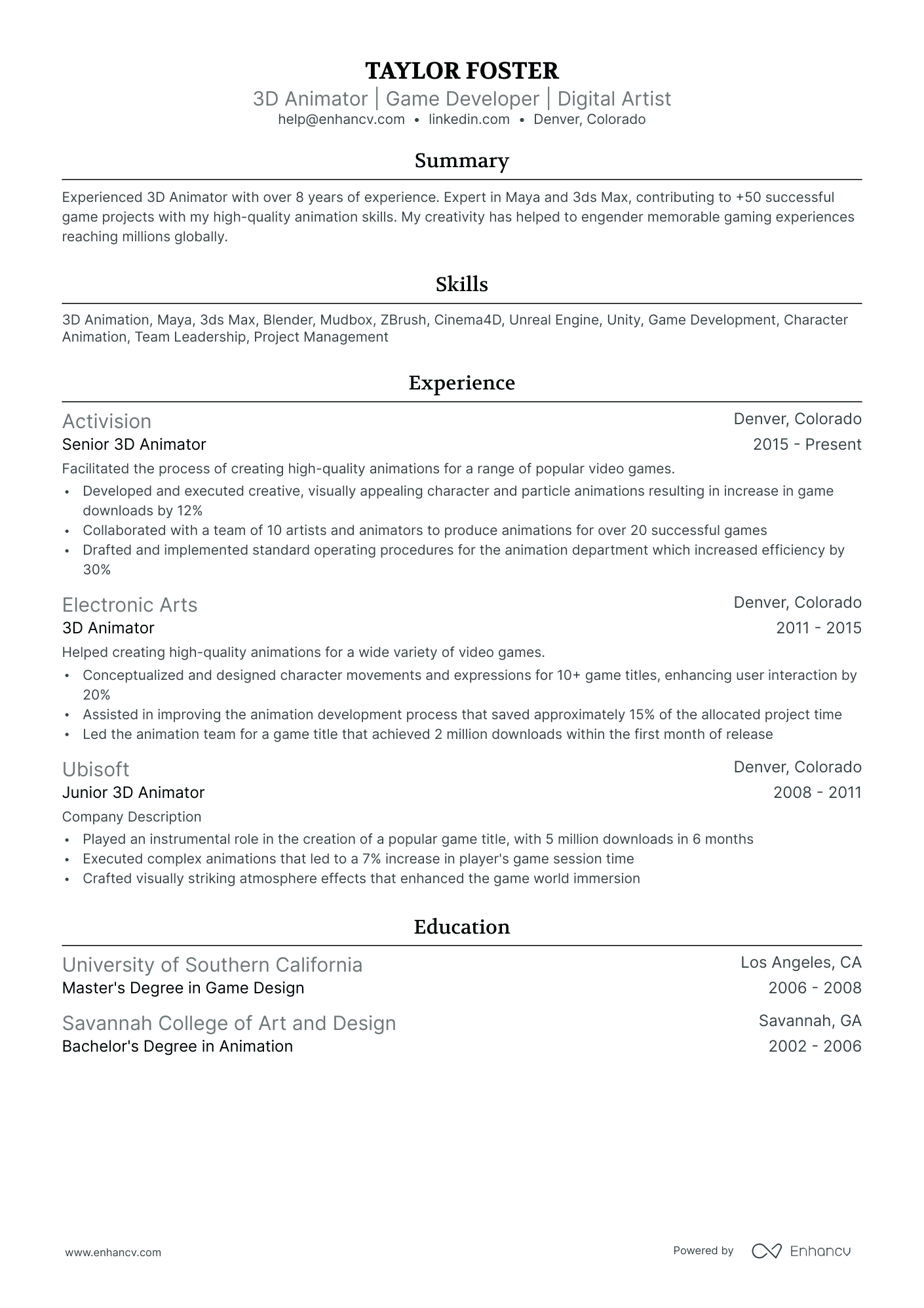
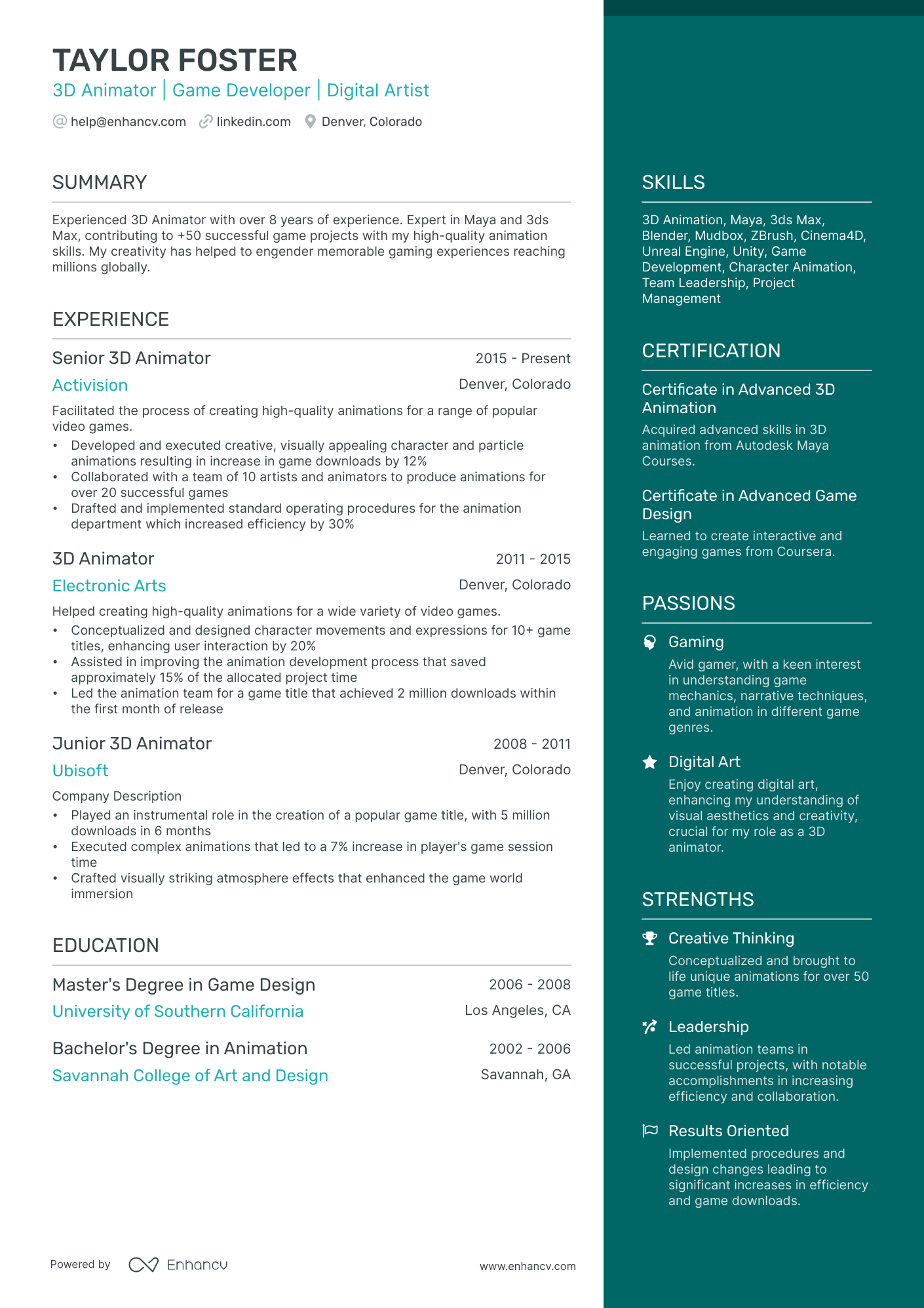
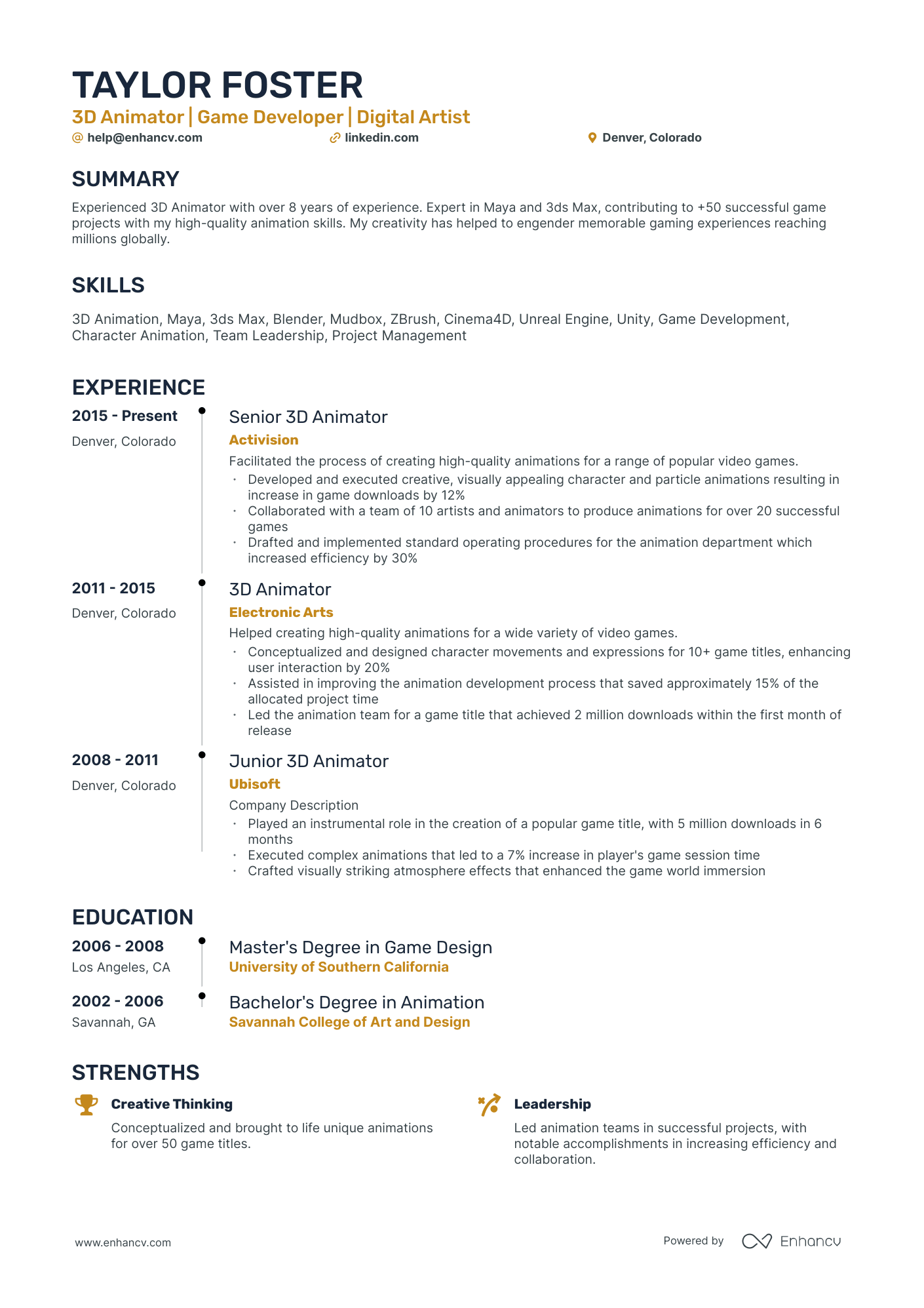
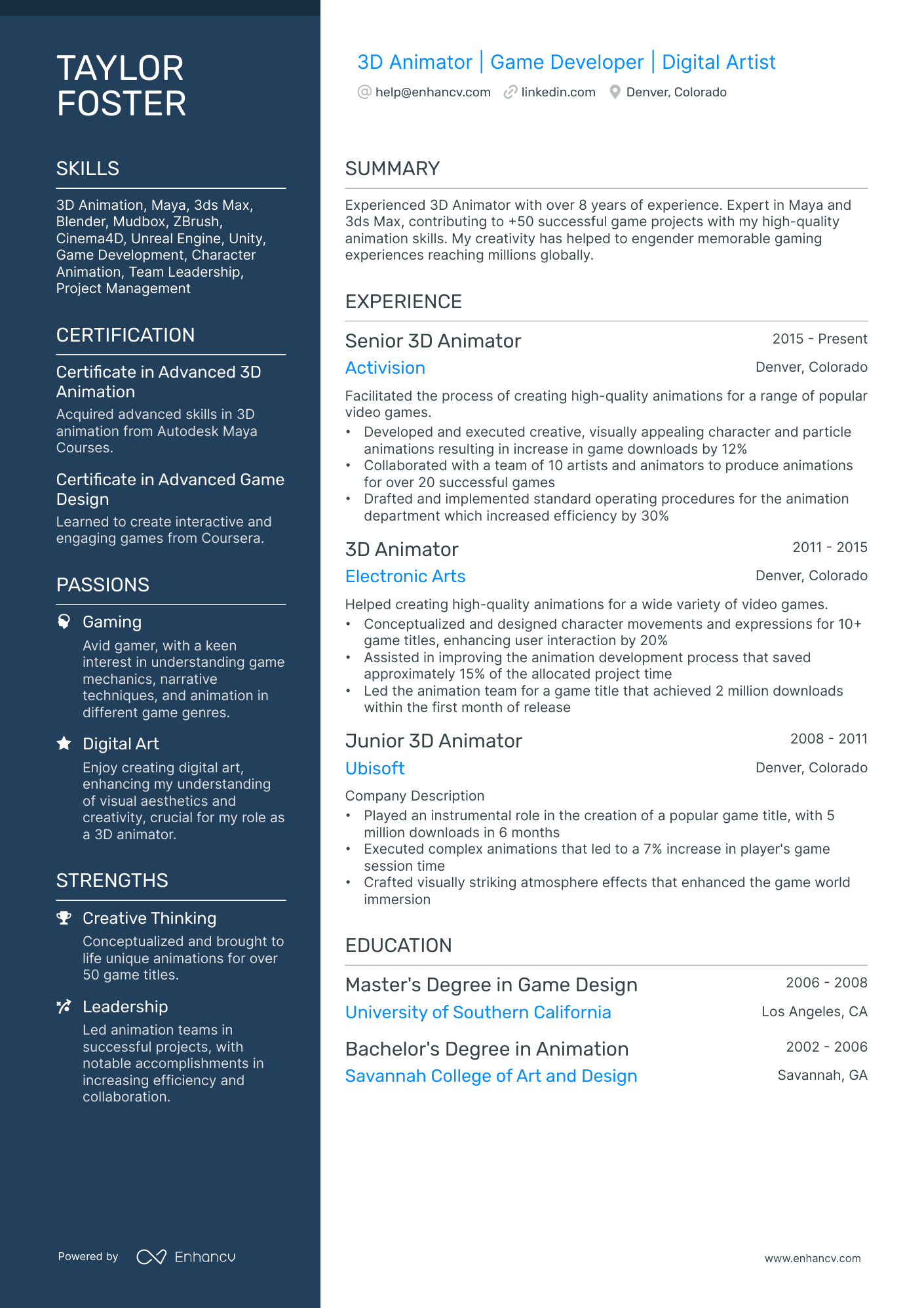
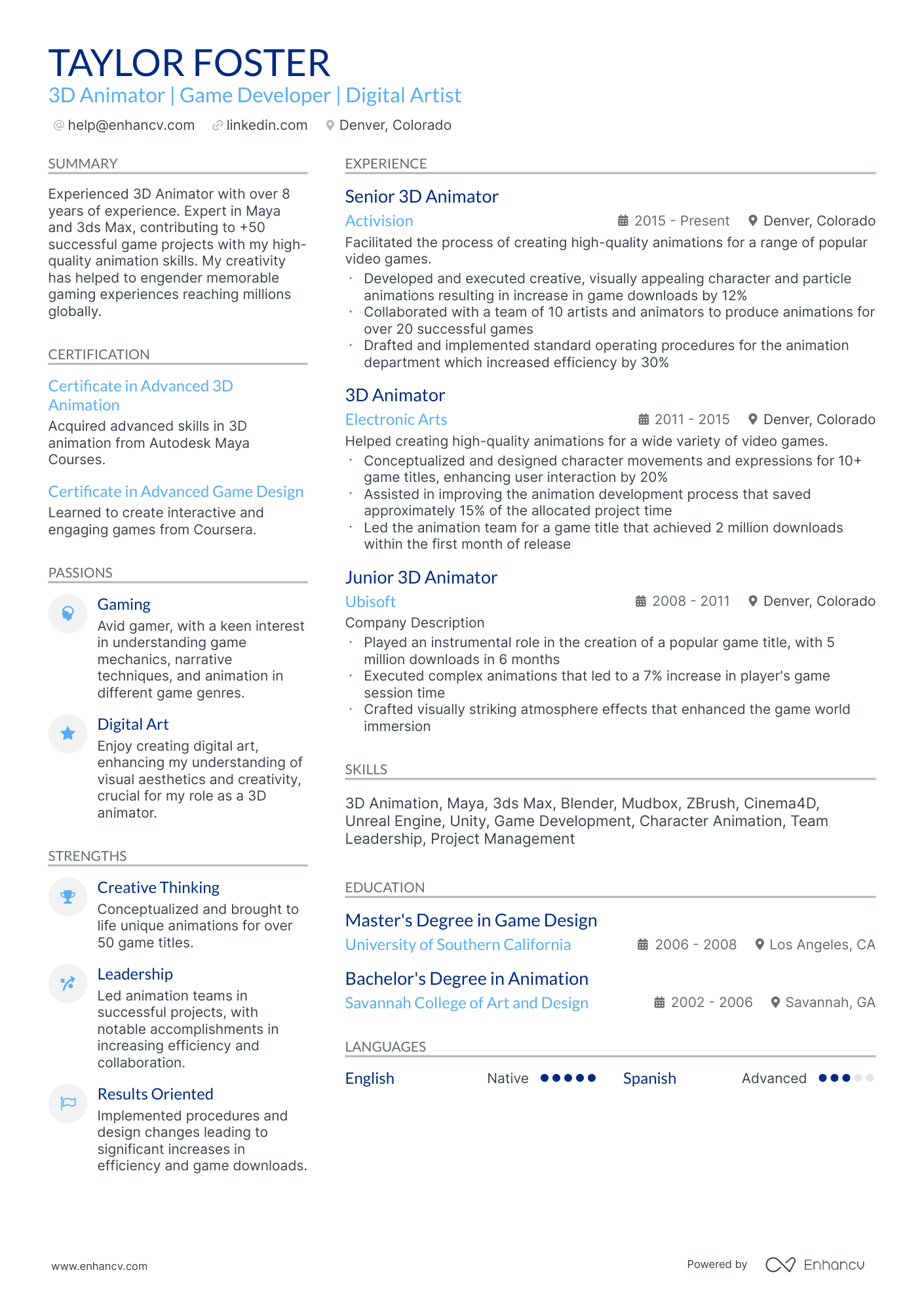
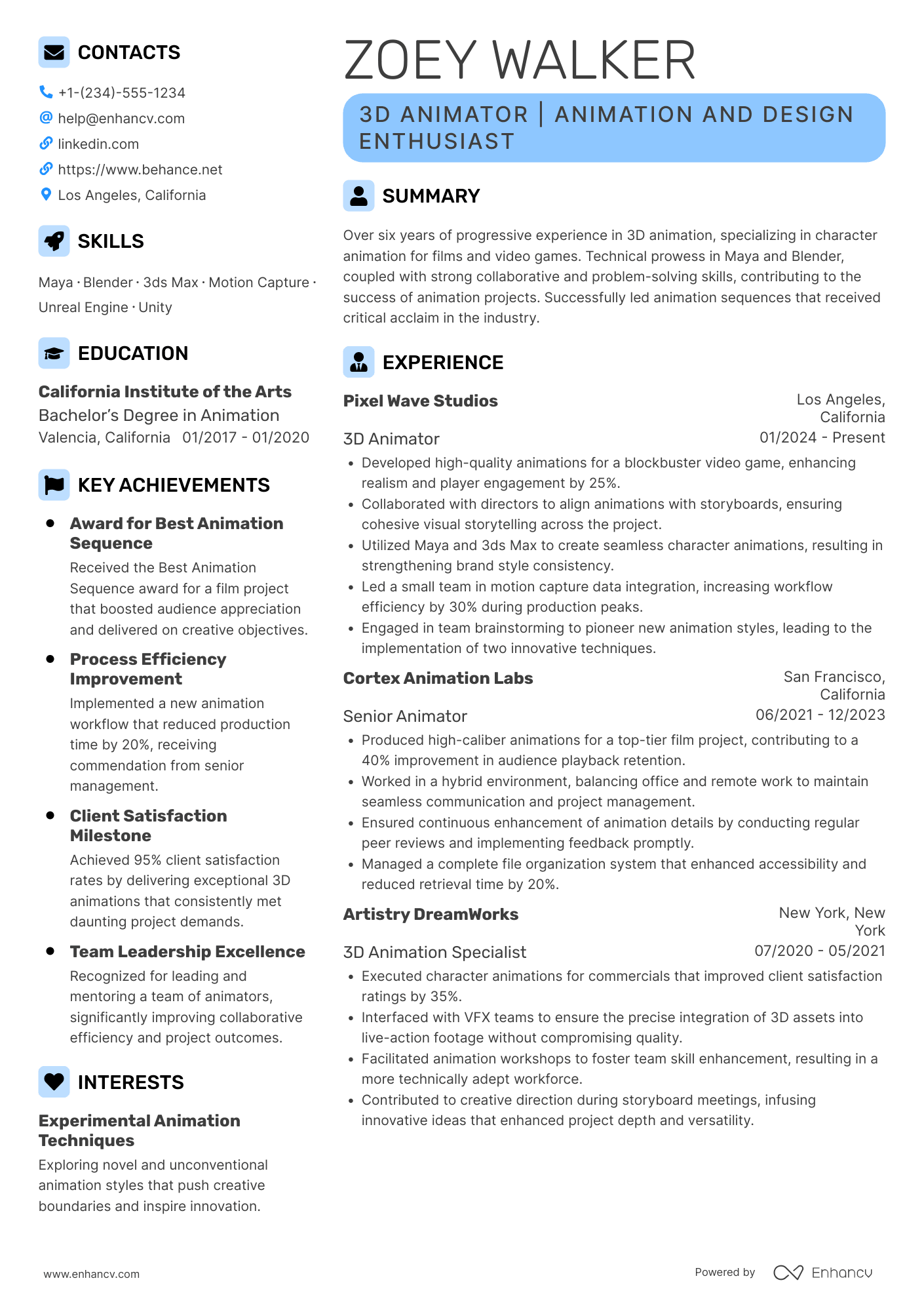
Most 3D animator resume submissions fail because they read like software checklists and task logs, not production-ready proof. In today's high-volume hiring, applicant tracking system screening and fast recruiter scans reward clarity, relevance, and measurable impact.
This guide shows you how to lead with outcomes: shots delivered, sequences completed, and deadlines met. You'll learn how to write a resume that highlights frame counts, render time reductions, fewer revision rounds, improved motion quality, platform performance gains, and on-brand consistency across episodes or campaigns.

Key takeaways
- Lead every experience bullet with a measurable outcome, not a task description.
- Tailor your resume's tools and terminology to match each job posting directly.
- Use reverse-chronological format if you have structured animation work history.
- Quantify achievements with metrics like revision reductions, render time savings, and delivery speed.
- Link your demo reel in the header so recruiters can review your work in seconds.
- Pair hard skills with proof in your experience bullets—never list them in isolation.
- Use Enhancv to turn vague job duties into focused, metric-driven resume bullets.
How to format a 3D animator resume
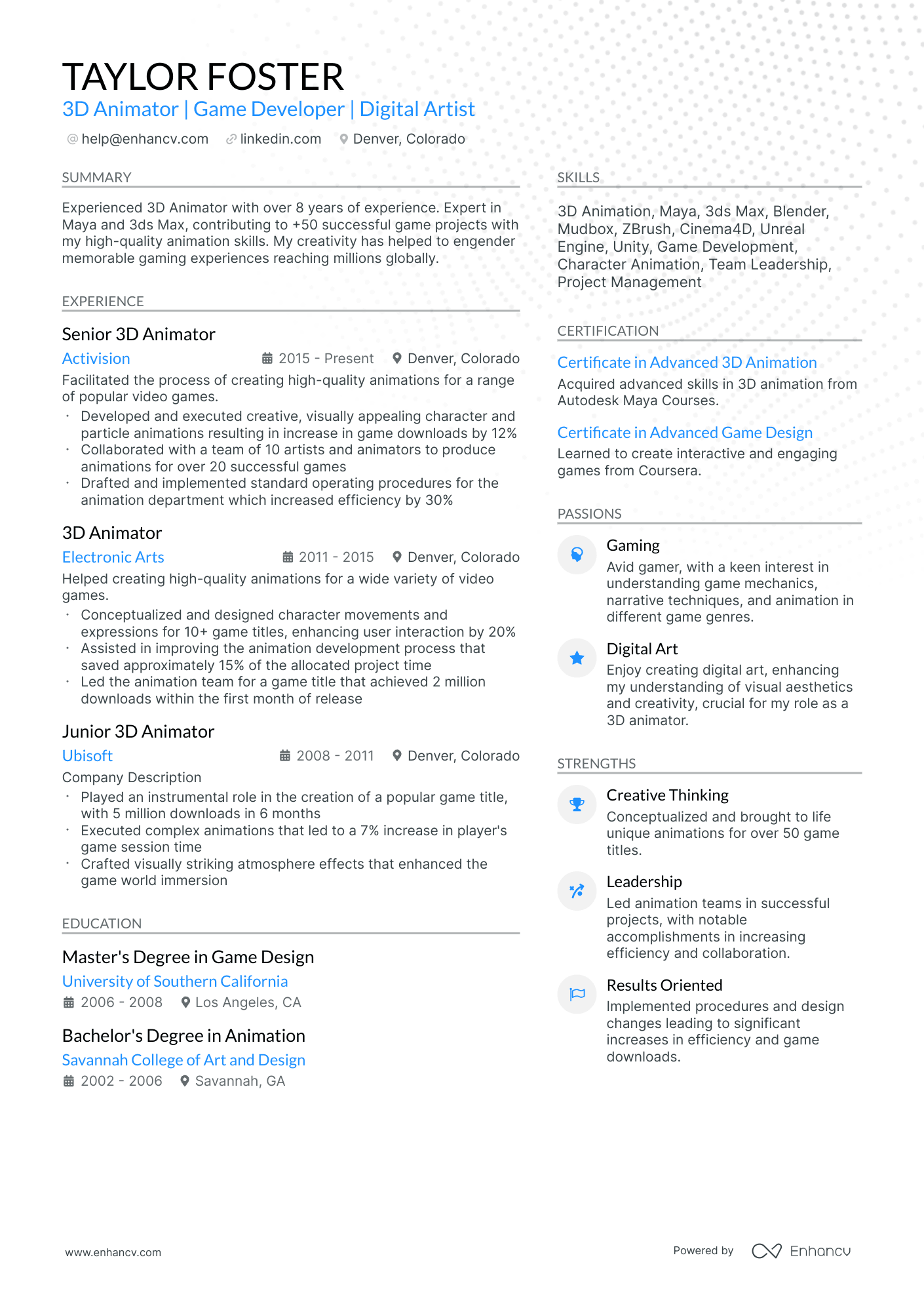
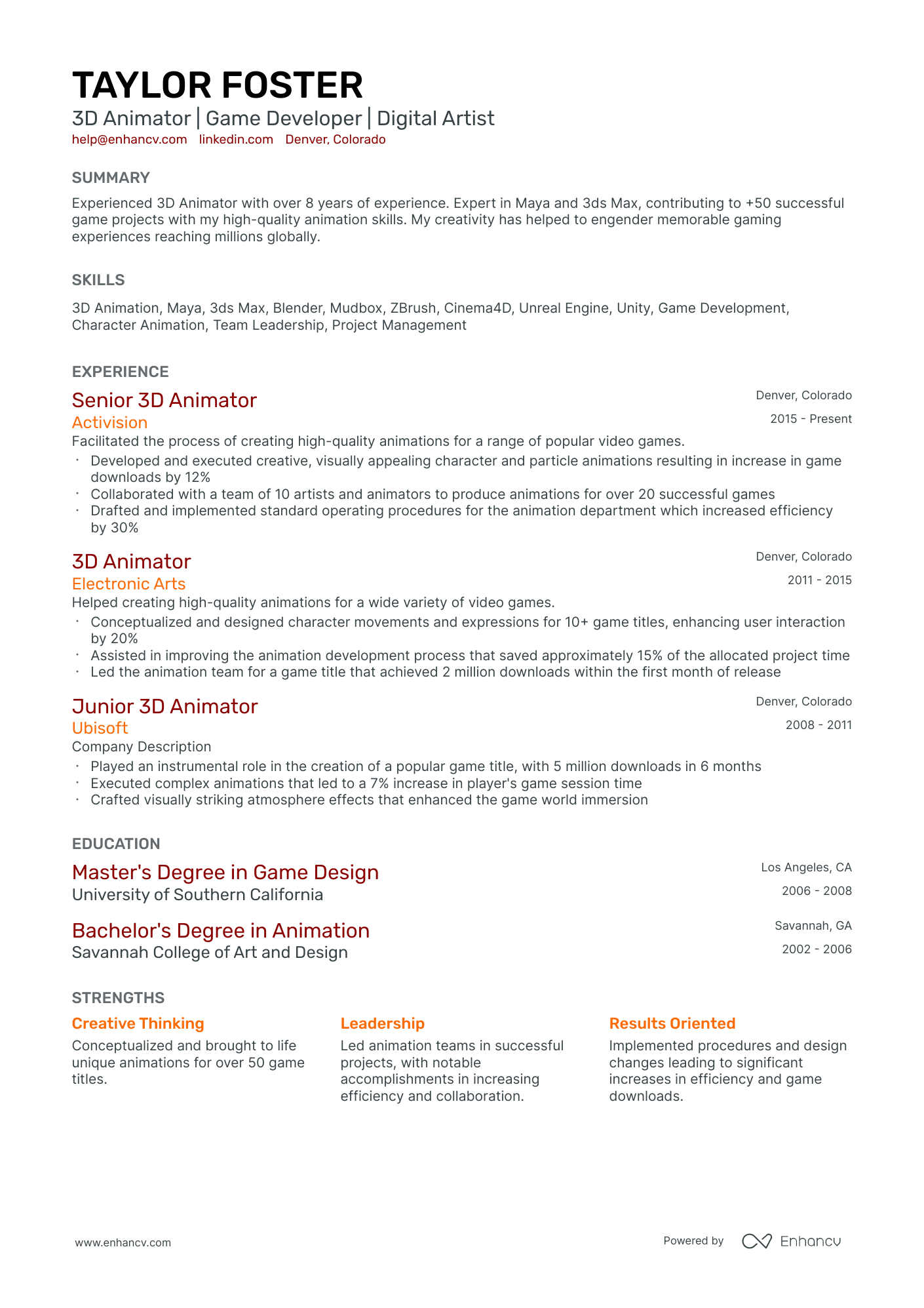
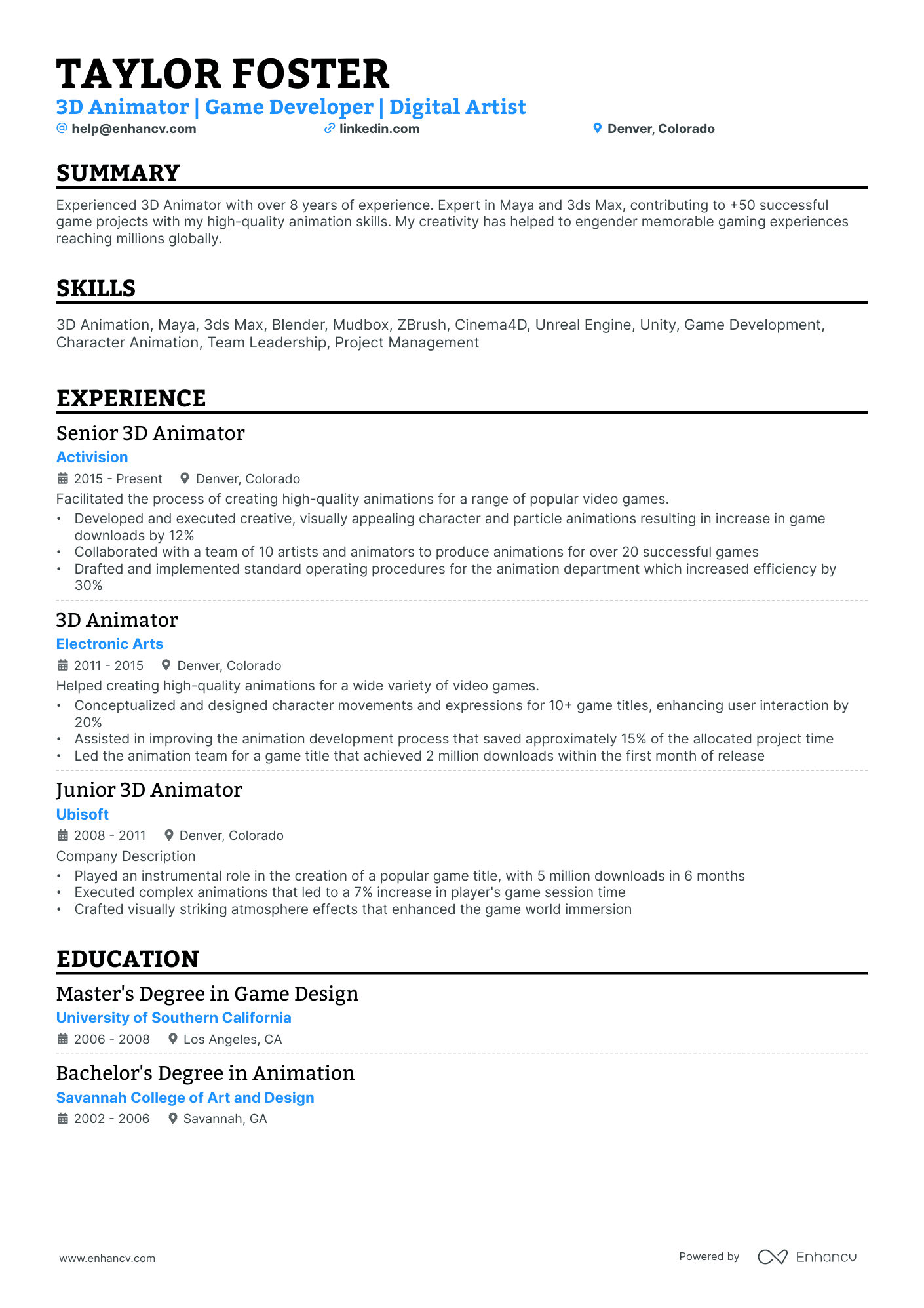
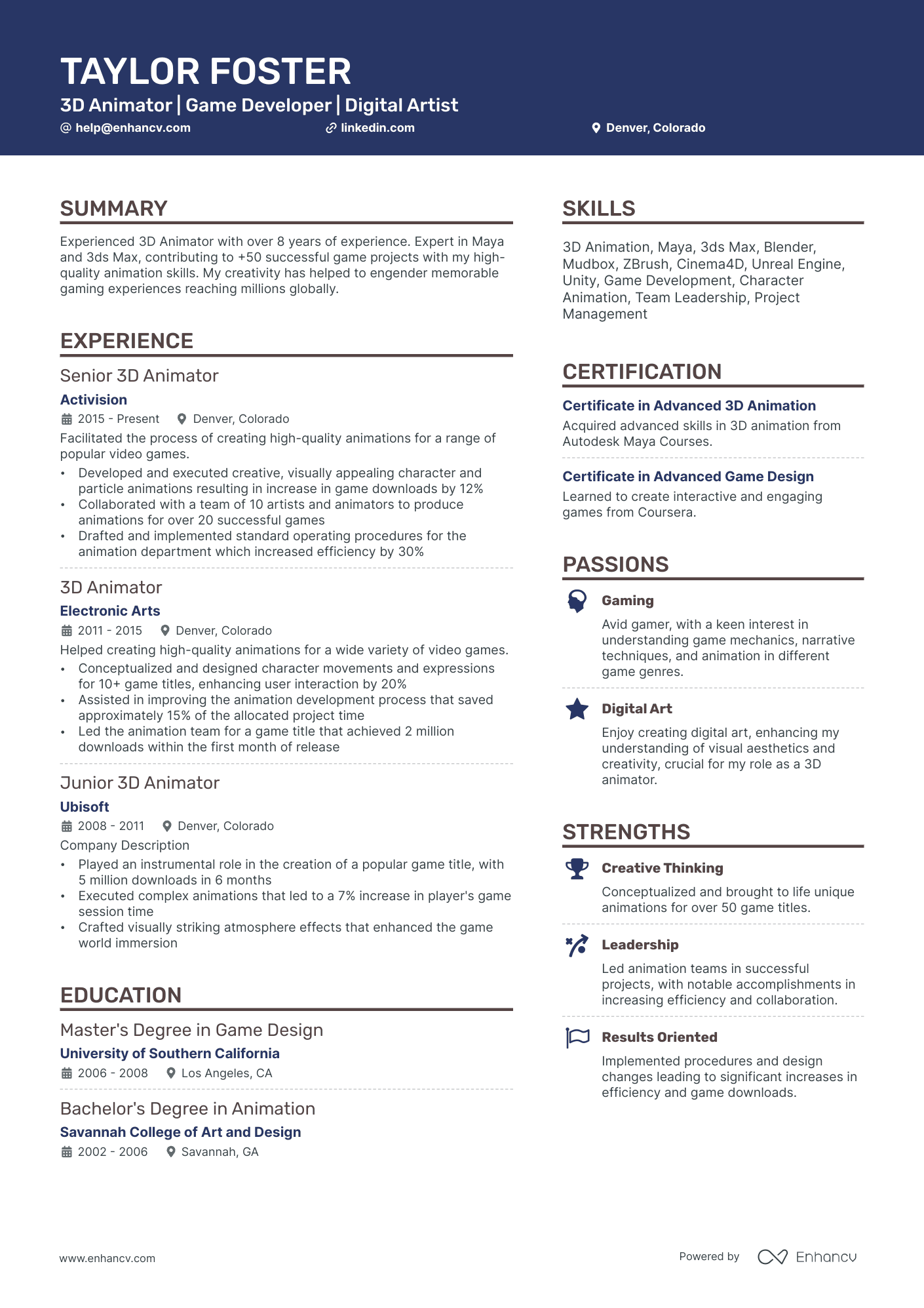
Recruiters evaluating 3D animator resumes prioritize a strong demo reel reference, technical proficiency across industry-standard tools, and evidence of collaborative project work. A clean, well-structured resume format ensures these signals surface quickly during both human review and applicant tracking system (ATS) parsing. Paying attention to your resume layout is equally important for readability and visual clarity.

I have significant experience in this role—which format should I use?
Use a reverse-chronological format to showcase your deepening expertise across studios, projects, and animation pipelines. Do:
- Lead with your most recent role and emphasize the scope of your contributions—team size, project scale, and pipeline ownership.
- Highlight proficiency in role-specific tools such as Maya, Blender, ZBrush, Houdini, Unreal Engine, and motion capture workflows.
- Quantify outcomes wherever possible, including project delivery timelines, rendering efficiency gains, or audience-facing metrics.
I'm junior or switching into this role—what format works best?
A hybrid format works best, letting you lead with core animation skills while still presenting project experience in a structured timeline. Do:
- Place a skills section near the top featuring software proficiency (Maya, Blender, After Effects), animation principles, and relevant coursework or certifications.
- Include personal projects, game jams, freelance work, or academic capstones that demonstrate applied 3D animation ability.
- Connect every listed skill to a specific action and its result so recruiters see practical application, not just a keyword list.
Why not use a functional resume?
A functional format strips away the project and timeline context that hiring managers rely on to assess how you've applied your animation skills in real production environments.
- Career changers with transferable motion design or VFX experience who lack formal 3D animation job titles but have relevant portfolio work.
- Recent graduates or bootcamp completers whose hands-on project work outweighs their limited employment history.
- Freelancers with resume gaps who completed contract-based animation work that doesn't fit neatly into a traditional timeline.
Now that you've established a clean, readable layout, it's time to fill each part of your resume with the right content.
What sections should go on a 3D animator resume
Recruiters expect a clean, easy-to-scan resume that shows your reel-ready 3D animation work, production experience, and technical range. Understanding resume sections and how to organize them is key to presenting your qualifications effectively.
Use this structure for maximum clarity:
- Header
- Summary
- Experience
- Skills
- Projects
- Education
- Certifications
- Optional sections: Awards, Publications, Languages
Strong experience bullets should emphasize shipped work, your contribution to the pipeline, measurable quality or efficiency gains, and the scope of assets, shots, or sequences you owned.
Is your resume good enough?
Drop your resume here or choose a file. PDF & DOCX only. Max 2MB file size.
Once you’ve organized the key resume components, the next step is to write your 3D animator experience section so each part supports your qualifications with clear, role-relevant detail.
How to write your 3D animator resume experience
Your work experience section proves you can deliver polished 3D animation work that ships—on time, on brand, and within pipeline constraints. Hiring managers prioritize demonstrated impact over descriptive task lists, so each bullet should connect the tools you used and the methods you followed to a tangible outcome.
Each entry should include:
- Job title
- Company and location (or remote)
- Dates of employment (month and year)
Three to five concise bullet points showing what you owned, how you executed, and what outcomes you delivered:
- Ownership scope: the characters, creatures, cinematics, sequences, or animation systems you were directly accountable for across specific titles, platforms, or production phases.
- Execution approach: the software, rigs, motion-capture pipelines, procedural workflows, or keyframe techniques you relied on to solve animation challenges and hit milestones.
- Value improved: the gains you drove in animation fidelity, render efficiency, rig performance, file optimization, or visual consistency that strengthened the final deliverable.
- Collaboration context: how you partnered with directors, riggers, modelers, engineers, lighting artists, or external studios to align animation work with broader creative and technical goals.
- Impact delivered: the measurable results your animation contributed to—whether through successful product launches, reduced revision cycles, expanded asset libraries, or audience and stakeholder reception.
Experience bullet formula
A 3D animator experience example
✅ Right example - modern, quantified, specific.
Senior 3D Animator
LumenArc Studios | Los Angeles, CA
2022–Present
Boutique animation studio producing real-time cinematics and in-game content for mid-sized AAA and indie game teams.
- Animated character performances and creature cycles in Autodesk Maya using HumanIK, constraints, and animation layers, reducing revision rounds by 30% through cleaner blocking and tighter pose-to-pose timing.
- Built a reusable facial animation pipeline with blendshapes, joint-based rigs, and pose libraries, cutting shot production time by 18% across forty-two dialogue-heavy sequences.
- Optimized real-time animation playback in Unreal Engine five by refining root motion, compression settings, and animation blueprints, improving frame stability by 12% in a combat-heavy vertical slice.
- Collaborated with riggers, gameplay engineers, and technical artists to debug skinning and deformation issues, lowering animation-related bug tickets by 25% in Jira over two releases.
- Delivered client-facing cinematic shots in ShotGrid with weekly review cycles, increasing on-time approvals from 78% to 92% by aligning animation beats with storyboards, camera, and audio timing.
Now that you have a solid experience entry as a reference point, let's look at how to adapt your own experience section to match the specific job you're targeting.
How to tailor your 3D animator resume experience
Recruiters evaluate your 3D animator resume through both human review and applicant tracking systems. Tailoring your resume to the job description ensures you pass both filters.
Ways to tailor your 3D animator experience:
- Match specific 3D software listed in the job description.
- Mirror the studio's terminology for animation pipelines and workflows.
- Reflect rendering engines or real-time platforms the role requires.
- Include relevant industry experience such as gaming or film production.
- Emphasize rigging or character animation if the posting highlights them.
- Align your work with quality standards or style guides referenced.
- Highlight collaboration with departments the job description names directly.
- Reference asset optimization methods when performance criteria are mentioned.
Tailoring means aligning your real accomplishments with what the role demands—not forcing disconnected keywords into your experience bullets.
Resume tailoring examples for 3D animator
| Job description excerpt | Untailored | Tailored |
|---|---|---|
| "Create character animations for AAA game titles using Maya and MotionBuilder, with a focus on realistic combat sequences and motion capture cleanup." | Animated characters for various projects using industry-standard software. | Animated 60+ combat sequences in Maya and MotionBuilder for a AAA action-RPG, cleaning up raw mocap data to achieve realistic hit reactions and weapon handling across 12 playable characters. |
| "Develop creature and environmental animations for feature films in Houdini and ZBrush, collaborating closely with the VFX supervisor to meet tight production deadlines." | Worked on animations for film projects and collaborated with team members. | Built procedural creature animations in Houdini and sculpted blend-shape targets in ZBrush for a feature film's 15-minute climax sequence, delivering all shots two weeks ahead of the VFX supervisor's deadline. |
| "Rig and animate stylized characters for a mobile game pipeline in Blender, optimizing bone counts and texture budgets for real-time performance on low-end devices." | Created rigs and animations for game characters using 3D tools. | Rigged and animated 20 stylized characters in Blender for a mobile RPG, reducing bone counts by 35% and keeping texture budgets under 512 KB per character to maintain 60 fps on low-end Android devices. |
Once you’ve aligned your experience with the role’s needs, quantify your 3D animation achievements to prove the impact of that work.
How to quantify your 3D animator achievements
Quantifying your achievements proves business impact beyond visuals. Focus on render performance, delivery speed, quality pass rates, revision volume, and audience or stakeholder outcomes tied to the animations you shipped.
Quantifying examples for 3D animator
| Metric | Example |
|---|---|
| Render efficiency | "Cut average frame render time 32% in Arnold by optimizing shaders, reducing samples, and baking textures for a 1,200-frame cinematic." |
| Delivery speed | "Delivered twelve character animation shots two days early by standardizing Maya playblasts and using a weekly shot-tracking board with production." |
| Quality pass rate | "Raised first-pass approval from 55% to 82% by tightening posing, arcs, and spacing, and aligning blocking reviews with the animation lead." |
| Revision reduction | "Reduced animation revision rounds from four to two per shot by adding clearer WIP check-ins and providing annotated viewport notes in SyncSketch." |
| Pipeline reliability | "Lowered broken rig incidents 40% by enforcing versioned rig publishes and validating constraints before handoff across five artists." |
Turn vague job duties into measurable, recruiter-ready resume bullets in seconds with Enhancv's Bullet Point Generator.
Once your bullet points clearly convey your accomplishments, the next step is ensuring your skills section reinforces that expertise with the right mix of hard and soft skills.
How to list your hard and soft skills on a 3D animator resume
Your skills section shows how you produce animation-ready shots, and recruiters and ATS scan this section for role keywords, tool matches, and pipeline fit—aim for a skills mix that's mostly hard skills, supported by job-specific soft skills. 3D animator roles require a blend of:
- Product strategy and discovery skills.
- Data, analytics, and experimentation skills.
- Delivery, execution, and go-to-market discipline.
- Soft skills.
Your skills section should be:
- Scannable (bullet-style grouping).
- Relevant to the job post.
- Backed by proof in experience bullets.
- Updated with current tools.
Place your skills section:
- Above experience if you're junior or switching careers.
- Below experience if you're mid/senior with strong achievements.

Hard skills
- Autodesk Maya, Blender
- Motion capture cleanup, retargeting
- Rigging basics, skinning
- Character animation, acting beats
- Body mechanics, weight, timing
- Facial animation, lip sync
- Keyframe animation, spline workflows
- Animation layers, non-linear animation
- Graph Editor, curve polishing
- Constraints, IK/FK switching
- Unreal Engine, Unity
- Shot blocking, playblasts
Soft skills
- Shot ownership and follow-through
- Incorporate director feedback fast
- Communicate intent in dailies
- Collaborate with rigging and modeling
- Coordinate with layout and lighting
- Maintain continuity across shots
- Prioritize fixes under deadlines
- Flag blockers early and clearly
- Document handoffs and notes
- Self-review against style guides
- Adapt performance to reference
- Manage versioning and approvals
How to show your 3D animator skills in context
Your skills shouldn't live only in a bulleted list on your resume. Explore resume skills examples to see how top candidates integrate their abilities throughout their application.
They should be demonstrated in:
- Your summary (high-level professional identity)
- Your experience (proof through outcomes)
Here's how that looks in practice.
Summary example
Senior 3D animator with 8+ years in game development. Skilled in Maya, ZBrush, and motion capture pipelines. Led a 12-person animation team that delivered cinematic sequences 20% under budget while maintaining AAA quality standards.
- Signals senior-level expertise immediately
- Names industry-standard tools directly
- Includes a concrete budget metric
- Highlights leadership as a soft skill
Experience example
Senior 3D Animator
Ironforge Interactive | Austin, TX
June 2019–March 2024
- Animated 200+ character assets in Maya and MotionBuilder, reducing revision cycles by 35% through standardized rigging workflows.
- Collaborated with art directors and engineers to build a real-time animation pipeline in Unreal Engine 5, cutting production time by 18%.
- Mentored four junior animators on facial capture cleanup techniques, improving team output quality scores by 22% across two project cycles.
- Every bullet includes measurable proof
- Skills appear naturally within achievements
Once you’ve demonstrated your animation abilities through relevant projects and outcomes, the next step is applying that approach to a resume when you’re starting out and don’t have professional experience.
How do I write a 3D animator resume with no experience
Even without full-time experience, you can demonstrate readiness through personal projects and applied coursework. If you're building a resume without work experience, focus on showcasing tangible animation output:
- Personal short film animation.
- Game jam character animations.
- Freelance logo animation gigs.
- School capstone 3D animation.
- Motion capture retargeting tests.
- Rigging and skinning practice.
- Animation challenges and critiques.
- Portfolio shots with breakdowns.
Focus on:
- Demo reel with shot breakdowns.
- Clean body mechanics and timing.
- Tool proficiency: Maya, Blender, Unreal.
- Production pipeline: rigs, renders, exports.
Resume format tip for entry-level 3D animator
Use a combination resume format because it highlights projects and a demo reel first, while still showing education, tools, and relevant experience. Do:
- Lead with demo reel link and tools.
- Write project bullets with metrics.
- Add a tools section with versions.
- Include pipeline steps you handled.
- Tailor keywords to each job post.
- Animated a twelve-second 3D animator short film in Blender, using rigged character cycles and lighting passes, and increased demo reel watch time by 22%.
Once you've structured your resume around transferable skills and personal projects, presenting your education effectively becomes the next way to strengthen your candidacy.
How to list your education on a 3D animator resume
Your education section helps hiring teams confirm you have foundational training in animation, design, or related fields. It validates the technical and artistic knowledge a 3D animator needs.
Include:
- Degree name
- Institution
- Location
- Graduation year
- Relevant coursework (for juniors or entry-level candidates)
- Honors & GPA (if 3.5 or higher)
Skip month and day details—list the graduation year only.
Here's a strong education entry tailored for a 3D animator resume:
Example education entry
Bachelor of Fine Arts in Animation
Ringling College of Art and Design, Sarasota, FL
Graduated 2021
GPA: 3.7/4.0
- Relevant Coursework: 3D Modeling, Character Rigging, Motion Capture Techniques, Digital Sculpting, Visual Storytelling
- Honors: Graduated magna cum laude, Dean's List (six semesters)
How to list your certifications on a 3D animator resume
Certifications on your resume show your commitment to learning, prove tool proficiency, and signal industry relevance as a 3D animator. They help hiring teams trust your pipeline knowledge, even when your work history is limited.
Include:
- Certificate name
- Issuing organization
- Year
- Optional: credential ID or URL
- Place certifications below education when your degree is recent and your certifications add support, not core qualification, for the 3D animator role.
- Place certifications above education when they are recent, role-relevant, and highlight key tools or workflows required for the 3D animator job.
Best certifications for your 3D animator resume
- Autodesk Certified Professional: Maya
- Autodesk Certified Professional: 3ds Max
- Adobe Certified Professional: After Effects
- Unity Certified Associate: Game Developer
- Unreal Engine Authorized Instructor Program Certification
- SideFX Certified Houdini Artist
Once you’ve positioned your credentials where hiring managers can spot them quickly, move to your 3D animator resume summary to tie those qualifications to the role you’re targeting.
How to write your 3D animator resume summary
Your resume summary is the first thing a recruiter reads, so it needs to earn their attention fast. A strong opening tied to 3D animation signals you're relevant before they scan anything else.
Keep it to three to four lines, with:
- Your title and total years of hands-on 3D animation experience.
- The domain you work in, such as gaming, film, advertising, or product visualization.
- Core tools like Maya, Blender, ZBrush, or Unreal Engine.
- One or two measurable accomplishments that prove your impact.
- Soft skills like collaboration or adaptability linked to real project outcomes.

PRO TIP
At the entry level, lead with your strongest tools and any real project contributions, even from internships or freelance work. Avoid generic phrases like "passionate self-starter" or "eager to learn." Recruiters want proof of what you can do, not promises about what you hope to become.
Example summary for a 3D animator
3D animator with two years of experience creating character animations in Maya and Blender for mobile games. Delivered 40+ production-ready assets ahead of schedule while collaborating across art and engineering teams.
Optimize your resume summary and objective for ATS
Drop your resume here or choose a file.
PDF & DOCX only. Max 2MB file size.
Now that your summary captures your strongest qualifications at a glance, make sure your header presents your contact details and professional identity just as clearly.
What to include in a 3D animator resume header
A resume header lists your key contact and professional links, and it matters for a 3D animator because it boosts visibility, credibility, and recruiter screening speed.
Essential resume header elements
- Full name
- Tailored job title and headline
- Location
- Phone number
- Professional email
- GitHub link
- Portfolio link
Including a LinkedIn link helps recruiters verify experience quickly and supports screening.
Do not include a photo on a 3D animator resume unless the role is explicitly front-facing or appearance-dependent.
Keep your header consistent with your portfolio branding, and place your strongest link first so recruiters can review your work in seconds.
3D animator resume header
Jordan Rivera
3D animator | Character animation and cinematic sequences
Los Angeles, CA
(323) 555-01XX
jordan.rivera@enhancv.com
github.com/jordanrivera
jordanrivera.com
linkedin.com/in/jordanrivera
Once your header makes it easy for hiring teams to identify you and reach you, add the additional resume sections that support the same goal with relevant details.
Additional sections for 3D animator resumes
Extra resume sections help you stand out when your core qualifications match other candidates, showcasing unique strengths relevant to the 3D animator role. For example, listing language skills can be a differentiator when applying to studios with international teams or multilingual productions.
- Languages
- Hobbies and interests
- Awards and competitions
- Professional affiliations and memberships
- Publications and demo reel features
- Volunteer animation work
- Conferences and workshops
Once your resume sections are set, pairing them with a strong cover letter can reinforce the narrative they create.
Do 3D animator resumes need a cover letter
A cover letter isn't required for a 3D animator, and your reel still carries the most weight. But understanding what a cover letter is and when to use one helps in competitive roles or studios that expect one. It can make a difference when your fit, context, or career path isn't obvious.
Use a cover letter when it adds clarity that your resume and reel can't:
- Explain role and team fit: Match your strengths to the pipeline, style, and collaboration needs of the team.
- Highlight one or two relevant projects or outcomes: Name the project, your specific contribution, and the measurable result or production impact.
- Show understanding of the product, users, or business context: Connect your animation choices to audience needs, brand tone, or gameplay and performance constraints.
- Address career transitions or non-obvious experience: Tie adjacent work to animation fundamentals, tools, and workflows the role uses.
Drop your resume here or choose a file.
PDF & DOCX only. Max 2MB file size.
Even if you choose to include a cover letter to add context beyond your resume, the next step is using AI to improve your three-dimensional animator resume so it communicates your value more clearly and consistently.
Using AI to improve your 3D animator resume
AI can sharpen your resume's clarity, structure, and impact. It helps tighten language and highlight relevant skills. But overuse strips authenticity. Once your content reads clearly and aligns with your target role, step away from AI. If you're wondering which AI is best for writing resumes, start with tools that focus on structure and specificity rather than generic rewrites.
Here are 10 practical prompts to strengthen specific sections of your 3D animator resume:
- Strengthen your summary: "Rewrite my 3D animator resume summary to highlight my strongest technical skills and years of experience in under four sentences."
- Quantify experience bullets: "Add measurable results to these 3D animator experience bullets, focusing on project scope, deadlines met, or output volume."
- Tailor skills to a job posting: "Compare this job description with my 3D animator skills section and suggest which skills to prioritize or add."
- Tighten wordy bullets: "Shorten each of these 3D animator experience bullet points to one concise line without losing key details."
- Improve action verbs: "Replace weak or repeated verbs in my 3D animator experience section with stronger, more specific action verbs."
- Refine project descriptions: "Rewrite my 3D animator project descriptions to clearly state my role, tools used, and the final deliverable."
- Align education details: "Suggest how to present my education section to best support a 3D animator role in gaming or film."
- Highlight certifications: "Reorder and rewrite my certifications section to emphasize those most relevant to a 3D animator position."
- Remove filler language: "Identify and remove filler words or vague phrases from my 3D animator resume without changing the meaning."
- Check role alignment: "Review my entire 3D animator resume and flag any bullet points that don't clearly connect to animation work."
Stop using AI once your resume sounds accurate, specific, and aligned with real experience. AI should never invent experience or inflate claims—if it didn't happen, it doesn't belong here.
Conclusion
A strong 3D animator resume highlights measurable outcomes, role-specific skills, and clean structure. Use clear sections, targeted keywords, and a portfolio link. Show impact with metrics like faster shot delivery, fewer revisions, and improved render times.
Keep it skimmable and consistent, with focused bullet points and relevant credits. Align your skills with today’s pipelines and tools, and show you can adapt as workflows evolve. This approach signals you’re ready to contribute on day one.