The last computer science cover letter that made me, а Certified Professional Resume Writer, read it, opened with a project outcome, not a degree. "I built a distributed caching layer that cut API response time from 400ms to 22ms." That's the first sentence. Everything after that, the school, the GPA, the frameworks, becomes credible because the result is already in the room.
Most entry-level computer science cover letters open with "I am a recent graduate with a strong passion for technology." That sentence tells the recruiter nothing except that you used the same template as hundreds of other applicants. CS hiring is competitive, so make sure you bring something unique to the table.

Key takeaways
- Lead with a specific technical project or achievement. Name the tech stack, the problem you solved, and the measurable outcome.
- Name your degree, specialization, and any relevant certifications: AWS Certified, Google Cloud, CompTIA Security+, etc.
- Match your experience to the role level: internship, entry-level, mid-level, or senior.
- Show you understand the company's technical environment—their stack, their product, their engineering culture.
- Include your GitHub URL or portfolio link in the header.
- Keep it to one page.
Taylor Foster
New York City, NY
+1-(234)-555-1234
t.foster@enhancv.com


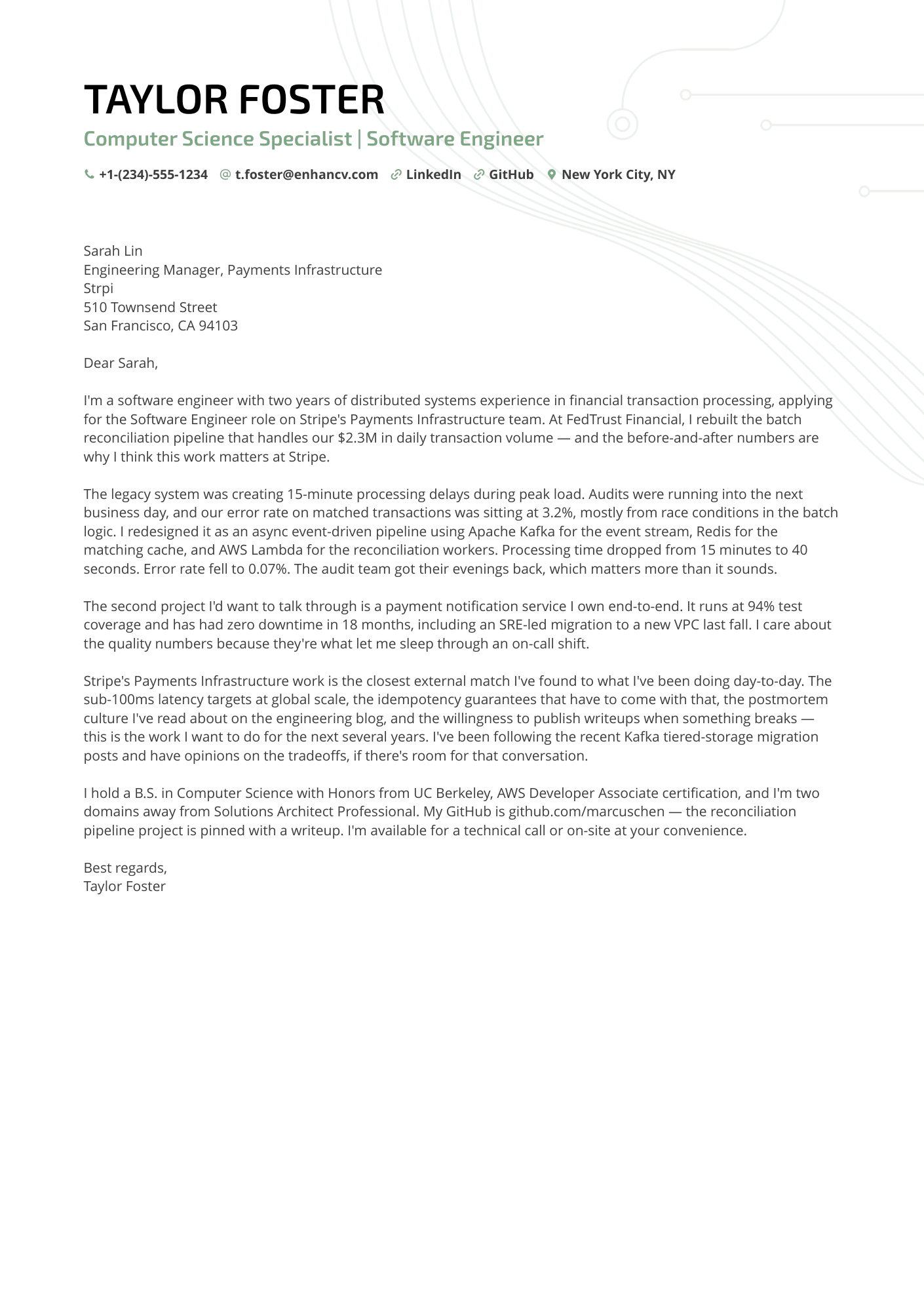
Here's why this letter works:
- Led with a technical achievement: The redesigned reconciliation pipeline has real before-and-after numbers: 15 minutes to 40 seconds, 3.2% error rate to 0.07%, $2.3M daily transaction volume. The hiring manager knows immediately what level this candidate operates at.
- Named the specific tech stack: Apache Kafka, Redis, AWS Lambda. Not "experience with cloud technologies" but actual tools, actual context.
- Second project shows reliability and craft: 94% test coverage and zero downtime in 18 months signals engineering discipline, not just delivery speed.
- Credential chain is clear: B.S. with Honors, AWS Developer Associate, Solutions Architect Professional in progress. The career trajectory is visible.
- Named the specific team at the company: Payments Infrastructure, not just "Stripe." That specificity matters in engineering hiring.
Built with Enhancv's Cover Letter Builder.
The letter is the narrative half of the application; the technical proof — stack, projects, measurable outcomes — has to land on the document next to it, and our computer science resume guide shows how to write bullets a senior engineer trusts on first read.
What your computer science cover letter needs to cover
Engineering managers ask four questions when they read your cover letter. Aim to answer all of them clearly.
1. Can you actually build what this role requires?
A software engineer cover letter without a concrete project is just a list of technologies you claim to know. Name the project, the stack, the scale, and the result. One real, shipped project is worth more than five bullet points listing programming languages.
2. What's your technical depth versus breadth?
Are you a backend engineer who can go deep on distributed systems? A full-stack developer who can own a feature end-to-end? A data engineer who optimizes query performance? Be specific about where your depth lives. Generalist claims don't clear the first filter.
3. Have you worked at a relevant scale or in a relevant domain?
Fintech has different constraints than edtech. Startup infrastructure is different from enterprise systems. Real-time systems are different from batch processing. Name your domain experience and the scale at which you've operated.
4. Why this team and this company?
"I've always admired your product" is not an answer. "I'm drawn to the challenge of building payment systems that work reliably at sub-100ms latency at global scale, which maps directly to the distributed systems work I've been doing in federal financial transaction processing" is an answer. Research the engineering blog, the tech talks, the open-source contributions.
Sections to include in your computer science cover letter
A computer science cover letter follows standard professional letter format, but the technical context within each section is what differentiates it.
Header
Your full name, email, phone, city/state, LinkedIn URL, and GitHub URL or portfolio link. Match it to your computer science resume. Credentials after your name if you hold relevant certifications.
Salutation
Use the hiring manager's name. Engineering job postings often don't include a name — check the company's engineering blog for the relevant team lead, search LinkedIn for the engineering manager, or check the company's GitHub org for active contributors. The right cover letter salutation shows you looked.
Opening paragraph
State the role and team, your current position and company, your degree and institution, and your top certification. Three sentences maximum.
Body paragraphs
First paragraph: your strongest technical project with the full Problem → Stack → Result arc. Second paragraph: a second project showing a different dimension of your skills (reliability, collaboration, API design, test coverage). Third paragraph: why this company and team specifically.
Closing
Request a technical call or on-site. Mention your GitHub so they can look before the call. Sign off cleanly.
Formatting tips
Keep it to one page—cover letter length is especially relevant in engineering, where hiring managers often spend less time on it than on your GitHub. Use a cover letter font that renders cleanly in PDF: Rubik or Georgia at 10 – 12 pt. Left-align your text and keep the cover letter format clean so the technical content reads without friction.
What computer science recruiters look for
Recruiters in the tech space scan cover letters for "proof of life." In a sea of generic templates, they are trained to ignore the adjectives and hunt for the nouns—specific technologies, hard numbers, and evidence of shipping code. To get past the initial filter, your letter needs to serve as a high-signal map of your technical capabilities.

What engineering hiring managers scan for first
1. Concrete technical projects with stack specifics and measurable outcomes
2. Degree and specialization: CS, software engineering, computer engineering, or equivalent
3. Relevant certifications: AWS, Google Cloud, Azure, CompTIA Security+, CKA, or role-specific credentials
4. Programming language and framework proficiency matched to the role's stack
5. Scale indicators: user counts, transaction volumes, data volumes, latency requirements handled
6. Engineering practices: test coverage, CI/CD experience, code review participation, documentation habits
How to address your computer science cover letter
Most engineering job postings don't name the hiring manager. That doesn't mean you can't find one.
Check the company's engineering blog. It’s often written by the team leads who are hiring. Search LinkedIn for "Engineering Manager" + the team name + the company. Look at the company's GitHub organization page for active contributors. Check tech conference speaker lists: engineering managers at tech companies often present at QCon, AWS re:Invent, or their company's engineering summit.
Use "Dear [Name]" when you have a name. If you genuinely cannot find one after real effort, "Dear [Team Name] Hiring Team" (e.g., "Dear Payments Infrastructure Hiring Team") is better than "Dear Hiring Manager."
How to open your computer science cover letter
The opener that gets ignored: "I am a passionate computer science graduate seeking an opportunity to apply my skills at an innovative company." Every CS applicant has sent that sentence.
Strong opening
I'm a software engineer with two years of distributed systems experience in financial transaction processing, applying for the Software Engineer role on Stripe's Payments Infrastructure team. My most recent project cut API response time from 15 minutes to 40 seconds and reduced error rate from 3.2% to 0.07% on a $2.3M daily transaction pipeline.
Weak opening
I am writing to apply for the Software Engineer position at Stripe. I am a passionate computer science graduate with strong problem-solving skills and a desire to make a positive impact through technology. I believe my technical skills and enthusiasm make me a great fit for your team.
The weak version has zero technical content and could apply to any engineering role at any company. The strong one names a domain, a team, and a quantified project outcome in two sentences. That's how to start a cover letter for a technical role.
Drop your resume here or choose a file.
PDF & DOCX only. Max 2MB file size.
How to write the body of your computer science cover letter
The body of a CS cover letter is where you prove technical competency. Not just familiarity with a stack but actual work you built, at actual scale, with actual results.
Use Problem → Stack → Result for every technical project you describe.
Don’t
"I have experience with distributed systems and cloud infrastructure."
Do
“Our legacy batch reconciliation system was creating 15-minute processing delays at peak load. I redesigned it with an async event-driven architecture using Apache Kafka and Redis caching on AWS Lambda. Processing time dropped from 15 minutes to 40 seconds, and error rate fell from 3.2% to 0.07%."
The specificity is what matters. Any software engineer can claim to know Kafka. Not every engineer has rebuilt a production pipeline with documented before-and-after results.
Tailoring your letter to the job posting
Technical job postings are more specific than most. Match your language to theirs exactly.
Match job posting language to your experience
| Job posting says | Your cover letter should include |
|---|---|
| Experience with distributed systems | Name the specific architecture pattern and tools: Kafka, RabbitMQ, gRPC, event sourcing, CQRS |
| Strong proficiency in Python/Go/Java | Name the projects where you used it at production scale, not just coursework |
| Experience with cloud platforms (AWS, GCP, Azure) | Name the specific services: Lambda, ECS, S3, BigQuery, Cloud Run, and your certification if you hold one |
| RESTful API design and development | Name the API you built, its consumers, and your documentation and testing approach |
| Agile or Scrum team experience | Describe your sprint cadence, your role in standups and retrospectives, and how you handle scope changes |
Enhancv's Tailoring Tool scans the job posting and highlights which skills and projects to lead with. Useful when you're applying to multiple roles with overlapping but distinct requirements.
How to close your computer science cover letter
Your closer should invite a technical conversation, not just express interest. Engineering hiring managers respect directness.
The weak version offers nothing actionable. The strong one points to concrete evidence (the GitHub), references the specific project, and invites a technical conversation. That's the close that gets the call. More options in our cover letter ending guide.
Computer science cover letter with no experience
CS students and recent graduates have more portfolio material than they realize. Class projects, open-source contributions, hackathon builds, freelance work, and personal side projects all count, as long as you describe them with the same rigor you'd apply to professional experience.

Entry-level CS cover letter formula
[Degree program + institution + graduation date or expected date] + [most complex project you built: problem, stack, and result] + [GitHub link or live demo URL] + [any internship or relevant work experience] + [specific reason you're applying to this company and team]
Here's what that looks like: "During my junior year at UC San Diego, I built a real-time collaborative code editor as my senior capstone project. The app supports 50 concurrent users with sub-50ms sync latency, built with WebSockets, React, and a Node.js backend deployed on Google Cloud Run. It's been used by 800+ students through a pilot with the CS department. The GitHub repo has 340 stars."
That's a real project with real users and real metrics. It doesn't matter that it wasn't a job. The engineering problem is real, and the outcome is documentable.
Don't apologize for being early in your career. Engineering managers hiring new grads know you're a new grad. They want to see that you can build real things, that you care about quality, and that you've researched why their technical problems are interesting.

PRO TIP
Use Enhancv's cover letter templates to handle formatting. Spend your time on the technical content, such as the project descriptions, the stack specifics, the metrics. Those are what get read.
Frequently asked questions about computer science cover letters
Still got questions? Take a look at the section below to find the answers to the most common ones.
What should a computer science cover letter include?
Your degree, institution, and any relevant certifications; one or two technical projects with specific stack details and measurable outcomes; your GitHub or portfolio URL; and a specific reason you want to work on that team at that company. Skip "I am passionate about coding." Show a project that proves it.
How long should a computer science cover letter be?
One page, or between 250 and 400 words. Engineering hiring managers read cover letters quickly, often after scanning your GitHub. A long letter that requires scrolling gets skimmed. The cover letter format should fit cleanly on one page without cramming.
What makes a computer science cover letter stand out?
Specificity in three dimensions: what you built (the technical problem and stack), how well you built it (quality indicators: test coverage, uptime, latency), and at what scale (user counts, data volumes, transaction rates). Generic claims about "proficiency in Python" are forgettable. A specific project with a measurable outcome is not.
How do I write a computer science cover letter with no experience?
Use your strongest project, like class capstone, personal build, hackathon, or open-source contribution, as your lead achievement. Describe it with the same rigor you'd apply to a professional project: what problem it solved, what stack you used, and what the outcome was. Include your GitHub. Show that you build things and think carefully about quality. See how to write a cover letter for more structure on this.