


When it comes to job hunting, there are two common approaches. One says you should apply to every role that seems like a good fit. The other warns that applying to too many jobs can dilute your focus and reduce the quality of each application.
While casting a wide net can sometimes lead to unexpected opportunities, being intentional about the jobs you apply for often leads to better results. So, how many jobs should you apply for to stay productive without burning out?
The answer depends on your overall job search strategy. The important thing is, whatever approach you choose, using a tool like Enhancv’s Job Application Tracker can help you stay organized by keeping all your applications in one place.

Key takeaways
- There’s no single number of applications that guarantees a job. Realistic ranges help you stay consistent without burning out.
- Applying to too many jobs at once can hurt your focus, motivation, and application quality. Aim to apply for 2-3 jobs per day, or roughly 10-15 a week.
- Tailoring your resume and cover letter greatly improves your chances of getting noticed.
- Staying organized by tracking applications makes follow-ups easier and reduces stress.
- A thoughtful, sustainable job search strategy works better than sending as many applications as possible.
How many jobs should I apply for at once?
There isn’t one universal number of job applications that works for everyone. Your choice depends on factors like your role, seniority, and how much time each application requires.
Instead of aiming for a fixed number, it’s more helpful to think in ranges.
Here’s a rough guideline for how many job applications per week make sense, depending on your experience level.
How many job applications per week is realistic?
| Entry-level roles or recent graduates (e.g., marketing assistant, junior developer, intern) | ~15 — roles are often similar, and applications take less time to tailor |
|---|---|
| Mid-level professionals (e.g., software engineer, product manager, data analyst) | 10–15 — more customization is needed to highlight relevant experience |
| Senior or highly specialized roles (e.g., engineering manager, staff engineer, head of marketing) | 5–10 — fewer suitable openings and significantly more effort per application |
| Career switchers (e.g., sales → customer success; or teacher → instructional designer) | 5–15 — extra time needed to position transferable skills |
For most job seekers, this works out to roughly two to three job applications per day, depending on how much tailoring each role requires.
In the end, it all depends on your situation. If you’re unemployed and job searching full-time, you may be able to apply to more roles per week than someone applying alongside a current job.
Likewise, senior professionals and career switchers often need more time per application, while entry-level candidates can move faster.
The key is to choose a pace you can maintain consistently without sacrificing quality.
Is it bad to apply for too many jobs?
Applying for too many jobs in a short period of time has a potential caveat—a job application burnout. Constantly tweaking resumes, writing cover letters, and tracking responses takes real mental energy—especially when you’re not hearing back.
When burnout sets in, the quality of your applications often drops, making it harder to stay consistent or motivated.
A pace you can maintain over weeks or months is far more effective than an intense burst of applications followed by exhaustion. That’s why you need sustainability.

PRO TIP
Burnout isn’t the only risk of high-volume applying. In some cases, the sheer number of applications can also work against you from the recruiter’s side.
As we explain in our most recent ATS (applicant tracking systems) study, the idea that software automatically rejects most resumes is largely a myth. 92% of recruiters don’t use ATS auto-rejection, and only 8% rely on strict filters tied to hard requirements. The real issue is volume—some roles attract hundreds or even 1,000+ applications in a matter of days, far more than recruiters can realistically review. As a result, even strong resumes can get lost in the pile and never be seen.
This can feel discouraging, but the takeaway isn’t to stop applying. It’s that having a clear strategy matters. Sending a large number of sporadic, untargeted applications increases the chances of getting lost in the pile—for everyone.
How to streamline your application process?
Unfortunately, there’s no formula to determine the exact number of job applications to get a job.
For many candidates wondering how many resumes they should send to get an interview, data suggests that job seekers often need to submit between ~30 and 200+ applications to land a single offer, so a strategic approach tends to matter more than sheer volume.
Here are a few essential tips to improve your chances.
#1 Tailor your resume for the role
Applicant tracking systems are designed to sort and filter resumes based on specific keywords and criteria found in the job description.
While ATS don’t automatically reject candidates, they prioritize resumes that clearly reflect the role’s essential skills and requirements—often by matching exact or closely related terms.
This is why tailoring your resume matters: aligning your experience with the job ad or highlighting relevant skills significantly increases your chances of passing the initial screening and landing an interview.
Once your resume reaches a recruiter, it’s typically scanned in seconds. At first glance, HR looks for clear structure, logical organization, and signals of relevance before deciding whether a deeper read is worth their time.
Getting a call from a recruiter and realizing mid-conversation that you’ve forgotten you even applied for the role is nothing short of embarrassing. I know—it's happened to me.
When that happens, it usually means you applied on autopilot. Taking the time to tailor your resume forces you to engage with the job description, which makes it far more likely you’ll remember the role, the company, and why you were interested in the first place.
Author’s take
#2 Include a cover letter
While not always required, a short, role-specific cover letter gives you space to explain your motivation, address gaps, or highlight transferable skills that might not be obvious from your resume alone.
Just remember: your cover letter shouldn’t repeat your resume. Instead, use it to add meaning—why this role, why this company, and why your experience is relevant now.
If writing a cover letter feels like a hurdle, Enhancv’s Cover Letter Generator can help. Upload your resume to instantly create a role-specific draft that you can quickly edit to match your voice.
Drop your resume here or choose a file.
PDF & DOCX only. Max 2MB file size.
#3 Keeping track of your applications
Knowing where you’ve applied, when you followed up, and which versions of your resume you used helps you stay organized and avoid duplicate or rushed submissions. It also makes it easier to spot what’s working and what isn’t.
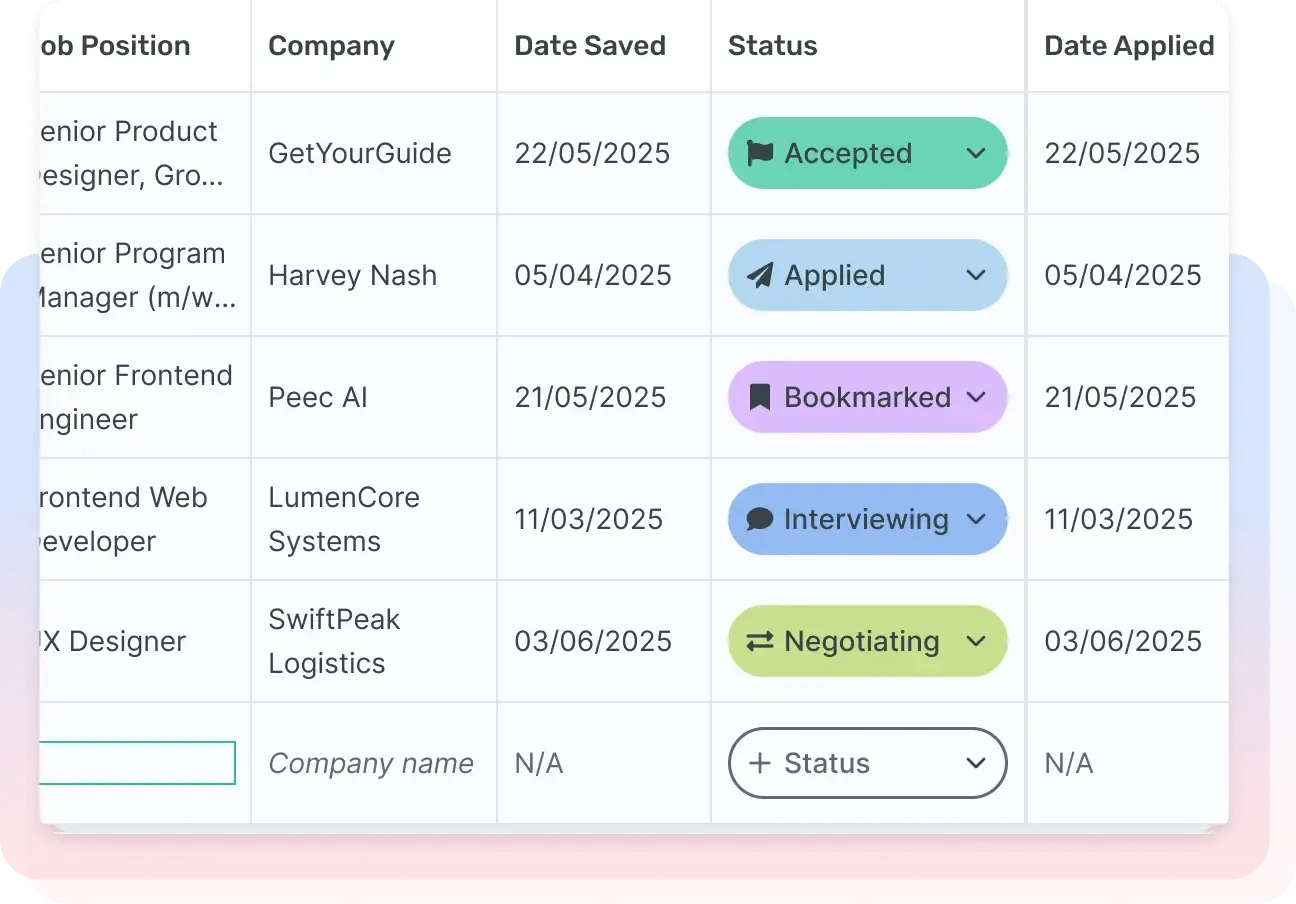
A job application tracker, like Enhancv’s, helps you keep all your applications in one place. Why hustle with tables or sticky notes on your desk when you can have all your info organized clearly? You could also use Enhancv’s Chrome Extension.
#4 Follow up intentionally
Following up on a job application can help—but only in certain situations. If you applied through a company website or had direct contact with a recruiter or hiring manager, a short follow-up one to two weeks later can signal genuine interest and professionalism. When a timeline is shared, always follow that instead.
If you applied through a large job board or platform with no direct contact, following up is often not possible—and that’s okay. In those cases, your energy is better spent on strong applications elsewhere.
#5 Network strategically
Networking doesn’t have to mean cold outreach or awkward messages. It often starts with conversations you’re already having—at industry events, meetups, or career fairs.
Even when networking doesn’t lead directly to a role, it can help your application get seen, provide useful context about a company, or open doors that never appear on job boards.
Frequently asked questions
The job search process can be confusing at times. These frequently asked questions address common concerns candidates have—from rejections to resumes to interviews.
How many job rejections are normal?
In today’s market, many qualified candidates face dozens of rejections—or no responses at all—before landing interviews. Resume rejections often reflect timing, volume, or internal factors rather than your ability. The key is to look for patterns, refine your approach, and avoid tying your self-worth to each outcome.
To make sure your resume is up to standard, try out Enhancv’s Free AI Checker. It’ll give your document a score and hints on what areas need improvement.
Is your resume good enough?
Drop your resume here or choose a file. PDF & DOCX only. Max 2MB file size.
Can ChatGPT rewrite my resume?
Tools like ChatGPT can help rewrite or refine parts of your resume, especially when it comes to phrasing or structure. However, they work best as a starting point. Your resume still needs your input to reflect real experience and align with the specific role you’re targeting.
I'm seeing a big uptick in the exact same format that I know is coming from ChatGPT. It's the five key things—each one has a bolded theme and then something in there. I know it. I use ChatGPT all the time, so I can see it. And I'm like, okay, I love ChatGPT—not hating on you for using it—but give it that human eye. Give it that once-over. Make sure what you're putting is accurate.
Kassandra, a Talent Acquisition Manager in renewable energy, who was interviewed in our ATS Rejection Survey
How do employers choose the best candidate?
Employers usually look for a mix of relevant skills, demonstrated impact, cultural fit, and clear communication. The “best” candidate isn’t always the most experienced one—it’s often the person who best matches the role’s requirements and shows genuine interest. Strong resumes, thoughtful interviews, and referrals can all influence the final decision.
What are the three golden rules of an interview?
The three commonly cited rules—or “three Cs”—of interviewing are clarity, competence, and connection. Be clear about your experience, demonstrate you can do the job, and build rapport with the interviewer. Together, these show that you’re not only qualified, but also someone others would want to work with.
Why is Gen Z struggling to get jobs?
While Gen Z is the youngest generation in the workforce, the challenge goes beyond age. Entry-level roles are becoming harder to find as companies reduce hiring and automate tasks that were once common early-career responsibilities.
According to CNBC, recent graduates are facing a shrinking pool of entry-level jobs, with employers expecting more experience for fewer openings, making it harder for Gen Z to break into the market—especially during periods of economic uncertainty.
What are red flags on resumes?
Some of the most common red flags that may raise concerns for employers are poor formatting, spelling or grammar mistakes, or content that feels generic and untailored. Unexplained employment gaps, frequent short job stints without context, and vague descriptions that lack measurable results can also hurt your chances.
Many of these issues are avoidable with clear structure, honest explanations, and role-specific customization.
What is the hardest month to get hired?
Hiring tends to slow down toward the end of the year—especially in December—due to holidays, budget planning, and limited decision-making availability.
Late summer can also be slower in some industries. That said, hiring never fully stops, and applying during quieter periods can sometimes mean less competition.
Conclusion: Making peace with the process
Job searching can be frustrating, isolating, and unpredictable—especially when you’re doing everything “right” and still not seeing immediate results. It’s normal to feel stuck or second-guess your approach along the way.
If anything helps in moments like that, it’s having fewer things to worry about. Starting from a strong resume you can confidently adapt for different roles removes some of the friction from the process.
Tools like Enhancv’s Resume Builder can help you get there without starting over each time. It’s quick and easy to use, giving you more time to focus on your overall strategy, prepare for interviews, or simply take a breath between applications.
From there, staying organized and moving at a pace you can sustain makes it easier to keep going, even when progress feels slow.
Make one that's truly you.